STEAL - Learning Semantic Boundaries from Noisy Annotations (CVPR 2019)

Overview

STEAL

This is the official inference code for:

Devil Is in the Edges: Learning Semantic Boundaries from Noisy Annotations

David Acuna, Amlan Kar, Sanja Fidler

CVPR 2019 [Paper] [Project Page]
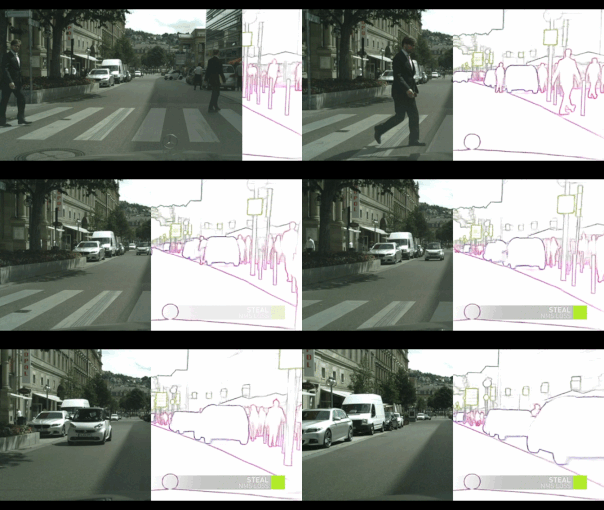
STEAL DEMO

License

# Copyright (c) 2019, NVIDIA CORPORATION. All rights reserved.
#
# Redistribution and use in source and binary forms, with or without
# modification, are permitted provided that the following conditions
# are met:
#  * Redistributions of source code must retain the above copyright
#    notice, this list of conditions and the following disclaimer.
#  * Redistributions in binary form must reproduce the above copyright
#    notice, this list of conditions and the following disclaimer in the
#    documentation and/or other materials provided with the distribution.
#  * Neither the name of NVIDIA CORPORATION nor the names of its
#    contributors may be used to endorse or promote products derived
#    from this software without specific prior written permission.
#
# THIS SOFTWARE IS PROVIDED BY THE COPYRIGHT HOLDERS ``AS IS'' AND ANY
# EXPRESS OR IMPLIED WARRANTIES, INCLUDING, BUT NOT LIMITED TO, THE
# IMPLIED WARRANTIES OF MERCHANTABILITY AND FITNESS FOR A PARTICULAR
# PURPOSE ARE DISCLAIMED.  IN NO EVENT SHALL THE COPYRIGHT OWNER OR
# CONTRIBUTORS BE LIABLE FOR ANY DIRECT, INDIRECT, INCIDENTAL, SPECIAL,
# EXEMPLARY, OR CONSEQUENTIAL DAMAGES (INCLUDING, BUT NOT LIMITED TO,
# PROCUREMENT OF SUBSTITUTE GOODS OR SERVICES; LOSS OF USE, DATA, OR
# PROFITS; OR BUSINESS INTERRUPTION) HOWEVER CAUSED AND ON ANY THEORY
# OF LIABILITY, WHETHER IN CONTRACT, STRICT LIABILITY, OR TORT
# (INCLUDING NEGLIGENCE OR OTHERWISE) ARISING IN ANY WAY OUT OF THE USE
# OF THIS SOFTWARE, EVEN IF ADVISED OF THE POSSIBILITY OF SUCH DAMAGE.

Usage

Clone this repo
git clone https://github.com/nv-tlabs/STEAL
cd STEAL

Install dependencies

This code requires PyTorch 0.4 and python 3+. Please install dependencies by

pip install -r requirments.txt

Download pretrained models

Download the tar of the pretrained models from the Google Drive Folder, save it in 'checkpoints/', and run

cd checkpoints
tar -xvf checkpoints.tar.gz
cd ../

Inference (SBD)

python inference_sbd.py \
    --root_dir_val= ./data/sbd/data_aug/\
    --flist_val= ./data/sbd/data_aug/val_list.txt\
    --output_folder=./output/sbd/ \
    --ckpt=./checkpoints/sbd/model_checkpoint.pt\

Instructions and preprocessing scripts to download SBD and preprocess the dataset can be found here: https://github.com/Chrisding/sbd-preprocess

Inference (Cityscapes)

python inference_cityscapes.py \
    --root_dir_val=./data/cityscapes-preprocess/data_proc \
    --flist_val=./data_proc/val.txt \
    --output_folder=./output/cityscapes/ \
    --ckpt=./checkpoints/cityscapes/model_checkpoint.pt\

Instructions and preprocessing scripts for Cityscapes can be found here: https://github.com/Chrisding/cityscapes-preprocess

Test-NMS: An example of how to apply TEST-NMS using Piotr's Structured Forest matlab toolbox. can be found in utils/edges_nms.m. During training, we optimized for the same set of operations with r=2 (Check paper for more details)

Coarse-to-fine Demo

Checkout the ipython notebook that provides a simple walkthrough demonstrating how to run our model to refine coarsely annotated data.

Coarse to Fine

If you use this code, please cite:

@inproceedings{AcunaCVPR19STEAL,
title={Devil is in the Edges: Learning Semantic Boundaries from Noisy Annotations},
author={David Acuna and Amlan Kar and Sanja Fidler},
booktitle={CVPR},
year={2019}
}
null

DeformingThings4D dataset Video | Paper DeformingThings4D is an synthetic dataset containing 1,972 animation sequences spanning 31 categories of human

208 Jan 03, 2023
Edge-oriented Convolution Block for Real-time Super Resolution on Mobile Devices, ACM Multimedia 2021

Codes for ECBSR Edge-oriented Convolution Block for Real-time Super Resolution on Mobile Devices Xindong Zhang, Hui Zeng, Lei Zhang ACM Multimedia 202

xindong zhang 236 Dec 26, 2022
A high-performance anchor-free YOLO. Exceeding yolov3~v5 with ONNX, TensorRT, NCNN, and Openvino supported.

YOLOX is an anchor-free version of YOLO, with a simpler design but better performance! It aims to bridge the gap between research and industrial communities. For more details, please refer to our rep

7.7k Jan 06, 2023
This repo contains the implementation of YOLOv2 in Keras with Tensorflow backend.

Easy training on custom dataset. Various backends (MobileNet and SqueezeNet) supported. A YOLO demo to detect raccoon run entirely in brower is accessible at https://git.io/vF7vI (not on Windows).

Huynh Ngoc Anh 1.7k Dec 24, 2022
Fair Recommendation in Two-Sided Platforms

Fair Recommendation in Two-Sided Platforms

gourabgggg 1 Nov 10, 2021
[NeurIPS 2021] Well-tuned Simple Nets Excel on Tabular Datasets

[NeurIPS 2021] Well-tuned Simple Nets Excel on Tabular Datasets Introduction This repo contains the source code accompanying the paper: Well-tuned Sim

52 Jan 04, 2023
Do Neural Networks for Segmentation Understand Insideness?

This is part of the code to reproduce the results of the paper Do Neural Networks for Segmentation Understand Insideness? [pdf] by K. Villalobos (*),

biolins 0 Mar 20, 2021
Hyper-parameter optimization for sklearn

hyperopt-sklearn Hyperopt-sklearn is Hyperopt-based model selection among machine learning algorithms in scikit-learn. See how to use hyperopt-sklearn

1.4k Jan 01, 2023
ppo_pytorch_cpp - an implementation of the proximal policy optimization algorithm for the C++ API of Pytorch

PPO Pytorch C++ This is an implementation of the proximal policy optimization algorithm for the C++ API of Pytorch. It uses a simple TestEnvironment t

Martin Huber 59 Dec 09, 2022
Real-time ground filtering algorithm of cloud points acquired using Terrestrial Laser Scanner (TLS)

This repository contains tools to simulate the ground filtering process of a registered point cloud. The repository contains two filtering methods. The first method uses a normal vector, and fit to p

5 Aug 25, 2022
Reproducible research and reusable acyclic workflows in Python. Execute code on HPC systems as if you executed them on your personal computer!

Reproducible research and reusable acyclic workflows in Python. Execute code on HPC systems as if you executed them on your machine! Motivation Would

Joeri Hermans 15 Sep 11, 2022
Dataset and Code for the paper "DepthTrack: Unveiling the Power of RGBD Tracking" (ICCV2021), and "Depth-only Object Tracking" (BMVC2021)

DeT and DOT Code and datasets for "DepthTrack: Unveiling the Power of RGBD Tracking" (ICCV2021) "Depth-only Object Tracking" (BMVC2021) @InProceedings

Yan Song 55 Dec 15, 2022
Inverse Rendering for Complex Indoor Scenes: Shape, Spatially-Varying Lighting and SVBRDF From a Single Image

Inverse Rendering for Complex Indoor Scenes: Shape, Spatially-Varying Lighting and SVBRDF From a Single Image (Project page) Zhengqin Li, Mohammad Sha

209 Jan 05, 2023
A Japanese Medical Information Extraction Toolkit

JaMIE: a Japanese Medical Information Extraction toolkit Joint Japanese Medical Problem, Modality and Relation Recognition The Train/Test phrases requ

7 Dec 12, 2022
[CVPR2021 Oral] End-to-End Video Instance Segmentation with Transformers

VisTR: End-to-End Video Instance Segmentation with Transformers This is the official implementation of the VisTR paper: Installation We provide instru

Yuqing Wang 687 Jan 07, 2023
Reproduced Code for Image Forgery Detection papers.

Image Forgery Detection With over 4.5 billion active internet users, the amount of multimedia content being shared every day has surpassed everyone’s

Umar Masud 15 Dec 06, 2022
A library for researching neural networks compression and acceleration methods.

A library for researching neural networks compression and acceleration methods.

Intel Labs 100 Dec 29, 2022
WHENet: Real-time Fine-Grained Estimation for Wide Range Head Pose

WHENet: Real-time Fine-Grained Estimation for Wide Range Head Pose Yijun Zhou and James Gregson - BMVC2020 Abstract: We present an end-to-end head-pos

368 Dec 26, 2022
Self-Supervised Learning with Data Augmentations Provably Isolates Content from Style

Self-Supervised Learning with Data Augmentations Provably Isolates Content from Style [NeurIPS 2021] Official code to reproduce the results and data p

Yash Sharma 27 Sep 19, 2022
CoSMA: Convolutional Semi-Regular Mesh Autoencoder. From Paper "Mesh Convolutional Autoencoder for Semi-Regular Meshes of Different Sizes"

Mesh Convolutional Autoencoder for Semi-Regular Meshes of Different Sizes Implementation of CoSMA: Convolutional Semi-Regular Mesh Autoencoder arXiv p

Fraunhofer SCAI 10 Oct 11, 2022