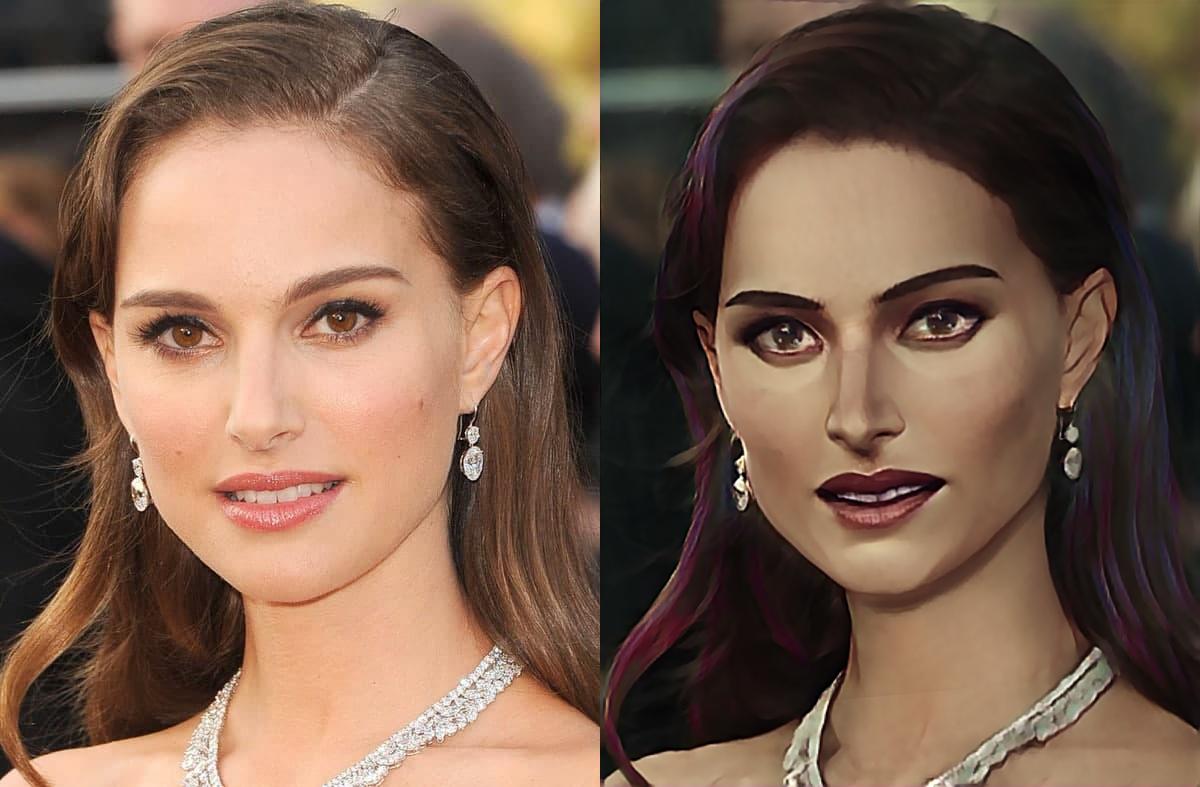
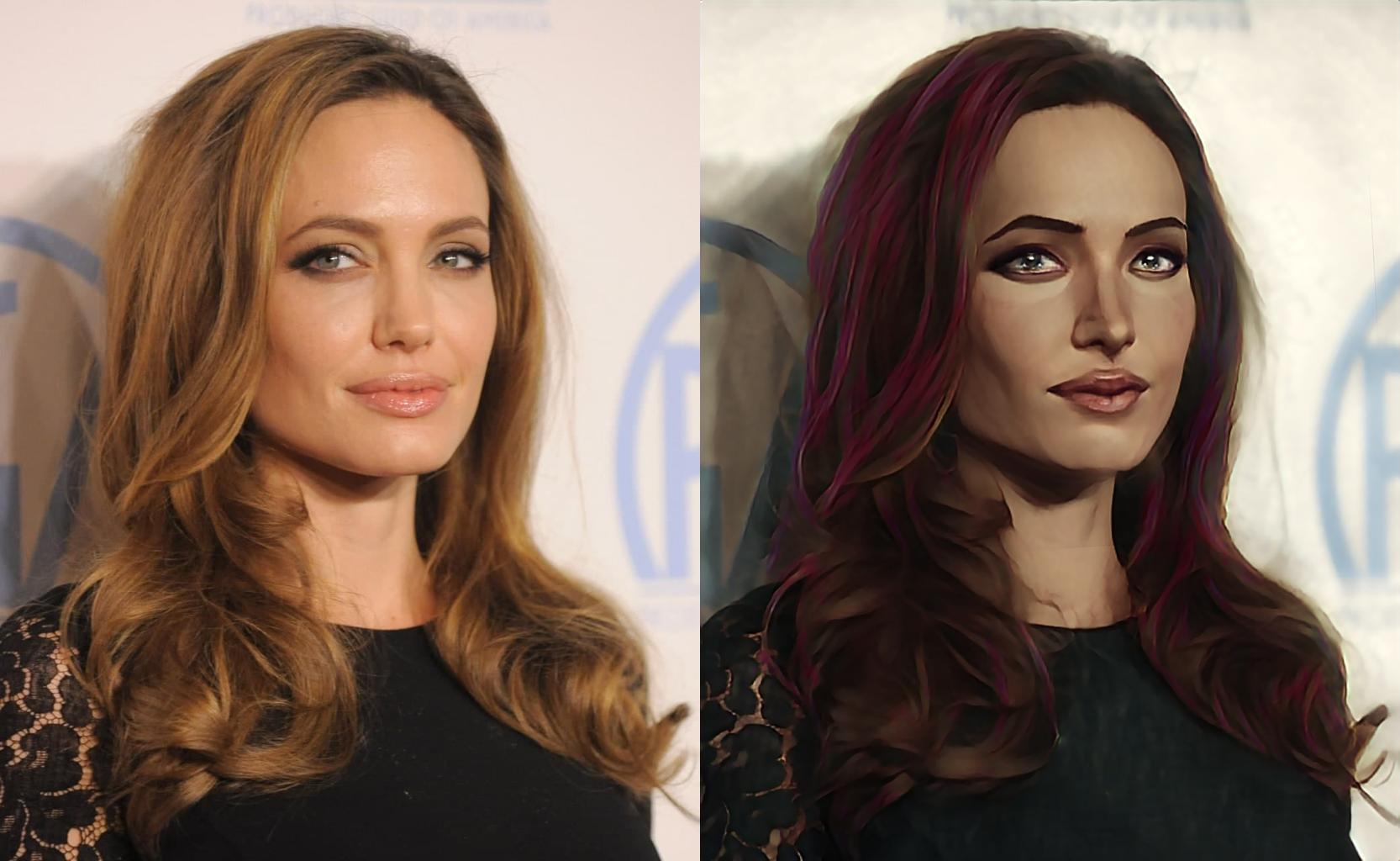
ArcaneGAN by Alex Spirin

Overview

ArcaneGAN by Alex Spirin

Colab visitors

Changelog

ArcaneGAN v0.3

Videos processed by the huggingface video inference colab.

obama2.mp4
ryan2.mp4

Image samples

arcaneganv03

Faces were enhanced via GPEN before applying the ArcaneGAN v0.3 filter.

ArcaneGAN v0.2

The release is here image photo_2021-12-04_08-05-34 photo_2021-12-04_07-23-17 weewq

Implementation Details

It does something, but not much at the moment.

The model is a pytroch *.jit of a fastai v1 flavored u-net trained on a paired dataset, generated via a blended stylegan2. You can see the blending colab I've used here.

Comments
  • How to convert the FastAI model to Pytorch JIT

    How to convert the FastAI model to Pytorch JIT

    Hi,

    I trained a model with unet_learner but I can't convert it to jit.

    I run the following code: torch.jit.save(torch.jit.script(learn.model), 'jit.pt')

    Here is the error:

    UnsupportedNodeError: GeneratorExp aren't supported: File "/usr/local/lib/python3.7/dist-packages/fastai/callbacks/hooks.py", line 21 "Applieshook_functomodule,input,output." if self.detach: input = (o.detach() for o in input ) if is_listy(input ) else input.detach() ~ <--- HERE output = (o.detach() for o in output) if is_listy(output) else output.detach() self.stored = self.hook_func(module, input, output)

    May I know how you convert it to a jit model? Thanks

    opened by ramtiin 2
  • Ошибка

    Ошибка

    Добрый вечер.В ArcaneGAN на colab for videos,выдаёт ошибку:

    RuntimeError: CUDA out of memory. Tried to allocate 2.80 GiB (GPU 0; 11.17 GiB total capacity; 5.74 GiB already allocated; 2.21 GiB free; 8.44 GiB reserved in total by PyTorch) If reserved memory is >> allocated memory try setting max_split_size_mb to avoid fragmentation. See documentation for Memory Management and PYTORCH_CUDA_ALLOC_CONF

    Помогите пожалуйста!

    opened by Zzip7 2
  • How do you change the style of the whole image

    How do you change the style of the whole image

    Nice work! My only confusion is how you change the style of the whole image instead of just the face. Usually, StyleGAN generates aligned face images by fine-tuning the FFHQ checkpoint. How does the pix2pix model trained with these face image pairs work with the full image or frame.

    opened by zhanglonghao1992 2
  • Architecture for video

    Architecture for video

    Hi, what does the architecture look like? Is it similar to Pix2Pix? And for processing of the video, are you doing anything extra to make sure the frames are consistent?

    opened by unography 2
  • How to prevent eyes occur in nose?

    How to prevent eyes occur in nose?

    Hello, I try your model and it's amazing, but I find in some pictures if the nose is too big, there will be eyes in the nose. I try to lower the 'target_face' and it can work. But the details like the light of the eyes and background will also lose when I lower the 'target_face'. So I wonder is there a way to prevent the eyes occurs in the nose and keep the details in the meantime? image

    opened by Folkfive 1
  • support arbitrary image size?

    support arbitrary image size?

    Great work!

    The unet prediction result will be cropped to be the same size as the training input, e.g. 256 or 512. For arbitrary image size (e.g. 1280*720), how to config or set the model to output the same size of the input image as your colab did? Thank you.

    opened by foobarhe 1
  • RuntimeError: CUDA out of memory

    RuntimeError: CUDA out of memory

    Добрый вечер.Извините,это опять я.Снова эта ошибка появляется.Можно ли,самому эту ошибку решать?Или исправлять можете только вы?Обьясните пожалуйста подробно.

    opened by Zzip7 1
  • about the paired datasets generated by stylegan

    about the paired datasets generated by stylegan

    how do you make sure the background and expression similarity between the generated input(face) and target(style face) ? I find that the style is too weak when less finetune and the similarity is too weak when more finetune, how do you solve it ? Would you like to share the paired datasets generated code with me ? thanks a lot ~

    opened by Leocien 1
  • Any news for training code?

    Any news for training code?

    Interesting topic... I wonder how you trained the model, especially the augmentation part. Fixed crop limitation is a well-known problem and would like to know how you handle it. :)

    opened by dongyun-kim-arch 0
  •  tuple issue

    tuple issue

    Was trying the ArcaneGan video colab but I am having a tuple issue can you please help, i am really excited to try the Arcane video can you please help out

    opened by mau021 0
  • What GPU is used for training?

    What GPU is used for training?

    Hi,

    I want to train the Fastai u-net model. However, when I try to train the critic (learn_critic.fit_one_cycle(6, 1e-3)), I get the following error:

    CUDA out of memory. Tried to allocate 4.00 GiB (GPU 0; 14.76 GiB total capacity; 9.78 GiB already allocated; 891.75 MiB free; 12.57 GiB reserved in total by PyTorch) If reserved memory is >> allocated memory try setting max_split_size_mb to avoid fragmentation. See documentation for Memory Management and PYTORCH_CUDA_ALLOC_CONF

    The GPU is a Tesla T4 with 16 GB of VRAM. My batch size is 4 and the training images size is 512*512. I also tried with lower numbers, but I'm still getting the same error.

    opened by ramtiin 2
  • How to make the style stronger?

    How to make the style stronger?

    The following are input image, my training output from pair label supervision, and the output from your test model。 I trained my model (Super-Resolution model) on the images from your model outputs, I find it difficult to change the facial features。 Like the eyes and face texture are changed, how to do it ? I use L1Loss (weight is 1) + PerceptualLoss (weight is 1)+ GANLoss (weight is 0.1),

    6W2HG4GXC2

    opened by xuanandsix 1
Releases(v0.4)
  • v0.4(Dec 25, 2021)

    ArcaneGAN v0.4

    Colab visitors

    The main differences are:

    • lighter styling (closer to original input)
    • sharper result
    • happier faces
    • reduced childish eyes effect
    • reduced stubble on feminine faces
    • increased temporal stability on videos
    • reduced mouth\teeth artifacts

    Image samples

    v0.3 vs v0.4

    v3-4

    Video samples

    https://user-images.githubusercontent.com/11751592/146966428-f4e27929-19dd-423f-a772-8aee709d2116.mp4

    https://user-images.githubusercontent.com/11751592/146966462-6511998e-77f5-4fd2-8ad9-5709bf0cd172.mp4

    Source code(tar.gz)
    Source code(zip)
    ArcaneGANv0.4.jit(59.75 MB)
  • v0.3(Dec 12, 2021)

    ArcaneGAN v0.3

    Colab

    Video samples

    This is a stronger-styled version. It performs okay on videos, though visible flickering is present. Here are some video examples.

    https://user-images.githubusercontent.com/11751592/145702737-c02b8b00-ad30-4358-98bf-97c8ad7fefdf.mp4

    https://user-images.githubusercontent.com/11751592/145702740-afd3377d-d117-467d-96ca-045e25d85ac6.mp4

    Image samples

    arcaneganv03

    Faces were enhanced via GPEN before applying the ArcaneGAN v0.3 filter.

    The model is a pytroch *.jit of a fastai v1 flavored u-net trained on a paired dataset, generated via a blended stylegan2. You can see the blending colab I've used here.

    Source code(tar.gz)
    Source code(zip)
    ArcaneGANv0.3.jit(79.40 MB)
  • v0.2(Dec 7, 2021)

    ArcaneGAN v0.2 This version is a bit better at doing something other than making images darker :D

    Here are some image pairs. I've specifically picked various images to see how the model performs in the wild, not on aligned and cropped faces. ds e42 ewewe maxresdefault photo_2021-11-16_19-32-15 photo_2021-11-16_19-34-02 photo_2021-11-16_19-34-33 photo_2021-11-16_19-34-49 photo_2021-11-29_13-23-56 photo_2021-11-29_13-26-13 photo_2021-12-04_07-22-51 photo_2021-12-04_07-23-17 photo_2021-12-04_07-25-29 photo_2021-12-04_07-48-29 photo_2021-12-04_08-04-43 photo_2021-12-04_08-06-17 photo_2021-12-04_08-06-40 photo_2021-12-04_08-07-04 photo_2021-12-04_08-09-53

    photo_2021-12-04_11-26-27 weewq 0_256_ 1_256_Всем онеме посоны

    The model is a pytroch *.jit of a fastai v1 flavored u-net trained on a paired dataset, generated via a blended stylegan2. You can see the blending colab I've used here.

    Inference notebook is here

    Source code(tar.gz)
    Source code(zip)
    ArcaneGANv0.2.jit(79.52 MB)
  • v0.1(Dec 6, 2021)

    ArcaneGAN v0.1 This is a proof of concept release. The model is in beta (which means it's beta than nothin')

    Here are some image pairs. I've specifically picked various images to see how the model performs in the wild, not on aligned and cropped faces.

    0_256_ 258c27bcb658a86765361c1faca7b749fa3a36aaf07e975b408281c0a9c76513 e42 ewewe maxresdefault photo_2021-11-16_19-32-15 photo_2021-11-16_19-34-02 photo_2021-11-16_19-34-33 photo_2021-11-16_19-34-49 photo_2021-12-04_07-23-17 photo_2021-12-04_07-48-29 photo_2021-12-04_08-06-40 photo_2021-12-04_08-07-04 photo_2021-12-04_11-26-27

    It does something, but not much at the moment.

    The model is a pytroch *.jit of a fastai v1 flavored u-net trained on a paired dataset, generated via a blended stylegan2. You can see the blending colab I've used here.

    Inference notebook is here

    Source code(tar.gz)
    Source code(zip)
    ArcaneGANv0.1.jit(79.53 MB)
Owner
Alex
Alex
【ACMMM 2021】DSANet: Dynamic Segment Aggregation Network for Video-Level Representation Learning

DSANet: Dynamic Segment Aggregation Network for Video-Level Representation Learning (ACMMM 2021) Overview We release the code of the DSANet (Dynamic S

Wenhao Wu 46 Dec 27, 2022
The official implementation of NeurIPS 2021 paper: Finding Optimal Tangent Points for Reducing Distortions of Hard-label Attacks

The official implementation of NeurIPS 2021 paper: Finding Optimal Tangent Points for Reducing Distortions of Hard-label Attacks

machen 11 Nov 27, 2022
repro_eval is a collection of measures to evaluate the reproducibility/replicability of system-oriented IR experiments

repro_eval repro_eval is a collection of measures to evaluate the reproducibility/replicability of system-oriented IR experiments. The measures were d

IR Group at Technische Hochschule Köln 9 May 25, 2022
A Collection of LiDAR-Camera-Calibration Papers, Toolboxes and Notes

A Collection of LiDAR-Camera-Calibration Papers, Toolboxes and Notes

443 Jan 06, 2023
MixRNet(Using mixup as regularization and tuning hyper-parameters for ResNets)

MixRNet(Using mixup as regularization and tuning hyper-parameters for ResNets) Using mixup data augmentation as reguliraztion and tuning the hyper par

Bhanu 2 Jan 16, 2022
Riemannian Convex Potential Maps

Modeling distributions on Riemannian manifolds is a crucial component in understanding non-Euclidean data that arises, e.g., in physics and geology. The budding approaches in this space are limited b

Facebook Research 61 Nov 28, 2022
An algorithm that handles large-scale aerial photo co-registration, based on SURF, RANSAC and PyTorch autograd.

An algorithm that handles large-scale aerial photo co-registration, based on SURF, RANSAC and PyTorch autograd.

Luna Yue Huang 41 Oct 29, 2022
A simple command line tool for text to image generation, using OpenAI's CLIP and a BigGAN.

Ryan Murdock has done it again, combining OpenAI's CLIP and the generator from a BigGAN! This repository wraps up his work so it is easily accessible to anyone who owns a GPU.

Phil Wang 2.3k Jan 09, 2023
A Python library for Deep Graph Networks

PyDGN Wiki Description This is a Python library to easily experiment with Deep Graph Networks (DGNs). It provides automatic management of data splitti

Federico Errica 194 Dec 22, 2022
Code to reproduce the experiments in the paper "Transformer Based Multi-Source Domain Adaptation" (EMNLP 2020)

Transformer Based Multi-Source Domain Adaptation Dustin Wright and Isabelle Augenstein To appear in EMNLP 2020. Read the preprint: https://arxiv.org/a

CopeNLU 36 Dec 05, 2022
ICSS - Interactive Continual Semantic Segmentation

Presentation This repository contains the code of our paper: Weakly-supervised c

Alteia 9 Jul 23, 2022
Deep Reinforcement Learning for Keras.

Deep Reinforcement Learning for Keras What is it? keras-rl implements some state-of-the art deep reinforcement learning algorithms in Python and seaml

Keras-RL 0 Dec 15, 2022
Nicholas Lee 3 Jan 09, 2022
Code for the paper Learning the Predictability of the Future

Learning the Predictability of the Future Code from the paper Learning the Predictability of the Future. Website of the project in hyperfuture.cs.colu

Computer Vision Lab at Columbia University 139 Nov 18, 2022
(CVPR 2022) Energy-based Latent Aligner for Incremental Learning

Energy-based Latent Aligner for Incremental Learning Accepted to CVPR 2022 We illustrate an Incremental Learning model trained on a continuum of tasks

Joseph K J 37 Jan 03, 2023
LEDNet: A Lightweight Encoder-Decoder Network for Real-time Semantic Segmentation

LEDNet: A Lightweight Encoder-Decoder Network for Real-time Semantic Segmentation Table of Contents: Introduction Project Structure Installation Datas

Yu Wang 492 Dec 02, 2022
Securetar - A streaming wrapper around python tarfile and allow secure handling files and support encryption

Secure Tar Secure Tarfile library It's a streaming wrapper around python tarfile

Pascal Vizeli 2 Dec 09, 2022
BERTMap: A BERT-Based Ontology Alignment System

BERTMap: A BERT-based Ontology Alignment System Important Notices The relevant paper was accepted in AAAI-2022. Arxiv version is available at: https:/

KRR 36 Dec 24, 2022
Code for Phase diagram of Stochastic Gradient Descent in high-dimensional two-layer neural networks

Phase diagram of Stochastic Gradient Descent in high-dimensional two-layer neural networks Under construction. Description Code for Phase diagram of S

Rodrigo Veiga 3 Nov 24, 2022
Jingju baseline - A baseline model of our project of Beijing opera script generation

Jingju Baseline It is a baseline of our project about Beijing opera script gener

midon 1 Jan 14, 2022