Training RNNs as Fast as CNNs

Related tags

Text Data & NLPsru
Overview

News

SRU++, a new SRU variant, is released. [tech report] [blog]

The experimental code and SRU++ implementation are available on the dev branch which will be merged into master later.

About

SRU is a recurrent unit that can run over 10 times faster than cuDNN LSTM, without loss of accuracy tested on many tasks.
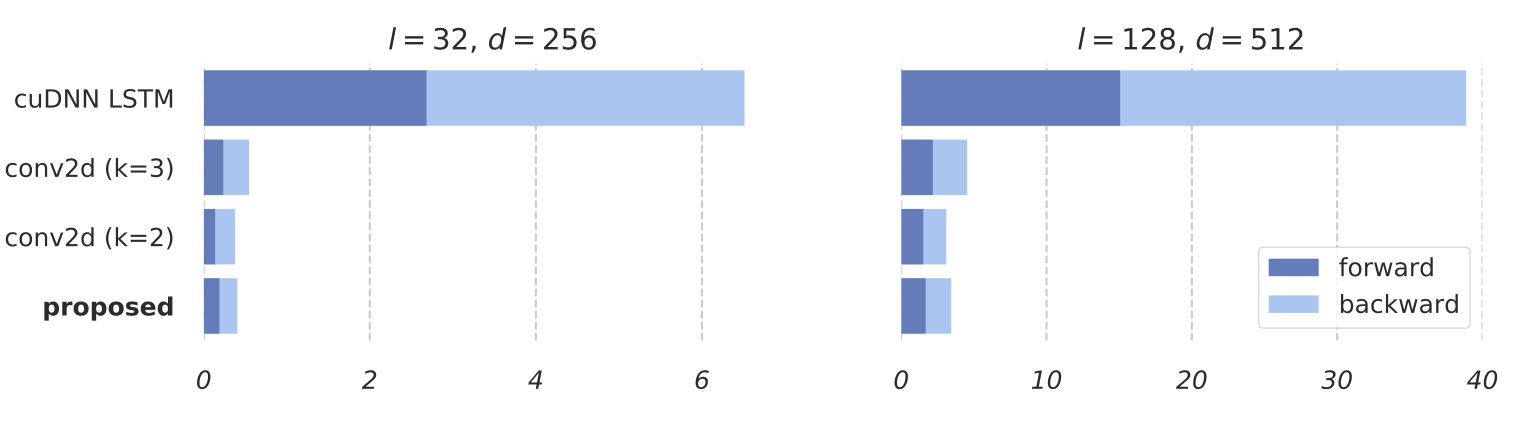

Average processing time of LSTM, conv2d and SRU, tested on GTX 1070

For example, the figure above presents the processing time of a single mini-batch of 32 samples. SRU achieves 10 to 16 times speed-up compared to LSTM, and operates as fast as (or faster than) word-level convolution using conv2d.

Reference:

Simple Recurrent Units for Highly Parallelizable Recurrence [paper]

@inproceedings{lei2018sru,
  title={Simple Recurrent Units for Highly Parallelizable Recurrence},
  author={Tao Lei and Yu Zhang and Sida I. Wang and Hui Dai and Yoav Artzi},
  booktitle={Empirical Methods in Natural Language Processing (EMNLP)},
  year={2018}
}

When Attention Meets Fast Recurrence: Training Language Models with Reduced Compute [paper]

@article{lei2021srupp,
  title={When Attention Meets Fast Recurrence: Training Language Models with Reduced Compute},
  author={Tao Lei},
  journal={arXiv preprint arXiv:2102.12459},
  year={2021}
}

Requirements

Install requirements via pip install -r requirements.txt.


Installation

From source:

SRU can be installed as a regular package via python setup.py install or pip install ..

From PyPi:

pip install sru

Directly use the source without installation:

Make sure this repo and CUDA library can be found by the system, e.g.

export PYTHONPATH=path_to_repo/sru
export LD_LIBRARY_PATH=/usr/local/cuda/lib64

Examples

The usage of SRU is similar to nn.LSTM. SRU likely requires more stacking layers than LSTM. We recommend starting by 2 layers and use more if necessary (see our report for more experimental details).

import torch
from sru import SRU, SRUCell

# input has length 20, batch size 32 and dimension 128
x = torch.FloatTensor(20, 32, 128).cuda()

input_size, hidden_size = 128, 128

rnn = SRU(input_size, hidden_size,
    num_layers = 2,          # number of stacking RNN layers
    dropout = 0.0,           # dropout applied between RNN layers
    bidirectional = False,   # bidirectional RNN
    layer_norm = False,      # apply layer normalization on the output of each layer
    highway_bias = -2,        # initial bias of highway gate (<= 0)
)
rnn.cuda()

output_states, c_states = rnn(x)      # forward pass

# output_states is (length, batch size, number of directions * hidden size)
# c_states is (layers, batch size, number of directions * hidden size)

Contributing

Please read and follow the guidelines.

Other Implementations

@musyoku had a very nice SRU implementaion in chainer.

@adrianbg implemented the first CPU version.


Owner
Tao Lei
Tao Lei
STonKGs is a Sophisticated Transformer that can be jointly trained on biomedical text and knowledge graphs

STonKGs STonKGs is a Sophisticated Transformer that can be jointly trained on biomedical text and knowledge graphs. This multimodal Transformer combin

STonKGs 27 Aug 11, 2022
Pattern Matching in Python

Pattern Matching finalmente chega no Python 3.10. E daí? "Pattern matching", ou "correspondência de padrões" como é conhecido no Brasil. Algumas pesso

Fabricio Werneck 6 Feb 16, 2022
Exploration of BERT-based models on twitter sentiment classifications

twitter-sentiment-analysis Explore the relationship between twitter sentiment of Tesla and its stock price/return. Explore the effect of different BER

Sammy Cui 2 Oct 02, 2022
使用pytorch+transformers复现了SimCSE论文中的有监督训练和无监督训练方法

SimCSE复现 项目描述 SimCSE是一种简单但是很巧妙的NLP对比学习方法,创新性地引入Dropout的方式,对样本添加噪声,从而达到对正样本增强的目的。 该框架的训练目的为:对于batch中的每个样本,拉近其与正样本之间的距离,拉远其与负样本之间的距离,使得模型能够在大规模无监督语料(也可以

58 Dec 20, 2022
Test finetuning of XLSR (multilingual wav2vec 2.0) for other speech classification tasks

wav2vec_finetune Test finetuning of XLSR (multilingual wav2vec 2.0) for other speech classification tasks Initial test: gender recognition on this dat

8 Aug 11, 2022
ByT5: Towards a token-free future with pre-trained byte-to-byte models

ByT5: Towards a token-free future with pre-trained byte-to-byte models ByT5 is a tokenizer-free extension of the mT5 model. Instead of using a subword

Google Research 409 Jan 06, 2023
PyTorch source code of NAACL 2019 paper "An Embarrassingly Simple Approach for Transfer Learning from Pretrained Language Models"

This repository contains source code for NAACL 2019 paper "An Embarrassingly Simple Approach for Transfer Learning from Pretrained Language Models" (P

Alexandra Chronopoulou 89 Aug 12, 2022
Yomichad - a Japanese pop-up dictionary that can display readings and English definitions of Japanese words

Yomichad is a Japanese pop-up dictionary that can display readings and English definitions of Japanese words, kanji, and optionally named entities. It is similar to yomichan, 10ten, and rikaikun in s

Jonas Belouadi 7 Nov 07, 2022
Unsupervised Language Model Pre-training for French

FlauBERT and FLUE FlauBERT is a French BERT trained on a very large and heterogeneous French corpus. Models of different sizes are trained using the n

GETALP 212 Dec 10, 2022
A method to generate speech across multiple speakers

VoiceLoop PyTorch implementation of the method described in the paper VoiceLoop: Voice Fitting and Synthesis via a Phonological Loop. VoiceLoop is a n

Facebook Archive 873 Dec 15, 2022
Code for paper "Role-oriented Network Embedding Based on Adversarial Learning between Higher-order and Local Features"

Role-oriented Network Embedding Based on Adversarial Learning between Higher-order and Local Features Train python main.py --dataset brazil-flights C

wang zhang 0 Jun 28, 2022
Stand-alone language identification system

langid.py readme Introduction langid.py is a standalone Language Identification (LangID) tool. The design principles are as follows: Fast Pre-trained

2k Jan 04, 2023
skweak: A software toolkit for weak supervision applied to NLP tasks

Labelled data remains a scarce resource in many practical NLP scenarios. This is especially the case when working with resource-poor languages (or text domains), or when using task-specific labels wi

Norsk Regnesentral (Norwegian Computing Center) 850 Dec 28, 2022
Persian Bert For Long-Range Sequences

ParsBigBird: Persian Bert For Long-Range Sequences The Bert and ParsBert algorithms can handle texts with token lengths of up to 512, however, many ta

Sajjad Ayoubi 63 Dec 14, 2022
Biterm Topic Model (BTM): modeling topics in short texts

Biterm Topic Model Bitermplus implements Biterm topic model for short texts introduced by Xiaohui Yan, Jiafeng Guo, Yanyan Lan, and Xueqi Cheng. Actua

Maksim Terpilowski 49 Dec 30, 2022
An ActivityWatch watcher to pose questions to the user and record her answers.

aw-watcher-ask An ActivityWatch watcher to pose questions to the user and record her answers. This watcher uses Zenity to present dialog boxes to the

Bernardo Chrispim Baron 33 Dec 03, 2022
Deploying a Text Summarization NLP use case on Docker Container Utilizing Nvidia GPU

GPU Docker NLP Application Deployment Deploying a Text Summarization NLP use case on Docker Container Utilizing Nvidia GPU, to setup the enviroment on

Ritesh Yadav 9 Oct 14, 2022
Code for the paper: Sequence-to-Sequence Learning with Latent Neural Grammars

Code for the paper: Sequence-to-Sequence Learning with Latent Neural Grammars

Yoon Kim 43 Dec 23, 2022
ChessCoach is a neural network-based chess engine capable of natural-language commentary.

ChessCoach is a neural network-based chess engine capable of natural-language commentary.

Chris Butner 380 Dec 03, 2022
PhoNLP: A BERT-based multi-task learning toolkit for part-of-speech tagging, named entity recognition and dependency parsing

PhoNLP is a multi-task learning model for joint part-of-speech (POS) tagging, named entity recognition (NER) and dependency parsing. Experiments on Vietnamese benchmark datasets show that PhoNLP prod

VinAI Research 109 Dec 02, 2022