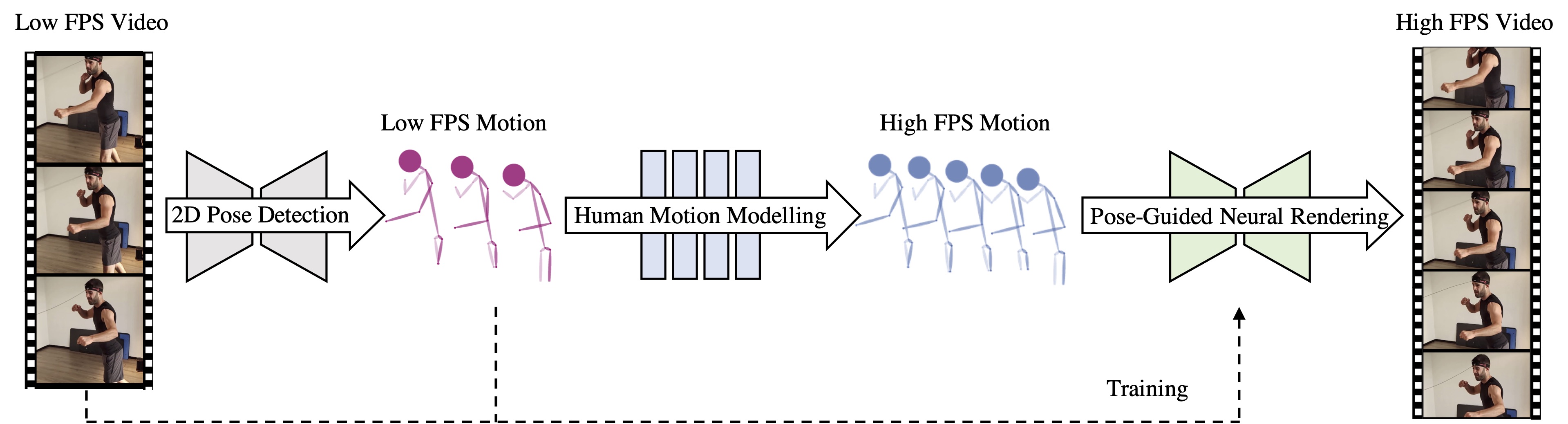
Official implementation for paper Render In-between: Motion Guided Video Synthesis for Action Interpolation

Overview

Render In-between: Motion Guided Video Synthesis for Action Interpolation

[Paper] [Supp] [arXiv] [4min Video]

This is the official Pytorch implementation for our work. Our proposed framework is able to synthesize challenging human videos in an action interpolation setting. This repository contains three subdirectories, including code and scripts for preparing our collected HumanSlomo dataset, the implementation of human motion modeling network trained on the large-scale AMASS dataset, as well as the pose-guided neural rendering model to synthesize video frames from poses. Please check each subfolder for the detailed information and how to execute the code.

HumanSlomo Dataset
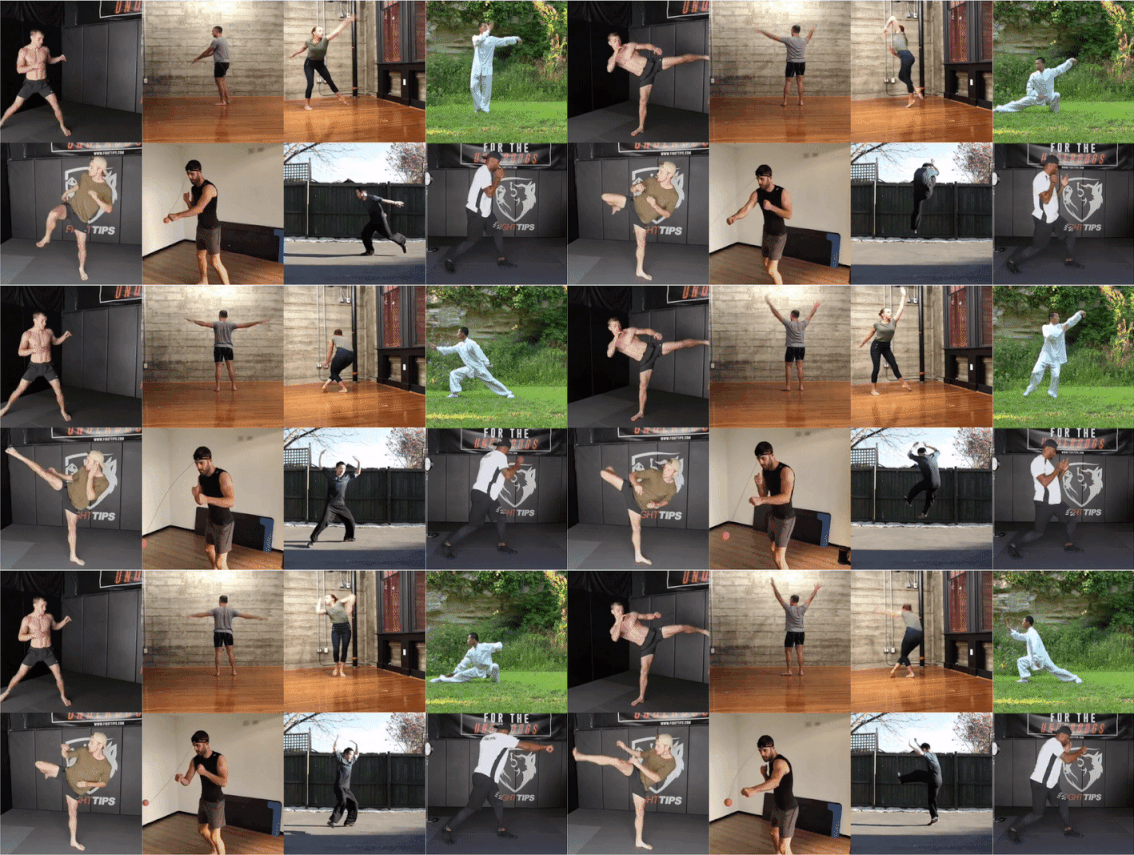
We collected a set of high FPS creative commons of human videos from Youtube. The videos are manually split into several continuous clips for training and test. You can also build your video dataset using the provided scripts.

Human Motion Modeling

Our human motion model is trained on a large scale motion capture dataset AMASS. We provide code to synthesize 2D human motion sequences for training from the SMPL parameters defined in AMASS. You can also simply use the pre-trained model to interpolate low-frame-rate noisy human body joints to high-frame-rate motion sequences.

Pose Guided Neural Rendering

The neural rendering model learned to map the pose sequences back to the original video domain. The final result is composed with the background warping from DAIN and the generated human body according to the predicted blending mask autoregressively. The model is trained in a conditional image generation setting, given only low-frame-rate videos as training data. Therefore, you can train your custom neural rendering model by constructing your own video dataset.

Quick Start

⬇️ example.zip [MEGA] (25.4MB)

Download this example action clip which includes necessary input files for our pipeline.

The first step is generating high FPS motion from low FPS poses with our motion modeling network.

cd Human_Motion_Modelling
python inference.py --pose-dir ../example/input_poses --save-dir ../example/ --upsample-rate 2

⬇️ checkpoints.zip [MEGA] (147.2MB)

Next we will map high FPS poses back to video frames with our pose-guided neural rendering. Download the checkpoint files to the corresponding folder to run the model.

cd Pose_Guided_Neural_Rendering
python inference.py --input-dir ../example/ --save-dir ../example/

Citation

@inproceedings{ho2021render,
    author = {Hsuan-I Ho, Xu Chen, Jie Song, Otmar Hilliges},
    title = {Render In-between: Motion GuidedVideo Synthesis for Action Interpolation},
    booktitle = {BMVC},
    year = {2021}
}

Acknowledgement

We use the pre-processing code in AMASS to synthesize our motion dataset. AlphaPose is used for generating 2D human body poses. DAIN is used for warping background images. Our human motion modeling network is based on the transformer backbone in DERT. Our pose-guided neural rendering model is based on imaginaire. We sincerely thank these authors for their awesome work.

[WWW 2021] Source code for "Graph Contrastive Learning with Adaptive Augmentation"

GCA Source code for Graph Contrastive Learning with Adaptive Augmentation (WWW 2021) For example, to run GCA-Degree under WikiCS, execute: python trai

Big Data and Multi-modal Computing Group, CRIPAC 97 Jan 07, 2023
Simple converter for deploying Stable-Baselines3 model to TFLite and/or Coral

Running SB3 developed agents on TFLite or Coral Introduction I've been using Stable-Baselines3 to train agents against some custom Gyms, some of which

Gary Briggs 16 Oct 11, 2022
A visualisation tool for Deep Reinforcement Learning

DRLVIS - Visualising Deep Reinforcement Learning Created by Marios Sirtmatsis with the support of Alex Bäuerle. DRLVis is an application used for visu

Marios Sirtmatsis 1 Nov 04, 2021
Evolutionary Population Curriculum for Scaling Multi-Agent Reinforcement Learning

Evolutionary Population Curriculum for Scaling Multi-Agent Reinforcement Learning This is the code for implementing the MADDPG algorithm presented in

97 Dec 21, 2022
Code and Resources for the Transformer Encoder Reasoning Network (TERN)

Transformer Encoder Reasoning Network Code for the cross-modal visual-linguistic retrieval method from "Transformer Reasoning Network for Image-Text M

Nicola Messina 53 Dec 30, 2022
Repository relating to the CVPR21 paper TimeLens: Event-based Video Frame Interpolation

TimeLens: Event-based Video Frame Interpolation This repository is about the High Speed Event and RGB (HS-ERGB) dataset, used in the 2021 CVPR paper T

Robotics and Perception Group 544 Dec 19, 2022
A code implementation of AC-GC: Activation Compression with Guaranteed Convergence, in NeurIPS 2021.

Code For AC-GC: Lossy Activation Compression with Guaranteed Convergence This code is intended to be used as a supplemental material for submission to

Dave Evans 2 Nov 01, 2022
An efficient PyTorch library for Global Wheat Detection using YOLOv5. The project is based on this Kaggle competition Global Wheat Detection (2021).

Global-Wheat-Detection An efficient PyTorch library for Global Wheat Detection using YOLOv5. The project is based on this Kaggle competition Global Wh

Chuxin Wang 11 Sep 25, 2022
Fermi Problems: A New Reasoning Challenge for AI

Fermi Problems: A New Reasoning Challenge for AI Fermi Problems are questions whose answer is a number that can only be reasonably estimated as a prec

AI2 15 May 28, 2022
CNNs for Sentence Classification in PyTorch

Introduction This is the implementation of Kim's Convolutional Neural Networks for Sentence Classification paper in PyTorch. Kim's implementation of t

Shawn Ng 956 Dec 19, 2022
Negative Sample is Negative in Its Own Way: Tailoring Negative Sentences forImage-Text Retrieval

NSGDC Some codes in this repo are copied/modified from opensource implementations made available by UNITER, PyTorch, HuggingFace, OpenNMT, and Nvidia.

Zhihao Fan 2 Nov 07, 2022
🤗 Push your spaCy pipelines to the Hugging Face Hub

spacy-huggingface-hub: Push your spaCy pipelines to the Hugging Face Hub This package provides a CLI command for uploading any trained spaCy pipeline

Explosion 30 Oct 09, 2022
PyTorch implementation of Densely Connected Time Delay Neural Network

Densely Connected Time Delay Neural Network PyTorch implementation of Densely Connected Time Delay Neural Network (D-TDNN) in our paper "Densely Conne

Ya-Qi Yu 64 Oct 11, 2022
Harmonious Textual Layout Generation over Natural Images via Deep Aesthetics Learning

Harmonious Textual Layout Generation over Natural Images via Deep Aesthetics Learning Code for the paper Harmonious Textual Layout Generation over Nat

7 Aug 09, 2022
Official implementation of deep-multi-trajectory-based single object tracking (IEEE T-CSVT 2021).

DeepMTA_PyTorch Officical PyTorch Implementation of "Dynamic Attention-guided Multi-TrajectoryAnalysis for Single Object Tracking", Xiao Wang, Zhe Che

Xiao Wang(王逍) 7 Dec 03, 2022
This is a collection of simple PyTorch implementations of neural networks and related algorithms. These implementations are documented with explanations,

labml.ai Deep Learning Paper Implementations This is a collection of simple PyTorch implementations of neural networks and related algorithms. These i

labml.ai 16.4k Jan 09, 2023
Numerical-computing-is-fun - Learning numerical computing with notebooks for all ages.

As much as this series is to educate aspiring computer programmers and data scientists of all ages and all backgrounds, it is also a reminder to mysel

EKA foundation 758 Dec 25, 2022
Angle data is a simple data type.

angledat Angle data is a simple data type. Installing + using Put angledat.py in the main dir of your project. Import it and use. Comments Comments st

1 Jan 05, 2022
Gated-Shape CNN for Semantic Segmentation (ICCV 2019)

GSCNN This is the official code for: Gated-SCNN: Gated Shape CNNs for Semantic Segmentation Towaki Takikawa, David Acuna, Varun Jampani, Sanja Fidler

859 Dec 26, 2022
DeepLearning Anomalies Detection with Bluetooth Sensor Data

Final Year Project. Constructing models to create offline anomalies detection using Travel Time Data collected from Bluetooth sensors along the route.

1 Jan 10, 2022