A Scheil-Gulliver simulation tool using pycalphad.

Overview

scheil

A Scheil-Gulliver simulation tool using pycalphad.

import matplotlib.pyplot as plt
from pycalphad import Database, variables as v
from scheil import simulate_scheil_solidification

# setup the simulation parameters
dbf = Database('alzn_mey.tdb')
comps = ['AL', 'ZN', 'VA']
phases = sorted(dbf.phases.keys())

liquid_phase_name = 'LIQUID'
initial_composition = {v.X('ZN'): 0.3}
start_temperature = 850

# perform the simulation
sol_res = simulate_scheil_solidification(dbf, comps, phases, initial_composition, start_temperature, step_temperature=1.0)

# plot the result
for phase_name, amounts in sol_res.cum_phase_amounts.items():
    plt.plot(sol_res.temperatures, amounts, label=phase_name)
plt.plot(sol_res.temperatures, sol_res.fraction_liquid, label='LIQUID')
plt.ylabel('Phase Fraction')
plt.xlabel('Temperature (K)')
plt.title('Al-30Zn Scheil simulation, phase fractions')
plt.legend(loc='best')
plt.show()
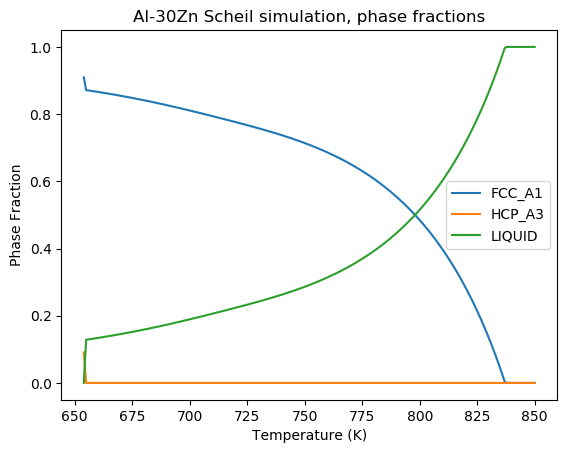
Phase fraction evolution during a Scheil simulation of Al-30Zn

Installation

pip (recommended)

scheil is suggested to be installed from PyPI.

pip install scheil

Anaconda

conda install -c conda-forge scheil

Development versions

To install an editable development version with pip:

git clone https://github.com/pycalphad/scheil.git
cd scheil
pip install --editable .[dev]

Upgrading scheil later requires you to run git pull in this directory.

Run the automated tests using

pytest

Theory

Uses classic Scheil-Gulliver theory (see G.H. Gulliver, J. Inst. Met. 9 (1913) 120–157 and Scheil, Zeitschrift Für Met. 34 (1942) 70–72.) with assumptions of

  1. Perfect mixing in the liquid
  2. Local equilibrium between solid and liquid
  3. No diffusion in the solid

Getting Help

For help on installing and using scheil, please join the pycalphad/pycalphad Gitter room.

Bugs and software issues should be reported on GitHub.

License

scheil is MIT licensed. See LICENSE.

Citing

If you use the scheil package in your work, please cite the relevant version.

The following DOI, doi:10.5281/zenodo.3630656, will link to the latest released version of the code on Zenodo where you can cite the specific version that you haved used. For example, version 0.1.2 can be cited as:

Bocklund, Brandon, Bobbio, Lourdes D., Otis, Richard A., Beese, Allison M., & Liu, Zi-Kui. (2020, January 29). pycalphad-scheil: 0.1.2 (Version 0.1.2). Zenodo. http://doi.org/10.5281/zenodo.3630657
@software{bocklund_brandon_2020_3630657,
  author       = {Bocklund, Brandon and
                  Bobbio, Lourdes D. and
                  Otis, Richard A. and
                  Beese, Allison M. and
                  Liu, Zi-Kui},
  title        = {pycalphad-scheil: 0.1.2},
  month        = jan,
  year         = 2020,
  publisher    = {Zenodo},
  version      = {0.1.2},
  doi          = {10.5281/zenodo.3630657},
  url          = {https://doi.org/10.5281/zenodo.3630657}
}
Comments
  • Multicomponent systems stop prematurely

    Multicomponent systems stop prematurely

    Hi Brandon, I am trying to use pycalphad to simulate solidification behaviour of alloys 625 and Monel. I noticed that simulation ends at some temperature dependent on composition and temperature step, even if solidification is far from complete. I attach an extreme example for Monel, comparing temperature steps of 5K and 2K. The simulation with 2K stops prematurely. I noted a similar behavior with alloys 625, even if not so dramatic. Also changes in composition affects the end point.

    image image

    I attach the code and the database I am using, derived from mc_ni_v2.034.tdb Thank you very much for your help and all you did with pycalphad!

    MonelScheil.txt ARNi.txt

    opened by AndRicci 10
  • Error while simulating Ni-Al-Cr system

    Error while simulating Ni-Al-Cr system

    I am using a revised version of Ni-database from MatCalc. This database works with pycalphad 0.8.3. When I run scheil 0.1.1, I got error message: ALN: Sublattice frozenset({Species('N', 'N1')}) of (frozenset({Species('AL', 'AL1')}), frozenset({Species('N', 'N1')})) has no components in {Species('AL', 'AL1')}

    Any suggestion?

    opened by dpttw 2
  • `simulate_equilibrium_solidification` should do order/disorder checks automatically

    `simulate_equilibrium_solidification` should do order/disorder checks automatically

    Currently there are no checks for order/disorder phase name checking in simulate_equilibrium_solidification, so a order/disorder modeled phase that is in a disordered configuration will still show as the ordered phase name.

    The main challenge in making this change that the order/disorder check assumes a pycalphad LightDataset, rather than xarray Dataset.

    opened by bocklund 1
  • Performance pass

    Performance pass

    The code should be profiled and any optimizations made if possible and reasonable.

    For example, equilibrium(..., to_xarray=False) could be used, but the indexing into the LightDataset objects would have to be updated

    opened by bocklund 1
  • Multicomponent systems incorrectly terminate at peritectic reactions

    Multicomponent systems incorrectly terminate at peritectic reactions

    Peritectic-type reactions in the ternary go from L+A -> A+B, terminating the current Scheil algorithm. Section 12.8 in Hillert's Phase Equilibria, Phase Diagrams, and Phase Transformations (2nd Edition) may be insightful. Specifically, the idea below might be able to be used to determine when a peritectic region is found and how to update the composition of the liquid so that the liquidus can continue to be followed down the liquidus projection to a eutectic.

    screen shot 2019-01-02 at 2 02 47 pm
    opened by bocklund 1
  • ENH: improve handling for ordered phases

    ENH: improve handling for ordered phases

    Introduces an OrderingRecord object to track the relationship between ordered and disordered phases, replacing the old ordering code. The new ordering approach can be used for arbitrary equilibrium calculations and is used to fix #8.

    The logic for defining how to compare the disordered phases is currently the same as before, considering the site ratios to determine equivalent sublattices. I am deferring action on this with the issue filed in https://github.com/pycalphad/scheil/issues/23.

    opened by bocklund 0
  • ENH: use adaptive sampling by default

    ENH: use adaptive sampling by default

    • Points dictionaries are now created for the user by default if they are not provided.
    • Adaptive sampling does not do any "local" random sampling by default, it just adds the point from the solution
    • Don't use pycalphad.core.utils.generate_dof to create the dof_dict (it is deprecated)
    opened by bocklund 0
  • ENH: Build phase records instead of callables

    ENH: Build phase records instead of callables

    Uses the pycalphad API to pass PhaseRecord dictionaries to calculate and equilibrium to improve the tight-loop performance of equilibrium and Scheil solidification simulations https://github.com/pycalphad/pycalphad/pull/361.

    Building phase records can give a significant performance boost, roughly 10x to 100x speedup in some cases.

    opened by bocklund 0
  • BLD/MAINT: Modernize project metadata

    BLD/MAINT: Modernize project metadata

    • Add pyproject.toml
    • Switch to setuptools_scm instead of versioneer
    • Update installation instructions in README
    • Add automated deployment on Releases
    • Update docs theme to furo
    opened by bocklund 0
  • FIX: Fix removing disordered phase candidates

    FIX: Fix removing disordered phase candidates

    Fixes a regression introduced in #11, where filter_phases was introduced to remove phases that cannot be stable or phases where the disordered part is given as a candidate phase. The change in #11 made it so the disordered phase was not a part of the list of solid_phases that could form during the solidification simulations. With the disordered phase name not included in the solid_phases, the order_disorder_eq_phases function that renamed the ordered phases with disordered configurations to their disordered counterpart would lead to the phase amount of disordered configurations to not be saved.

    This PR fixes that and adds a parameterized test case that tests that the disordered phase always is accounted for regardless of whether or not the ordered phase is in the candidate phases or not.

    opened by bocklund 0
  • FIX: Force exit in equilibrium solidification after a successful binary search

    FIX: Force exit in equilibrium solidification after a successful binary search

    • Exit the equilibrium solidification while loop after a binary search, because the solidification must be converged then by definition (fixes a floating point precision issue where 0.999... < 1 caused the loop to be infinite on some platforms.
    • Update CI for pip version of pycalphad
    • Remove environment.yml development file
    • Drop Python 3.6
    opened by bocklund 0
  • Improve logic for deciding which sublattices are equivalent when checking ordering

    Improve logic for deciding which sublattices are equivalent when checking ordering

    Currently, sublattices in ordered (partitioned) phases are considered equivalent by symmetry if their site ratios are equal. This is a poor heuristic and will fail to determine that sublattices 0 and 1 are equivalent in an FCC_L12 phase with sublattice model [['A', 'B'], ['A', 'B'], ['VA']] with site ratios [0.25, 0.75, 3].

    Relevant for this fix will be the current heuristic in pycalphad models https://github.com/pycalphad/pycalphad/pull/311, and the changes that will occur as a result of fixing https://github.com/pycalphad/pycalphad/issues/345.

    opened by bocklund 0
Releases(0.1.6)
Owner
pycalphad
Computational Thermodynamics in Python
pycalphad
nptsne is a numpy compatible python binary package that offers a number of APIs for fast tSNE calculation.

nptsne nptsne is a numpy compatible python binary package that offers a number of APIs for fast tSNE calculation and HSNE modelling. For more detail s

Biomedical Visual Analytics Unit LUMC - TU Delft 29 Jul 05, 2022
Piglet-shaders - PoC of custom shaders for Piglet

Piglet custom shader PoC This is a PoC for compiling Piglet fragment shaders usi

6 Mar 10, 2022
A way of looking at COVID-19 data that I haven't seen before.

Visualizing Omicron: COVID-19 Deaths vs. Cases Click here for other countries. Data is from Our World in Data/Johns Hopkins University. About this pro

1 Jan 10, 2022
Lightweight, extensible data validation library for Python

Cerberus Cerberus is a lightweight and extensible data validation library for Python. v = Validator({'name': {'type': 'string'}}) v.validate({

eve 2.9k Dec 27, 2022
A Python wrapper of Neighbor Retrieval Visualizer (NeRV)

PyNeRV A Python wrapper of the dimensionality reduction algorithm Neighbor Retrieval Visualizer (NeRV) Compile Set up the paths in Makefile then make.

2 Aug 29, 2021
CompleX Group Interactions (XGI) provides an ecosystem for the analysis and representation of complex systems with group interactions.

XGI CompleX Group Interactions (XGI) is a Python package for the representation, manipulation, and study of the structure, dynamics, and functions of

Complex Group Interactions 67 Dec 28, 2022
Tandem Mass Spectrum Prediction with Graph Transformers

MassFormer This is the original implementation of MassFormer, a graph transformer for small molecule MS/MS prediction. Check out the preprint on arxiv

Röst Lab 13 Oct 27, 2022
Comparing USD and GBP Exchange Rates

Currency Data Visualization Comparing USD and GBP Exchange Rates This is a bar graph comparing GBP and USD exchange rates. I chose blue for the UK bec

5 Oct 28, 2021
A collection of 100 Deep Learning images and visualizations

A collection of Deep Learning images and visualizations. The project has been developed by the AI Summer team and currently contains almost 100 images.

AI Summer 65 Sep 12, 2022
eoplatform is a Python package that aims to simplify Remote Sensing Earth Observation by providing actionable information on a wide swath of RS platforms and provide a simple API for downloading and visualizing RS imagery

An Earth Observation Platform Earth Observation made easy. Report Bug | Request Feature About eoplatform is a Python package that aims to simplify Rem

Matthew Tralka 4 Aug 11, 2022
The windML framework provides an easy-to-use access to wind data sources within the Python world, building upon numpy, scipy, sklearn, and matplotlib. Renewable Wind Energy, Forecasting, Prediction

windml Build status : The importance of wind in smart grids with a large number of renewable energy resources is increasing. With the growing infrastr

Computational Intelligence Group 125 Dec 24, 2022
Jupyter Notebook extension leveraging pandas DataFrames by integrating DataTables and ChartJS.

Jupyter DataTables Jupyter Notebook extension to leverage pandas DataFrames by integrating DataTables JS. About Data scientists and in fact many devel

Marek Čermák 142 Dec 28, 2022
Python implementation of the Density Line Chart by Moritz & Fisher.

PyDLC - Density Line Charts with Python Python implementation of the Density Line Chart (Moritz & Fisher, 2018) to visualize large collections of time

Charles L. Bérubé 10 Jan 06, 2023
Plot and save the ground truth and predicted results of human 3.6 M and CMU mocap dataset.

Visualization-of-Human3.6M-Dataset Plot and save the ground truth and predicted results of human 3.6 M and CMU mocap dataset. human-motion-prediction

Gaurav Kumar Yadav 5 Nov 18, 2022
Getting started with Python, Dash and Plot.ly for the Data Dashboards team

data_dashboards Getting started with Python, Dash and Plot.ly for the Data Dashboards team Getting started MacOS users: # Install the pyenv version ma

Department for Levelling Up, Housing and Communities 1 Nov 08, 2021
Visualization Library

CamViz Overview // Installation // Demos // License Overview CamViz is a visualization library developed by the TRI-ML team with the goal of providing

Toyota Research Institute - Machine Learning 67 Nov 24, 2022
Simple Python interface for Graphviz

Simple Python interface for Graphviz

Sebastian Bank 1.3k Dec 26, 2022
Python+Numpy+OpenGL: fast, scalable and beautiful scientific visualization

Python+Numpy+OpenGL: fast, scalable and beautiful scientific visualization

Glumpy 1.1k Jan 05, 2023
Mattia Ficarelli 2 Mar 29, 2022