Visualizing Yolov5's layers using GradCam

Overview

YOLO-V5 GRADCAM

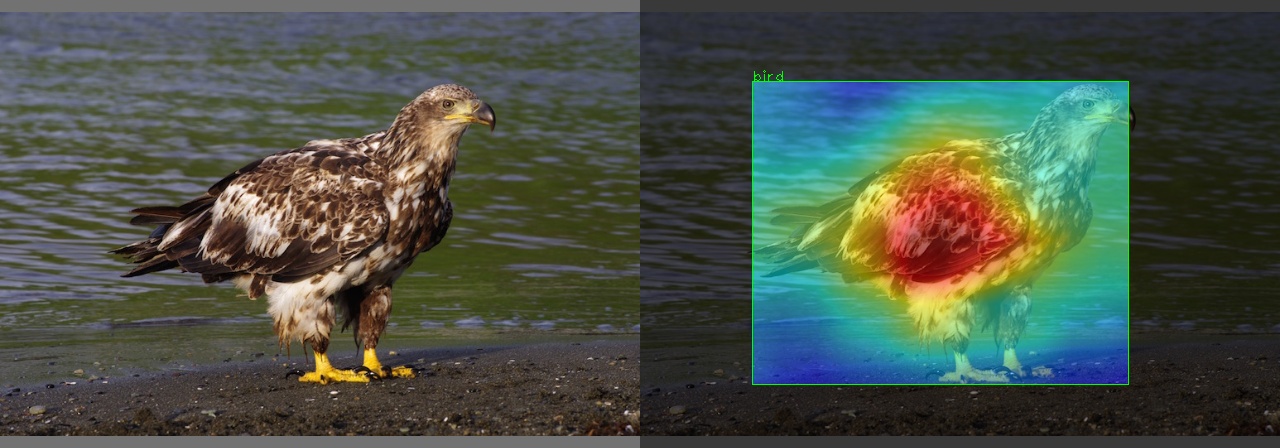
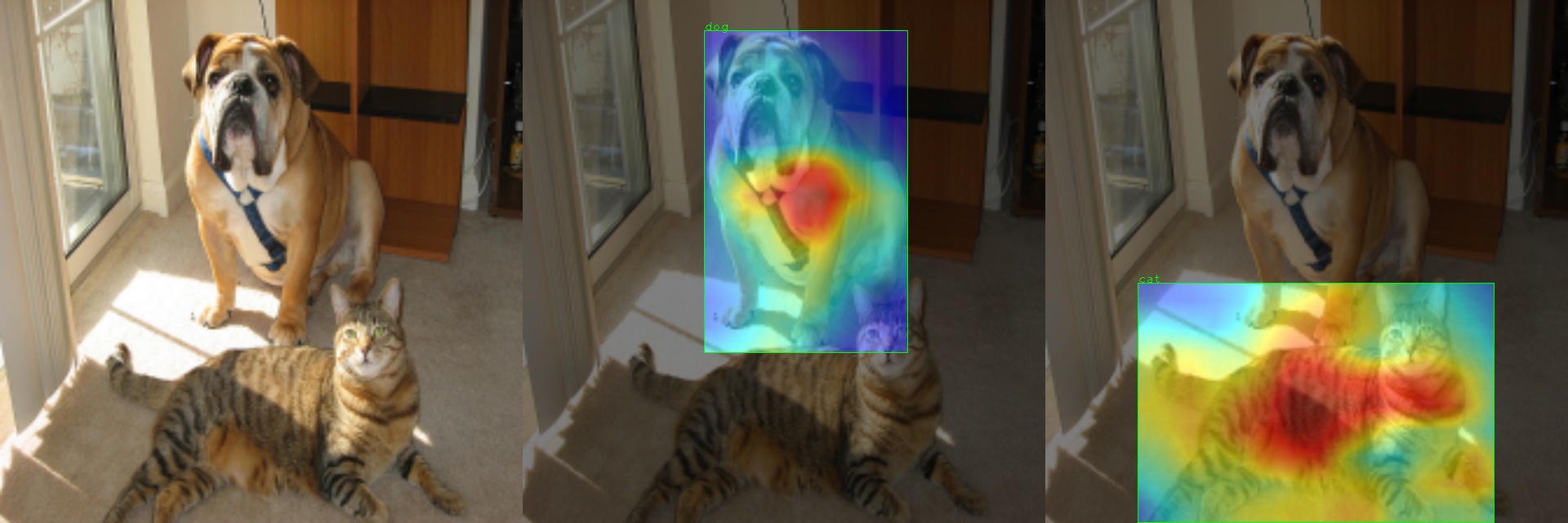
I constantly desired to know to which part of an object the object-detection models pay more attention. So I searched for it, but I didn't find any for Yolov5. Here is my implementation of Grad-cam for YOLO-v5. To load the model I used the yolov5's main codes, and for computing GradCam I used the codes from the gradcam_plus_plus-pytorch repository. Please follow my GitHub account and star the project if this functionality benefits your research or projects.

Installation

pip install -r requirements.txt

Infer

python main.py --model-path yolov5s.pt --img-path images/cat-dog.jpg --output-dir outputs

NOTE: If you don't have any weights and just want to test, don't change the model-path argument. The yolov5s model will be automatically downloaded thanks to the download function from yolov5.

NOTE: For more input arguments, check out the main.py or run the following command:

python main.py -h

Examples

Open In Colab

cat&dog

cat&dog

cat&dog

Note

I checked the code, but I couldn't find an explanation for why the truck's heatmap does not show anything. Please inform me or create a pull request if you find the reason.

TO Do

  1. Add GradCam++
  2. Add ScoreCam
  3. Add the functionality to the deep_utils library

References

  1. https://github.com/1Konny/gradcam_plus_plus-pytorch
  2. https://github.com/ultralytics/yolov5
  3. https://github.com/pooya-mohammadi/deep_utils

Citation

Please cite yolov5-gradcam if it helps your research. You can use the following BibTeX entry:

@misc{deep_utils,
	title = {yolov5-gradcam},
	author = {Mohammadi Kazaj, Pooya},
	howpublished = {\url{github.com/pooya-mohammadi/yolov5-gradcam}},
	year = {2021}
}
Owner
Pooya Mohammadi Kazaj
Open Source Enthusiast | AI Developer & Researcher
Pooya Mohammadi Kazaj
More than a hundred strange attractors

dysts Analyze more than a hundred chaotic systems. Basic Usage Import a model and run a simulation with default initial conditions and parameter value

William Gilpin 185 Dec 23, 2022
A PyTorch-based library for semi-supervised learning

News If you want to join TorchSSL team, please e-mail Yidong Wang ([email protected]<

1k Jan 06, 2023
DANA paper supplementary materials

DANA Supplements This repository stores the data, results, and R scripts to generate these reuslts and figures for the corresponding paper Depth Norma

0 Dec 17, 2021
PN-Net a neural field-based framework for depth estimation from single-view RGB images.

PN-Net We present a neural field-based framework for depth estimation from single-view RGB images. Rather than representing a 2D depth map as a single

1 Oct 02, 2021
Enigma-Plus - Python based Enigma machine simulator with some extra features

Enigma-Plus Python based Enigma machine simulator with some extra features Examp

1 Jan 05, 2022
A High-Quality Real Time Upscaler for Anime Video

Anime4K Anime4K is a set of open-source, high-quality real-time anime upscaling/denoising algorithms that can be implemented in any programming langua

15.7k Jan 06, 2023
Cerberus Transformer: Joint Semantic, Affordance and Attribute Parsing

Cerberus Transformer: Joint Semantic, Affordance and Attribute Parsing Paper Introduction Multi-task indoor scene understanding is widely considered a

62 Dec 05, 2022
[SIGGRAPH Asia 2019] Artistic Glyph Image Synthesis via One-Stage Few-Shot Learning

AGIS-Net Introduction This is the official PyTorch implementation of the Artistic Glyph Image Synthesis via One-Stage Few-Shot Learning. paper | suppl

Yue Gao 102 Jan 02, 2023
The second project in Python course on FCC

Assignment Write a function named add_time that takes in two required parameters and one optional parameter: a start time in the 12-hour clock format

Denise T 1 Dec 13, 2021
Codes for our IJCAI21 paper: Dialogue Discourse-Aware Graph Model and Data Augmentation for Meeting Summarization

DDAMS This is the pytorch code for our IJCAI 2021 paper Dialogue Discourse-Aware Graph Model and Data Augmentation for Meeting Summarization [Arxiv Pr

xcfeng 55 Dec 27, 2022
ESTDepth: Multi-view Depth Estimation using Epipolar Spatio-Temporal Networks (CVPR 2021)

ESTDepth: Multi-view Depth Estimation using Epipolar Spatio-Temporal Networks (CVPR 2021) Project Page | Video | Paper | Data We present a novel metho

65 Nov 28, 2022
Instance Segmentation in 3D Scenes using Semantic Superpoint Tree Networks

SSTNet Instance Segmentation in 3D Scenes using Semantic Superpoint Tree Networks(ICCV2021) by Zhihao Liang, Zhihao Li, Songcen Xu, Mingkui Tan, Kui J

83 Nov 29, 2022
Semi-Supervised Graph Prototypical Networks for Hyperspectral Image Classification, IGARSS, 2021.

Semi-Supervised Graph Prototypical Networks for Hyperspectral Image Classification, IGARSS, 2021. Bobo Xi, Jiaojiao Li, Yunsong Li and Qian Du. Code f

Bobo Xi 7 Nov 03, 2022
"Segmenter: Transformer for Semantic Segmentation" reproduced via mmsegmentation

Segmenter-based-on-OpenMMLab "Segmenter: Transformer for Semantic Segmentation, arxiv 2105.05633." reproduced via mmsegmentation. We reproduce Segment

EricKani 22 Feb 24, 2022
Example repository for custom C++/CUDA operators for TorchScript

Custom TorchScript Operators Example This repository contains examples for writing, compiling and using custom TorchScript operators. See here for the

106 Dec 14, 2022
Unofficial implementation of Fast-SCNN: Fast Semantic Segmentation Network

Fast-SCNN: Fast Semantic Segmentation Network Unofficial implementation of the model architecture of Fast-SCNN. Real-time Semantic Segmentation and mo

Philip Popien 69 Aug 11, 2022
Explicable Reward Design for Reinforcement Learning Agents [NeurIPS'21]

Explicable Reward Design for Reinforcement Learning Agents [NeurIPS'21]

3 May 12, 2022
[CVPR'22] COAP: Learning Compositional Occupancy of People

COAP: Compositional Articulated Occupancy of People Paper | Video | Project Page This is the official implementation of the CVPR 2022 paper COAP: Lear

Marko Mihajlovic 111 Dec 11, 2022
Companion code for the paper "An Infinite-Feature Extension for Bayesian ReLU Nets That Fixes Their Asymptotic Overconfidence" (NeurIPS 2021)

ReLU-GP Residual (RGPR) This repository contains code for reproducing the following NeurIPS 2021 paper: @inproceedings{kristiadi2021infinite, title=

Agustinus Kristiadi 4 Dec 26, 2021
PyTorch CZSL framework containing GQA, the open-world setting, and the CGE and CompCos methods.

Compositional Zero-Shot Learning This is the official PyTorch code of the CVPR 2021 works Learning Graph Embeddings for Compositional Zero-shot Learni

EML Tübingen 70 Dec 27, 2022