当前位置:网站首页>Explanation of tree chain dissection idea + acwing 2568 Tree chain dissection (DFS sequence + mountain climbing method + segment tree)
Explanation of tree chain dissection idea + acwing 2568 Tree chain dissection (DFS sequence + mountain climbing method + segment tree)
2022-07-19 10:53:00 【Morgannr】
The tree chain splits
Pass to renumber all nodes in the tree , Make any path in the tree become O(logn) Segment continuous interval .
let me put it another way , The function of tree chain dissection That is to say : Given Any tree , Put in the tree All points According to certain rules Number , Makes it A chain ( A sequence ). After the transformation , Any path in the tree Can be transformed into In this sequence logn A continuous interval .
thus , about The problem of paths in trees , Can be successfully transformed into Interval problem .
for example , If we want to get The sum of the weights of each node in a path in the tree , perhaps Add a number to a path as a whole , Wait for a series of questions , We can turn it into Interval problem Solve , After that, we can generally use Line segment tree Conduct Section Maintenance of problems , Of course, it can also be used Tree array Etc. can be used for Maintain the data structure of the interval ( The core idea )
Next let's see how it Specific operation Of :( how Transform a tree into a sequence , as well as How to convert each path in the tree into no more than logn Segment continuous interval )
First of all, let's Build a tree :
STEP I The concept is introduced
Define first Several concepts :
- (1)“ Heavy son ” and “ Light son ”
Let's divide all the sons into Two kinds of :“ Heavy son ” and “ Light son ”, Be careful , about leaf node No, “ son ” The concept . For... In the tree Any node , Here we use The root node For example , Can put all its sons There are two kinds of , First ask Each of its sub trees Of Total number of nodes .
As far as the picture above is concerned , The root node The first subtree on the left has 3 Nodes , The first subtree on the right has 4 Nodes , obviously The maximum number of nodes Yes. On the right side This subtree , that The root of the right subtree That is to say Of its parent node “ Heavy son ”, The corresponding figure below is Red nodes .

Be careful , If There are multiple subtrees with the maximum number of nodes , that Select the root node of any subtree As “ Heavy son ” that will do .
In addition to the heavy son, the son is called “ Light son ”.
And so on , The following figure 4 individual “ Red nodes ” Are all of their parent nodes “ Heavy son ”. The rest is “ Light son ”.
- (2)“ Heavy edge ” and “ Light side ”
“ Heavy son ” Corresponding “ Heavy edge ”,“ Light son ” Corresponding “ Light side ”.
namely ,“ Heavy son ” and Its parent node The connected edge is “ Heavy edge ”,“ Light son ” and Its parent node The connected edge is “ Light side ”( except “ Heavy edge ” outside All sides of are called “ Light side ”).
Corresponding to the figure below , all Red edge That is to say “ Heavy edge ”
- (3)“ heavy chain ”
This concept is only applicable to “ Heavy edge ”.
“ heavy chain ”, namely great A path consisting of multiple edges , Corresponding to the figure below The path under the red box That is to say “ heavy chain ”.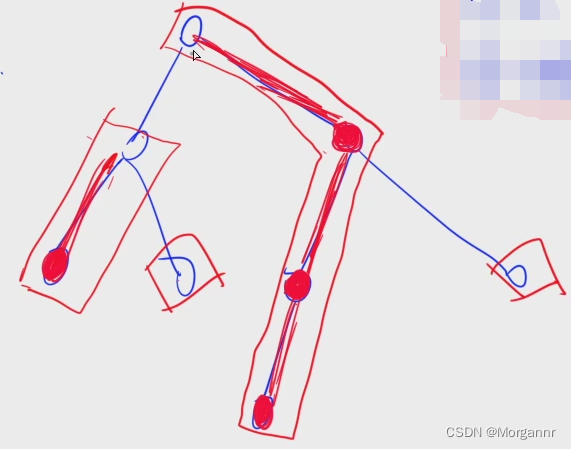
In the diagram above , We found two “ heavy chain ” All are Separate nodes , This is because : We Put each node into one “ heavy chain ” in .
Here we can also find , The beginning of the heavy chain must be the light son .
STEP II Two times dfs Preprocessing ( The core )
After introducing the concept , Let's draw a very important conclusion , This is also The tree chain splits Of emphasis :
- Put in the tree All points and edges After classification , Any path in the tree can be split into
O(logn)Continuous intervals .
that , How to turn the current tree into a sequence ? We just use Of this tree dfs order , So-called dfs order , I've been in contact before , namely stay dfs In the process of , Traverse each point in order The order of the .
Take the root node as the 1 A little bit To traverse the , During traversal , We First traverse the current point “ Heavy son ”.
Pictured , The number marked above the node is dfs Traverse The order of time .

This traversal benefits : Guarantee “ heavy chain ” All points on the are numbered consecutively .
thus , We'll take a tree according to its dfs order Turn into a chain .
To sum up :( Through the following two steps, you can turn the whole tree into a section dfs order , You can also mark each heavy chain )
- First step , Through the first
dfsIn the tag tree Every point of the heavy son , That is to saydfsRecord the size of each subtree in the process , After recursion of all sons , Determine which subtree has the most nodes , The root node of the subtree is the heavy son , Mark the .
First passdfscode snippet :( Pretreated at the same timedepthArrays are convenient for follow-up Mountain climbing Use )
void dfs1(int u, int father, int dep)	// Node number   Its parent node number   Current depth
{

	depth[u] = dep, fa[u] = father, sz[u] = 1;
	for (int i = h[u]; ~i; i = ne[i])
	{

		int j = e[i];
		if (j == father) continue;
		dfs1(j, u, dep + 1);
		sz[u] += sz[j];	// Current subtree size plus  j  The size of the tree
		if (sz[son[u]] < sz[j]) son[u] = j;	// If the current number of nodes with multiple children is less than  j  The number of nodes of the tree , Explain that the current heavy son should be  j
	}
}
- The second step , After marking the heavy son , Do it again
dfs, You can find out Each heavy chain 了 . stay The second timedfsmeanwhile We can getdfsorder , meanwhile Mark each heavy chain ( Just mark The vertex of each point on the heavy chain that will do , Like in the picture above , On a heavy chain2、3、4The vertices of node No. are1Number point )
Second timesdfscode snippet :( Give priority to your son , Its benefits have been mentioned above )
void dfs2(int u, int t)	// Current point   And the vertex of the heavy chain where the current point is located
{

	id[u] = ++cnt; //dfs order
	nw[cnt] = w[u];	//dfs Second in the preface cnt The weight of each point is w[u]
	top[u] = t;	// The vertex of the heavy chain where the current point is located is t
	if (!son[u]) return;	// If the current point is a leaf node , No son
	dfs2(son[u], t);	// Otherwise, priority should be given to search for his son
	// after dfs All light sons
	for (int i = h[u]; ~i; i = ne[i])
	{

		int j = e[i];
		// If xx or j For his son , Because the heavy son has been searched , So skip the current loop
		if (j == fa[u] || j == son[u]) continue;
		dfs2(j, j);	// Recursive light son , The top of the heavy chain where the light son is located is himself
	}
}
STEP III Mountain climbing Split any path into intervals ( Inquire about or When modifying )
After the first two steps , Now we want to Query a path or modify the value of a path when , We have to think about how Put in the tree Any path Split into O(logn) A continuous interval ( namely heavy chain )?
This is actually one It's similar to asking for LCA The process of :( Mountain climbing )
- There is... In the tree Two nodes
a、b, There is a path between , Now split the path into Several heavy chains . Every time We are all separated finda、bThe heavy chain of two points , Every time I find The vertex depth of the heavy chain is large ( a “ Short ”) The node of , And walk to its Parent node , Iteration goes up (bThe other side of the node Also in the same way ), Final , At two o 'clock I'm sure I'll come to The same heavy chain On ( namely At two o 'clockLCAThe heavy chain ), The middle part of two points Is the path The last paragraph .
code snippet :( Because the form of query path is the same as that of modification path , Let's take modification as an example )
void modify_path(int u, int v, int k)	// Mountain climbing
{

	// How to judge whether two points are in the same heavy chain ?
	// It's similar to parallel search   Save the vertex number of the heavy chain where each point is located
	// Judge whether the vertices of the heavy chain where the two points are located are the same
	while (top[u] != top[v])	// When two points are not in the same heavy chain
	{

		if (depth[top[u]] < depth[top[v]]) swap(u, v);
		// Priority u Heavy chain
		modify(1, id[top[u]], id[u], k);	// Modify this continuous interval   That is, subtree
		u = fa[top[u]];	// Jump over the heavy chain
	}
	if (depth[u] < depth[v]) swap(u, v);
	modify(1, id[v], id[u], k);	// Revise the last paragraph
}
In this way , We will take a、b The path between two points is divided into several heavy chains , The number is O(logn) Level . Now we have successfully transformed the problem on the tree into logn An interval problem , After use Line segment tree perhaps Other data structures solve , Time complexity O(n * (logn ^ 2)). As shown in the figure below , The red part by heavy chain .

STEP IV Example
Let's look at a specific example ,


The question :
Given a tree , Requirement realization Four operations :
- Add a value to the weight of all points on the path between two nodes
- Add a value to the weight of all points in a certain tree
- Ask the sum of the weights of all points on the path between two points
- Ask the sum of the weights of all points in a certain tree
Ideas :
basis The tree chain splits As a problem-solving idea , See the above thought explanation for details .
Time complexity :
O ( n ∗ ( l o g n ) 2 ) O(n * (logn) ^ 2) O(n∗(logn)2)
Code :
#include <bits/stdc++.h>

using namespace std;
//#define map unordered_map
#define int long long
const int N = 1e5 + 10, M = N << 1;
int n, m;
int h[N], e[M], ne[M], w[N], idx;
int depth[N], fa[N], sz[N], son[N], top[N];
int id[N], nw[N], cnt;

struct node
{

	int l, r;
	int add, sum;
} t[N << 2];

inline void add(int a, int b)
{

	e[idx] = b, ne[idx] = h[a], h[a] = idx++;
}

void dfs1(int u, int father, int dep)
{

	depth[u] = dep, fa[u] = father, sz[u] = 1;
	for (int i = h[u]; ~i; i = ne[i])
	{

		int j = e[i];
		if (j == father) continue;
		dfs1(j, u, dep + 1);
		sz[u] += sz[j];
		if (sz[son[u]] < sz[j]) son[u] = j;
	}
}

void dfs2(int u, int t)
{

	id[u] = ++cnt, nw[cnt] = w[u], top[u] = t;
	if (!son[u]) return;
	dfs2(son[u], t);
	for (int i = h[u]; ~i; i = ne[i])
	{

		int j = e[i];
		if (j == fa[u] || j == son[u]) continue;
		dfs2(j, j);
	}
}

void pushup(int u) {

	t[u].sum = t[u << 1].sum + t[u << 1 | 1].sum;
}

void pushdown(int u) {

	auto& rt = t[u], & le = t[u << 1], & ri = t[u << 1 | 1];
	if (rt.add)
	{

		le.add += rt.add, le.sum += rt.add * (le.r - le.l + 1);
		ri.add += rt.add, ri.sum += rt.add * (ri.r - ri.l + 1);
		rt.add = 0;
	}
}

void build(int u, int l, int r)
{

	t[u] = {
     l, r };
	if (l == r) {

		t[u].sum = nw[r];//////////
		return;
	}
	int mid = l + r >> 1;
	build(u << 1, l, mid), build(u << 1 | 1, mid + 1, r);
	pushup(u);
}

void modify(int u, int l, int r, int v)
{

	if (l <= t[u].l && r >= t[u].r)
	{

		t[u].add += v, t[u].sum += v * (t[u].r - t[u].l + 1);
		return;
	}
	pushdown(u);
	int mid = t[u].l + t[u].r >> 1;
	if (l <= mid) modify(u << 1, l, r, v);
	if (r > mid) modify(u << 1 | 1, l, r, v);
	pushup(u);
}

int ask(int u, int l, int r)
{

	if (l <= t[u].l && r >= t[u].r)
	{

		return t[u].sum;
	}
	pushdown(u);
	int mid = t[u].l + t[u].r >> 1;
	int res = 0;
	if (l <= mid) res += ask(u << 1, l, r);
	if (r > mid) res += ask(u << 1 | 1, l, r);
	return res;
}

void modify_path(int u, int v, int k)
{

	while (top[u] != top[v])
	{

		if (depth[top[u]] < depth[top[v]]) swap(u, v);
		modify(1, id[top[u]], id[u], k);
		u = fa[top[u]];
	}
	if (depth[u] < depth[v]) swap(u, v);
	modify(1, id[v], id[u], k);
}

int ask_path(int u, int v)
{

	int res = 0;
	while (top[u] != top[v])
	{

		if (depth[top[u]] < depth[top[v]]) swap(u, v);
		res += ask(1, id[top[u]], id[u]);
		u = fa[top[u]];
	}
	if (depth[u] < depth[v]) swap(u, v);
	res += ask(1, id[v], id[u]);
	return res;
}

void modify_tree(int u, int v)
{

	modify(1, id[u], id[u] + sz[u] - 1, v);
}

int ask_tree(int u)
{

	return ask(1, id[u], id[u] + sz[u] - 1);
}

signed main()
{

	cin >> n;
	for (int i = 1; i <= n; ++i) scanf("%lld", &w[i]);
	memset(h, -1, sizeof h);
	int t = n - 1;
	while (t--)
	{

		int x, y; scanf("%lld%lld", &x, &y);
		add(x, y), add(y, x);
	}
	dfs1(1, -1, 1);
	dfs2(1, -1);
	build(1, 1, n);
	cin >> m;
	while (m--)
	{

		int op, u;
		scanf("%lld%lld", &op, &u);
		if (op == 1)
		{

			int v, k; scanf("%lld%lld", &v, &k);
			modify_path(u, v, k);
		}
		else if (op == 2)
		{

			int k; scanf("%lld", &k);
			modify_tree(u, k);
		}
		else if (op == 3)
		{

			int v; scanf("%lld", &v);
			printf("%lld\n", ask_path(u, v));
		}
		else
		{

			printf("%lld\n", ask_tree(u));
		}
	}
	return 0;
}
( Code + notes )
#include <bits/stdc++.h>

using namespace std;
//#define map unordered_map
//#define int long long
const int N = 1e5 + 10, M = N << 1;
typedef long long ll;
int n, m;
int h[N], e[M], ne[M], w[N], idx;
int id[N];	// It turns out that every point in the tree is dfs Number in the sequence
int nw[N];	// Weight of each numbered point , That is, the weight of the newly numbered point  dfs Second in the preface i A dot number
int cnt;
int depth[N];	// The depth of each point
int sz[N];	// The size of the subtree with each point as the root node
int top[N];	// The vertex of the heavy chain where each point is located
int fa[N];	// Each point parent node
int son[N];	// Every point of the heavy son

struct node
{

	int l, r;
	ll add, sum;	// Maintain two values in the segment tree
} t[N << 2];

void add(int a, int b) {

	e[idx] = b, ne[idx] = h[a], h[a] = idx++;
}

void dfs1(int u, int father, int dep)	// Node number   Its parent node number   Current depth
{

	depth[u] = dep, fa[u] = father, sz[u] = 1;
	for (int i = h[u]; ~i; i = ne[i])
	{

		int j = e[i];
		if (j == father) continue;
		dfs1(j, u, dep + 1);
		sz[u] += sz[j];	// Current subtree size plus  j  The size of the tree
		if (sz[son[u]] < sz[j]) son[u] = j;	// If the current number of nodes with multiple children is less than  j  The number of nodes of the tree , Explain that the current heavy son should be  j
	}
}

void dfs2(int u, int t)	// Current point   And the vertex of the heavy chain where the current point is located
{

	id[u] = ++cnt; //dfs order
	nw[cnt] = w[u];	//dfs Second in the preface cnt The weight of each point is w[u]
	top[u] = t;	// The vertex of the heavy chain where the current point is located is t
	if (!son[u]) return;	// If the current point is a leaf node , No son
	dfs2(son[u], t);	// Otherwise, priority should be given to search for his son
	// after dfs All light sons
	for (int i = h[u]; ~i; i = ne[i])
	{

		int j = e[i];
		// If xx or j For his son , Because the heavy son has been searched , So skip the current loop
		if (j == fa[u] || j == son[u]) continue;
		dfs2(j, j);	// Recursive light son , The top of the heavy chain where the light son is located is himself
	}
}

void pushup(int u)
{

	t[u].sum = t[u << 1].sum + t[u << 1 | 1].sum;
}

void pushdown(int u)	// Pass down the lazy sign
{

	auto &rt = t[u], &le = t[u << 1], &ri = t[u << 1 | 1];
	if (rt.add)
	{

		le.add += rt.add, le.sum += rt.add * (le.r - le.l + 1);
		ri.add += rt.add, ri.sum += rt.add * (ri.r - ri.l + 1);
		rt.add = 0;
	}
}

void build(int u, int l, int r)
{

	t[u] = {
     l, r };
	if (l == r) {

		t[u].sum = nw[l];
		return;
	}
	int mid = l + r >> 1;
	build(u << 1, l, mid), build(u << 1 | 1, mid + 1, r);
	pushup(u);
}

void modify(int u, int l, int r, int v)
{

	if (l <= t[u].l && r >= t[u].r)
	{

		t[u].add += v, t[u].sum += v * (t[u].r - t[u].l + 1);
		return;
	}
	pushdown(u);
	int mid = t[u].l + t[u].r >> 1;
	if (l <= mid) modify(u << 1, l, r, v);
	if (r > mid) modify(u << 1 | 1, l, r, v);
	pushup(u);
}

ll ask(int u, int l, int r)
{

	if (l <= t[u].l && r >= t[u].r)
	{

		return t[u].sum;
	}
	pushdown(u);
	int mid = t[u].l + t[u].r >> 1;
	ll res = 0;
	if (l <= mid) res += ask(u << 1, l, r);
	if (r > mid) res += ask(u << 1 | 1, l, r);
	return res;
}

void modify_path(int u, int v, int k)	// The mountain climbing method mentioned before
{

	// How to judge whether two points are in the same heavy chain ?
	// It's similar to parallel search   I saved the vertex number of the heavy chain where each point is located
	// Judge whether the vertices of the heavy chain where the two points are located are the same
	while (top[u] != top[v])	// When two points are not in the same heavy chain
	{

		if (depth[top[u]] < depth[top[v]]) swap(u, v);
		// Priority u Heavy chain
		modify(1, id[top[u]], id[u], k);	// Modify this continuous interval   That is, subtree
		u = fa[top[u]];	// Jump over the heavy chain
	}
	if (depth[u] < depth[v]) swap(u, v);
	modify(1, id[v], id[u], k);	// Revise the last paragraph
}

ll ask_path(int u, int v)	// The same as the modification form
{

	ll res = 0;
	while (top[u] != top[v])
	{

		if (depth[top[u]] < depth[top[v]]) swap(u, v);
		res += ask(1, id[top[u]], id[u]);
		u = fa[top[u]];
	}
	if (depth[u] < depth[v]) swap(u, v);
	res += ask(1, id[v], id[u]);
	return res;
}

void modify_tree(int u, int v)	// With u The subtree is a continuous interval , The left and right endpoints are as follows
{

	modify(1, id[u], id[u] + sz[u] - 1, v);
}

ll ask_tree(int u)
{

	return ask(1, id[u], id[u] + sz[u] - 1);
}

signed main()
{

	cin >> n;
	for (int i = 1; i <= n; ++i)
	{

		scanf("%d", &w[i]);
	}
	memset(h, -1, sizeof h);
	int t = n - 1;
	while (t--)
	{

		int u, v; scanf("%d%d", &u, &v);
		add(u, v), add(v, u);
	}

	dfs1(1, -1, 1);	// First ask the heavy son of each point
	dfs2(1, -1);	// Please  dfs  order
	build(1, 1, n);	// Build a line segment tree

	// The tree chain splits
	cin >> m;
	while (m--)
	{

		int t, u, v, k; scanf("%d%d", &t, &u);
		if (t == 1)
		{

			scanf("%d%d", &v, &k);
			modify_path(u, v, k);
		}
		else if (t == 2)
		{

			scanf("%d", &k);
			modify_tree(u, k);
		}
		else if (t == 3)
		{

			scanf("%d", &v);
			printf("%lld\n", ask_path(u, v));
		}
		else
		{

			printf("%lld\n", ask_tree(u));
		}
	}

	return 0;
}
边栏推荐
- 【华为云IoT】读书笔记之《万物互联:物联网核心技术与安全》第3章(下)
- String type function transfer problem
- 基于“7·20郑州特大暴雨”对空天地一体化通信的思考
- 因果学习将开启下一代AI浪潮?九章云极DataCanvas正式发布YLearn因果学习开源项目
- 如何在双链笔记软件中建立仪表盘和知识库?以嵌入式小组件库 NotionPet 为例
- 金鱼哥RHCA回忆录:CL210描述OPENSTACK控制平面--识别overclound控制平台服务+章节实验
- 欧拉角,轴角,四元数与旋转矩阵详解
- OpenCV编程:OpenCV3.X训练自己的分类器
- Satellite network capacity improvement method based on network coding
- vulnhub inclusiveness: 1
猜你喜欢

手机键盘(模拟题)

Win10安装Apache Jena 3.17

LeetCode 2315. Statistical asterisk (string)
LeetCode 2325. 解密消息(map)

ENVI_ Idl: use the inverse distance weight method to select the nearest n points for interpolation (bottom implementation) and output them to GeoTIFF format (the effect is equivalent to the inverse di

Aike AI frontier promotion (7.17)

Win10的环境变量配置

vSphere 下借助 vDS 或 NSX 做端口镜像的方法总结

Take a look at this ugly face | MathWorks account unavailable - technical issue

军品研制过程所需文件-进阶版
随机推荐
发明闪存能赚多少钱?这是一个日本的狗血故事
数据库面基知识汇总后
37. Flex layout
[acwing] game 60 c-acwing 4496 eat fruit
「百度一面」怒喷面试官!不就是树遍历时增加一个行号?
Google Earth Engine——Hansen Global Forest Change v1.8 (2000-2020) 森林覆盖度和森林损失量数据集
Efficient space-based computing technology for satellite communication in 6g
Scala's dosing in idea
Integrated network architecture and network slicing technology of air, earth and sea
Win10安装Apache Jena 3.17
SVN学习
ENVI_ Idl: use the inverse distance weight method to select the nearest n points for interpolation (bottom implementation) and output them to GeoTIFF format (the effect is equivalent to the inverse di
6G智慧内生:技术挑战、架构和关键特征
使用tesseract.js-offline识别图片文字记录
LeetCode 2315. 统计星号(字符串)
VScode+Unity3D的配置
unity3d中的旋转
Pytoch and weight decay (L2 norm)
Over fitting and under fitting
Use testeract JS offline recognition picture text record