当前位置:网站首页>Network knowledge-03 data link layer Ethernet
Network knowledge-03 data link layer Ethernet
2022-07-19 07:17:00 【Earth shattering pig worm】
List of articles
3 Use the data link layer of the broadcast channel
Broadcast channels can carry one-to-many communications . LAN is the broadcast channel used .
3.1 LAN
LAN refers to a group of computers interconnected by multiple computers in a certain area , It's usually within a few thousand meters ; Wan usually spans a large physical range , It covers tens to thousands of kilometers , It can connect multiple cities or countries , Or across several continents and providing long-distance communication , Forming an international remote network .
Protocol running on the cables connected to the devices at both ends , For LAN , There's Ethernet , Token ring ,FDDI etc. .
The following figure shows the topology of LAN :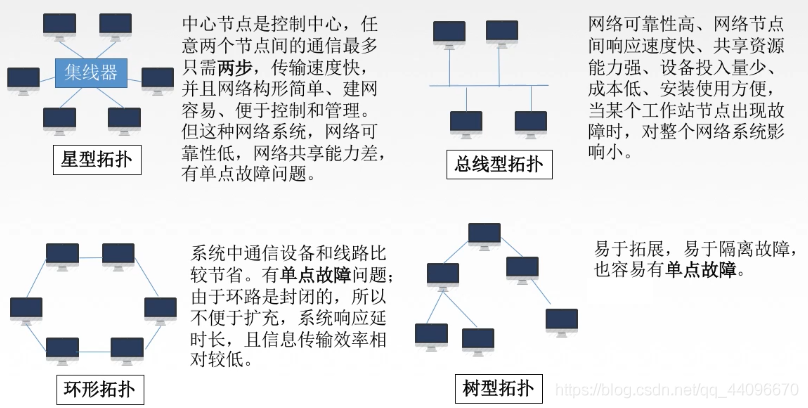
3.1.1 The classification of LAN
- Ethernet : Ethernet is the most widely used LAN , Including standard Ethernet (10Mbps)、 Fast Ethernet (100Mbps)、 Gigabit Ethernet (1000 Mbps) and 10G Ethernet , They all fit IEEE802.3 Series of standard specifications . Logical topology master line , Physical topology is star or extended star . Use CSMA/CD.
- Token ring network : Physically, star topology is adopted , Logically, it is a ring topology . Already “ chrysanthemums after the double ninth festival ”
- PDDI network ( Floer Distrilouked Data inervece): Physically, the double ring topology is adopted , Logically, it is a ring topology .
- ATM network ( Asynchronous Transler Mode): Newer switching unit technology , Use 53 Byte fixed length units are exchanged .
- WLAN ( Local Area Network WLAN): use IEEE 802.11 standard .
3.1.2 IEEE 802 standard
IEEE 802 The series standard is IEEE 802 LAN/MAN LAN developed by the Standards Committee 、 Technical standard of man (1980 year 2 Month set up ). One of the most widely used is Ethernet 、 Token ring 、 WLAN, etc . Each sub standard in this series of standards is the responsibility of a special working group in the Committee .
- IEEE 802.3: Ethernet media access control protocol (CSMACD) And physical layer technical specifications 2.
- IEEE 802.5: Token ring network (Token-Ring) Media access control protocol and physical layer technical specification .
- IEEE 802.8: Optical fiber technical advisory group , Provide technical consultation on optical fiber networking .
- IEEE 802.11: WLAN (WLAN) Media access control protocol and physical layer technical specification .
3.1.3 MAC Sublayer LLC Sublayer
IEEE 802 The LAN reference model described in the standard only corresponds to OSI The data link layer and physical layer of the reference model , It divides the data link layer into logical link layer LLC Sublayer and media access control MAC Sublayer .
- Logical link control LLC(Logical Link Control) - Deal with content unrelated to access to the transmission media
- Media access control MAC(Medium Access Control)- Deal with content related to access to transmission media
However, due to the rapid development of the Internet TCP/IP The only Lan that the system often uses is DIX Ethernet V2 instead of IEEE 802.3 LAN in standard , So now IEEE The logical link control sublayer designated by the committee LLC The role of has disappeared , Adapters produced by many manufacturers are only equipped with MAC Agreement without LLC agreement
[ Failed to transfer the external chain picture , The origin station may have anti-theft chain mechanism , It is suggested to save the pictures and upload them directly (img-uVJ74rlZ-1651218479207)(https://note.youdao.com/yws/res/19519/WEBRESOURCE0aa6f4aa09dfcf6e9af989fbb48aac11)]
3.2 Ethernet
Ethernet (Ethernet) Refers to the Xerox The company was founded by Xerox、Intel and DEC Baseband bus LAN specification jointly developed by the company , It is the most common communication protocol standard adopted by the existing LAN . Ethernet use CSMA/CD( Carrier monitor multiple access and collision detection ) technology .
Ethernet plays a dominant role in all kinds of LAN technologies :
- Low cost ( Ethernet network card is missing 100 block );
- It is the most widely used LAN technology ;
- Than token ring 、ATM Net cheap , Simple ;
- Meet the network speed requirements :10Mb/s~10Gb/s.
Ethernet has two standards :
- DIX Ethernet V2: First LAN product ( Ethernet ) Statute .
- IEEE 802.3:IEEE 802 The committee 802.3 The first one developed by the working group IEEE Ethernet standard for .( There are a few changes to the frame format )
Ethernet provides no connection 、 Unreliable service .
3.2.1 The frame format
So far, TCP/IP The LAN often used in the system refers to DIX Ethernet V2, Most of these data frames use Ethernet II Format .
The difference between the two types of frame formats :
3.2.1.1 Ethernet_II The frame format
When Type The field value is greater than or equal to 1536 ( Or hexadecimal 0x0600) when , The frame uses Ethernet II Format .
Most data frames in Ethernet use Ethernet II Format .
The length of Ethernet data frame is 64-1518 Between bytes .
Ethernet_II The fields in the frame are described as follows :
- DMAC(Destination MAC) It is purpose MAC Address .DMAC The length of the field is 6 Bytes , Identify the receiver of the frame .
- SMAC(Source MAC) It is the source. MAC Address .SMAC The length of the field is 6 Bytes , Identify the sender of the frame .
- The type field (Type) Used to identify the high-level protocol contained in the data field , The length of this field is 2 Bytes . The value of type field is 0x0800 The frame of the image represents IP Protocol frame ; The value of type field is 0806 The frame of the image represents ARP Protocol frame .
- Data field (Data) It's network layer data , The minimum length must be 46 Bytes to ensure that the frame length is at least 64 byte , The maximum length of a data field is 1500 byte .
Cyclic redundancy check fields (FCS) Provides an error detection mechanism . The length of this field is 4 Bytes .
3.2.1.2 IEEE802.3 The frame format
When Type The field value is less than or equal to 1500( Or hexadecimal 0x05DC) when , The frame uses IEEE 802.3 Format .
IEEE 802.3 The frame length field value is less than or equal to 1500 (0x05DC)
IEEE 802.3 The frame format is similar to Ethernet_II frame , It's just Ethernet_II The frame of Type Domain by 802.3 The frame of Length Domain substitution , And occupied Data Field 8 Bytes as LLC and SNAP Field .
- Length The field defines Data The number of bytes the field contains .
- Logical link control LLC(Logical Link Control) By the destination service access point DSAP(Destination Service Access Point)、 Source service access point SSAP(Source Service Access Point) and Control Field composition .
- SNAP(Sub-network Access Protocol) By organization code (Org Code) And type (Type) Field composition .Org code All three bytes are 0.Type The meaning of the field is the same as Ethernet_II In the frame Type The fields are the same .
IEEE802.3 Frame according to DSAP and SSAP The values of fields can be divided into the following categories :
- When DSAP and SSAP Take a specific value 0xff when ,802.3 The frame becomes Netware-ETHERNET frame , Used to carry NetWare Data of type .
- When DSAP and SSAP Take a specific value 0xaa when ,802.3 The frame becomes ETHERNET_SNAP frame .ETHERNET_SNAP Frames can be used to transmit a variety of protocols .
- DSAP and SSAP Other values are pure IEEE802.3 frame .
3.2.2 Data frame transmission

The data link layer is based on MAC Address for frame transmission
Ethernet passes through the layer-2 link MAC Address to uniquely identify network devices , And realize the communication between network devices on LAN .MAC Address is also called physical address , Most network card manufacturers put MAC The address is burned into the network card ROM in . The sender uses the of the receiver MAC Address as destination address . After the Ethernet frame is encapsulated, it will be converted into a bit stream through the physical layer and transmitted on the physical medium .
in addition , It should be noted that network packets are transmitted in large end byte order , Of course, the header has to be big endian .Java The default is also big end processing .
3.2.3 The frame type
Ethernet depends on your destination MAC Can be divided into : unicast , radio broadcast , Multicast .
3.2.3.1 unicast

Sending from a single source to a single destination . Each host interface consists of a MAC Address unique identification ,MAC Address of the OUI in , The first byte is 8 The bits represent the address type . For hosts MAC Address , This bit is fixed to 0, Show purpose MAC The address is MAC Address frames are sent to a unique destination .
In the conflict domain , All hosts can receive unicast frames sent by the source host , But other hosts find that the destination address is different from the local address MAC If the address is inconsistent, the received frame will be discarded , Only the real destination host will receive and process the received frame .
The following figure shows the unicast data frame 
3.2.3.2 radio broadcast

Indicates that frames are sent from a single source to all hosts on the shared Ethernet . The purpose of the broadcast frame MAC The address is hexadecimal FF:FF:FF:FF:FF:FF, All hosts that receive the broadcast frame will receive and process the frame .
Broadcast mode will generate a lot of traffic , Leading to lower bandwidth utilization , And then affect the performance of the whole network .
When all hosts in the network need to receive the same information and process it , It's usually broadcast .
The following figure shows the broadcast data frame 
3.2.3.3 Multicast

Multicast is more efficient than broadcast . Multicast forwarding can be understood as selective broadcasting , Hosts listen for specific multicast addresses , Receive and process the purpose MAC The address is the multicast MAC The frame of the address .
Multicast MAC Address and unicast MAC The address is passed through the second... In the first byte 8 Bit by bit . Multicast MAC Address No 8 The bits are 1, And unicast MAC Address No 8 The bits are 0.
When a group of hosts on the network is needed ( Not all hosts ) Receive the same information , And other hosts are not affected , Multicast is usually used .
The following figure shows the multicast data frame 
3.2.4 CSMA/CD agreement
The early development of LAN , LAN using bus mode , The feature is that all computers are on the same bus , Data can only be sent when the bus is idle . In this way, a protocol is needed to negotiate the speech conflict between multiple computers , This is it. CSMA/CD agreement : Carrier monitoring multipoint access / Collision detection .
Because Ethernet sends data using Manchester code The signal of , Therefore, the Ethernet protocol does not need the tail of the delimiter , Because once the host no longer sends signals , The high-low level conversion in Ethernet disappears , This feature can be used as the tail of the frame .
Ethernet uses carrier frames with collision detection to listen to multiple access (CSMA/CD) Mechanism . Nodes in Ethernet can see all the information sent in the network , therefore , We say Ethernet is a broadcast network .
The working process of Ethernet is as follows , When a host in Ethernet wants to transmit data , It will proceed as follows :
- Whether there is a signal transmitted on the frame listening channel . If any , Indicates that the channel is busy , Just continue to listen , Until the channel is free .
- If no frame hears any signal , Just transfer data
- Continue to listen to frames while transmitting , If a conflict is found, the backoff algorithm is executed , Wait randomly for a period of time , Repeat the steps 1( When conflict occurs , The computer involved in the conflict will send and return to the frame listening channel state .
- If no conflict is found, the transmission is successful , Computers all computers before trying to send data again , Must wait after the last send 9.6 Microsecond ( With 10Mbps function ).
according to CSMA/CD agreement , It can be inferred that to detect the collision in the transmission process , The minimum length of data is 64 byte . Ethernet MTU by 64~1500
In the use of CSMA/CS When the agreement , It is impossible for one station to transmit and receive at the same time ( But the channel must be monitored while sending ). Therefore use CSMA/CS Protocol Ethernet can not carry out full duplex communication, but only two-way alternate communication ( Half duplex communication ).
3.3 Ethernet classification
According to the different transmission rates , Ethernet is divided into standard Ethernet (10Mbit/s)、 Fast Ethernet (100Mbis) Gigabit Ethernet (1000Mbs) And 10 Gigabit Ethernet (10Gbit/s), These Ethernet are compliant with IEEE 802.3 Is compatible .
3.3.1 Standard Ethernet
Standard Ethernet is the earliest Ethernet , Its transmission rate is 10Mbts, Also known as traditional Ethernet . The networking mode of this Ethernet is very flexible , It is possible to use both rough and 、 Thin cables form a bus network , Twisted pair can also be used to form a star network , You can also use coaxial cable and twisted pair to form a hybrid network . These networks are consistent with EE8023 standard ,IEEE8023 Some traditional Ethernet physical layer standards specified in are as follows .
- 10 Base-2: Use thin coaxial cable , The maximum segment length is 185m.
- 10 Base-5: Use thick coaxial cable , The maximum segment length is 500m.
- 10 Base-T: Use double lines , The maximum segment length is 100m.
- 10 Boad-36: Use coaxial cable , The maximum segment length is 3600m.
- 10 Base-F: Using optical fiber , The maximum segment length is 2000m, The transmission rate is 10Mb/s.
The first digit in the above standard represents the transmission rate , Unit is Mbis; The number at the end represents the length of a single segment of network cable ( The datum unit is 100m);Base Baseband transmission , Broad Indicates broadband transmission .
3.3.2 Fast Ethernet
With the development of network and the popularization of various network technologies , Standard Ethernet technology has been difficult to meet people's demand for network data traffic and rate .1993 year 10 Months ago , People can only choose expensive 、 be based on 100Mbs Fiber optic cable FDD Technology to build a high standard network ,1993 year 10 month , Grand Junction The company launched the world's first fast Ethernet hub FastSwitch10/100 And 100m network interface card Fast NIC 100, Fast Ethernet technology has been officially applied .
And then ,Intel、3COM And other companies have also launched their own fast Ethernet devices , meanwhile IEEE802 The working group is interested in 100Mbi/s Various standards of Ethernet are studied , And in 1995 year 4 Month issued IEEE 802.3u 100Base-T Fast Ethernet standard , The era of Fast Ethernet is coming .
IEEE 802.3U The standard basically maintains the provisions of the standard lan , Including frame format 、 Interface 、 Media access control method (CSMA/CD) etc. , Just change the data transfer rate from 10Mbts Promoted to 100Mbit/s, Some new physical layer standards are used , The details are as follows .
- 100 Base-1X: Use two pairs of 5 Class shielded or unshielded twisted pair , A pair for sending data , A pair for transmitting data ; Use RJ-45 or DB9 Interface , The maximum distance between the node and the hub is 100m, Support full duplex .
- 100 Base-T4: Use 4 Yes 3 class 、4 Class or 5 Class a twisted pair ,3 For sending data ,1 For detecting collision signals ; Use R-45 The connector , The maximum segment length is 100m, Full duplex is not supported .
- 100 Base-FX: Use a pair of single-mode or multimode fibers , All the way for sending data , One way is used to receive data ; The maximum segment length is 200m( When using single-mode fiber 2000m), Support full duplex . This kind of network is mainly used to build the main network , To improve the transmission rate of the backbone network .
3.3.3 Gigabit Ethernet
Gigabit Ethernet (GigabitEthernet) Also known as Gigabit Ethernet .1995 year 11 month ,IEEE802.3 Any high-speed research group of the working group , Research to increase the fast Ethernet rate to 1000Mbls Feasibility and method of .1996 year 6 month ,IEEE The Standards Committee approved the application for authorization of Gigabit Ethernet scheme , And then IEEE802.3 The working group established IEEE 802.3z The Working Committee , The committee established the Gigabit Ethernet standard , The main provisions of the standard are as follows :
- Rate is 1000Mbit/s Full duplex of Ethernet in communication / With half duplex operation .
- Use 8023 Ethernet frame format 、CSMA/CD technology .
- Support a repeater in a conflict domain .
- Backwards compatible 10Base-T and 100Base-T IEEE802.3.
The working group has developed a series of physical layer standards for Gigabit Ethernet , The common standards are as follows :
- 1000 Base-SX: The core diameter used is 50m And 625m、 The working wavelength is 850m Multimode fiber , use 8B/10B Encoding mode , The transmission distances are 260m and 525m. This standard is mainly applied to the short distance main network on the same floor of the building .
- 1000 Base-LX: The core diameter used is 50pm And 625m、 The working wavelength is 850nm And core diameter is 5m、 The working wavelength is 1300nm The multimode 、 Single mode fiber , The transmission distances are 525m、550m and 3000m. This standard is mainly applied to campus backbone network .
- 1000 Base-CX: Use 1500 Shielded twisted pair , use 8B/10B Encoding mode , The transmission rate is 1.25Gbis, The transmission distance is 25m. This standard is mainly used for the connection of cluster devices , Such as equipment interconnection in a switch room .
- 1000 Base-T: Use 4 Yes 5 Class unshielded twisted pair , use PAM5 Encoding mode , The transmission distance is 100m.
This standard is mainly used for communication of buildings on the same floor , Thus, unshielded twisted pair cable laid by standard Ethernet or fast Ethernet can be used .
Gigabit Ethernet uses optical fiber as uplink , For connection between buildings , Originally designed as a switching technology , After that, it is widely used in server connection and backbone network . Now , Gigabit Ethernet has become the mainstream network technology , Whether it's large enterprises or small and medium-sized enterprises , When building a network, Gigabit Ethernet will be the first choice for high-speed network technology .
3.3.4 10 Gigabit Ethernet
10 Gigabit Ethernet (10 Gigabit Ethernet,10GE) Also known as 10 Gigabit Ethernet , It is a high-speed Ethernet after Gigabit Ethernet . On Gigabit Ethernet IEEE 802.3Z Soon after the adoption of the specification ,IEEEE Set up a high-speed research group (High Speed Study Group,HssG), The research group is mainly committed to 10GE The study of .
10GE Not simply increasing the speed of Gigabit Ethernet 10 times ,2002 year 6 month ,IEEE802.3ae The committee formulated 10GE The official standard of , The standard mainly includes the following contents :
- compatible 8023 Minimum and maximum Ethernet frame lengths defined in the standard .
- Only full duplex mode is supported .
- Use point-to-point links and structured cabling to form a Star LAN .
- stay MAC/PLS Implement on the service interface 10Gbs The speed of .
- Define two physical layer specifications , LAN PHY And wan PHY.
- The definition will MAC/PLS The data transmission rate corresponds to the WAN PHY Adaptation mechanism of data transmission rate .
- Define interfaces that support specific physical media (PMD) Physical layer specification , It includes multimode fiber, single-mode fiber and corresponding transmission distance ; Support ISO/C11801 Types of optical fiber media defined in the second edition, etc .
- adopt WAN Interface sublayer ,10Gbi/s It can also be adjusted to a lower transmission rate .
Besides ,10Gbis No longer use copper wire , Only optical fiber is used as the transmission medium ; No longer use CSMA/CD agreement . Gigabit Ethernet can still use existing Fibre Channel Technology , but 10GE Use the newly developed physical layer .10GE Common physical layer specifications are as follows :
- 10G Base-SR:SR Express " Short Reach"( short distance ),10GBae-SR For short distance connections only , The specification supports the encoding method of 64B/66B Short wave (850mm) Multimode fiber , The effective transmission distance is 2m~300m.
- 10G Base-LR:LR Express “Long Reach”( The long distance ),10 G Base-LR It is mainly used for long-distance connection , The specification supports the encoding method of 64B/66B The long wave of (1310mm) Single mode fiber , The effective transmission distance is 2m~10km, Up to 25km.
- 10G Base-ER:ER Express “ Extended Reach”( Super long distance ,10G Base-ER Support ultra long wave (1550nm) Single mode fiber , The effective transmission distance is 2m~40km.
3.4 Extended Ethernet
In most cases , We hope to expand the coverage of Ethernet . This section discusses the expansion of Ethernet at the physical layer and data link layer , This extended Ethernet is still a network in the network layer .
3.4.1 Extending Ethernet at the physical layer
The distance between hosts on Ethernet cannot be too far , Otherwise, the signal sent by the host will be attenuated to CSMA/CD The protocol doesn't work . So we can consider expanding Ethernet from logistics , To break through the limitation of distance .
3.4.1.1 Using optical fiber expansion
The host uses fiber and a pair of fiber modems to connect to the hub , It's easy to connect the mainframe to a hub a few kilometers away 
3.4.1.2 Using hub extensions
Connect multiple Ethernet segments into larger ones through one or more hubs 、 Ethernet with multi-level star structure , For example, a department has a department , The second system , The third series is extended through the hub .
When introducing the advantages and disadvantages of this method , First, let's introduce what collision domain is .
- Collision domain (collision domain) It is also called conflict domain , It refers to the part of the network where the frame sent by one site will collide with the frame sent by other stations . There are three collision domains on the left of the above figure , On the right is a larger collision domain .
- The larger the collision domain is , The higher the probability of collision ( This involves CSMA/CD).
It is obvious from the picture that , Advantages and disadvantages of hub expansion .
- advantage :
- So that the computers on Ethernet belonging to different collision domains can communicate across collision domains
- Expand the geographical coverage of Ethernet
- The bridge makes each network segment an isolated collision domain

- shortcoming :
- The collision domain has increased , But the overall throughput has not improved
- If different collision domains use different data rates , Then you can't use hubs to interconnect them
3.4.2 Extending Ethernet in data link layer
A more common way to expand Ethernet is at the data link layer . Early use of bridges , Now use Ethernet switches .
3.4.2.1 Use the bridge
The bridge works at the data link layer , It is based on MAC The destination address of the frame forwards the received frame . The bridge has the function of filtering frames . When the bridge receives a frame , This frame is not forwarded to all interfaces , But first check the purpose of this frame MAC Address , Then determine which interface to forward the frame to 
The advantages and disadvantages of using a bridge are as follows :
- advantage
- Filter traffic , Expand the scope of Physics , Improved reliability .
- Can interconnect different physical layers 、 Different MAC Sublayers and different rates ( Such as 10Mb/s and 100Mb/s Ethernet ) LAN .
- shortcoming
- Store and forward increase delay , stay MAC The sublayer has no flow control function , It's different MAC When the network segments of the sublayer are bridged together, the delay is larger .
- It is not possible for many to many hosts to communicate at the same time , Because the bridge can only analyze and forward one frame at a time .
- Bridge is only suitable for a small number of users ( No more than a few hundred ) And the LAN with less traffic , Otherwise, network congestion may occur due to the excessive broadcast information . This is the so-called broadcast storm .
Bridges are different from hubs :
- When the hub forwards frames , No detection of transmission media .
- The bridge must execute before forwarding frames CSMA/CD Algorithm , If there is a collision in the transmission process , You have to stop sending and back off .
- The hub works on the physical layer , The bridge works at the data link layer .
3.4.2.2 Use the switch
1990 The switched hub came out in , Many bridges are eliminated . Switching hubs are often called Ethernet switches or layer-2 switches .
Ethernet switch features :
Isolate collision domain
Ethernet switch is essentially a multi interface bridge , Each interface is directly connected to the host , And it works in full duplex mode , The switch can connect many pairs of interfaces at the same time , So that each pair of hosts communicating with each other can act as an exclusive communication medium , Transmit data without collision , Ethernet switch uses a special switch structure chip , Forwarding by hardware is much faster than that by software .
Exclusive bandwidth
Ethernet with hub expansion , Divide the bandwidth equally , Ethernet extended by switch , Each site enjoys exclusive bandwidth , Virtually increased the total bandwidth .
Don't use CSMA/CD
Logically , Ethernet with hub expansion , The essence is bus Ethernet , You have to use CSMA/CD Protocol to handle collisions , And it can only work in half duplex mode , The switch adopts star Ethernet , Do not use shared bus , There is no collision problem , No need to use CSMA/CD, And it works in full duplex mode , However, the Ethernet frame structure is still used
The way Ethernet switches exchange frames :
- Store and forward mode : The whole data frame is first cached and then processed
- Straight through (cut-through) The way : When receiving the data frame, immediately press the purpose of the data frame MAC The address determines the forwarding interface of the frame , Therefore, the frame forwarding speed is improved , The disadvantage is that it forwards the frame directly without checking for errors , Therefore, it is possible to forward some invalid frames to other sites .
Self learning function of Ethernet switch :
The forwarding of switches still depends on Forwarding , Ethernet switches run self-learning algorithms to automatically maintain and publish .


边栏推荐
- SNN learning diary - install spikengjelly
- Servlet 笔记
- Sword finger offer question brushing record - offer 04 Search in two-dimensional array
- M design of GPS data longitude and latitude height analysis and Kalman analysis software based on matlab-GUI
- Regular expression, generator, iterator
- ivew 穿梭框Transfer组件高亮显示操作值
- What if the website is hijacked?
- 论文阅读:Deep Residual Shrinkage Networksfor Fault Diagnosis
- m基于Lorenz混沌自同步的混沌数字保密通信系统的FPGA实现,verilog编程实现,带MATLAB混沌程序
- linux下执行shell脚本调用sql文件,传输到远程服务器
猜你喜欢

爬虫基础—爬虫的基本原理

快速掌握sort命令,tr命令

Pytorch learning diary (II)
My world 1.12.2 Magic Baby (Fairy treasure dream) service opening tutorial

m3GPP-LTE通信网络中认知家庭网络Cognitive-femtocell性能matlab仿真
M BTS antenna design based on MATLAB, with GUI interface

网络知识-02 物理层

SNN learning diary - install spikengjelly

TypeScript(一)

M design of GPS data longitude and latitude height analysis and Kalman analysis software based on matlab-GUI
随机推荐
Filter过滤器
PyTorch学习笔记(一)
2021-10-25 浏览器兼容遇到的问题
[ restartedMain] o.s.b.d.LoggingFailureAnalysisReporter :
regular expression
正则表达式
Edit close automatically generate configuration file when saving
What if the website is hijacked?
网络知识-03 数据链路层-PPPoE
m基于Simulink的高速跳频通信系统抗干扰性能分析
MySQL解压版安装步骤(Windows)
Execute shell script under Linux to call SQL file and transfer it to remote server
Sword finger offer question brushing record - offer 06 Print linked list from end to end
m基于matlab的协作mimo分布式空时编码技术的仿真
怎么知道网络是否需要用高防服务器?怎么选择机房也是很重要的一点以及后期业务的稳定性
Functions and random numbers
PyTorch学习日记(三)
Quickly learn to use cut command and uniq command
Fundamentals of crawler - basic principles of agent
What do you need to build a website