当前位置:网站首页>[dynamic programming] - longest ascending subsequence model
[dynamic programming] - longest ascending subsequence model
2022-07-19 13:56:00 【Xuanche_】

AcWing 1017. Kidd's glider
sample input :
3
8
300 207 155 299 298 170 158 65
8
65 158 170 298 299 155 207 300
10
2 1 3 4 5 6 7 8 9 10
sample output :
6
6
9

When confirmed Direction and The starting point After finishing , What is the longest distance ?
The starting point :a[i]
The longest : With a[i] Starting from Longest ascending subsequence (LIS)
#include <iostream>
#include <algorithm>
using namespace std;

const int N = 110;

int n;
int a[N], f[N];

int main()
{
    int T;
    cin >> T;
    while(T -- )
    {
        cin >> n;
        for(int i = 1; i <= n; i ++ ) scanf("%d", &a[i]);

        //  Forward solution  LIS
        int res = 0;
        for(int i = 1; i <= n; i ++ )
        {
            f[i] = 1;
            for(int j = 1; j < i; j ++ )
                if(a[i] > a[j])
                    f[i] = max(f[i], f[j] + 1);
            res = max(res, f[i]);
        }

        //  Reverse solution  LIS
        for(int i = n; i; i -- )
        {
            f[i] = 1;
            for(int j = n; j > i; j -- )
                if(a[i] > a[j])
                    f[i] = max(f[i], f[j] + 1);
            res = max(res, f[i]);
        }

        cout << res << endl;
    }
    return 0;
}
AcWing 1014. Mountaineering
sample input :
sample output :
4

The title includes the following Conditions :
- according to Number increment In order to browse ( Subsequence )
- Two adjacent scenic spots cannot be the same height ( Strictly monotonous )
- Once you start to fall, you can't rise
The goal is : Ask how many scenic spots you can visit at most
Two LIS Then the maximum value of addition is solved
#include <iostream>
#include <algorithm>
using namespace std;

const int N = 1010;

int n;
int a[N];
int f[N], g[N];


int main()
{
    cin >> n;
    for(int i = 1; i <= n; i ++ ) scanf("%d", &a[i]);
    for(int i = 1; i <= n; i ++ )
    {
        f[i] = 1;
        for(int j = 1; j < i; j ++ )
            if(a[i] > a[j])
                f[i] = max(f[i], f[j] + 1);
    }

    for(int i = n; i; i -- )
    {
        g[i] = 1;
        for(int j = n; j > i; j -- )
            if(a[i] > a[j])
                g[i] = max(g[i], g[j] + 1);
    }

    int res = 0;
    for(int i = 1; i <= n; i ++ ) res = max(res, f[i] + g[i] - 1);

    cout << res << endl;

    return 0;
}
AcWing 1012. Friendly city
sample input :
7
22 4
2 6
10 3
15 12
9 8
17 17
4 2
sample output :
4

 all Legal way of building bridges All correspond to a Ascending subsequence of dependent variable

therefore , The scenario , In the case of upper coordinate sorting , The order of the lower coordinates is not from small to large , It must be illegal ( There will be intersection )
therefore , This question becomes : The coordinates above the bridge are sorted from small to large , Find the length of the longest ascending subsequence of the lower coordinate
#include <iostream>
#include <cstring>
#include <algorithm>

using namespace std;

const int N = 5010;

typedef pair<int, int> PII;

int n;
PII q[N];
int f[N];

int main()
{
    cin >> n;
    for(int i = 0; i < n; i ++ ) scanf("%d%d", &q[i].first, &q[i].second);
    sort(q, q + n);

    int res = 0;
    for(int i = 0; i < n; i ++ )
    {
        f[i] = 1;
        for(int j = 0; j < i; j ++ )
            if(q[i].second > q[j].second)
                f[i] = max(f[i], f[j] + 1);
        res = max(res, f[i]);
    }

    cout << res << endl;

    return 0;
}
AcWing 1016. The maximal ascending subsequence and
sample input :
7
1 7 3 5 9 4 8
sample output :
18

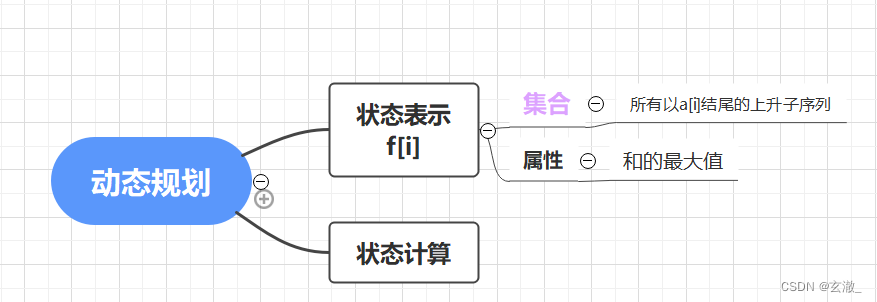

#include <iostream>
#include <algorithm>
using namespace std;

const int N = 1010;

int n;
int a[N], f[N];

int main()
{
    cin >> n;
    for(int i = 1; i <= n; i ++ ) scanf("%d", &a[i]);

    for(int i = 1; i <= n; i ++ )
    {
        f[i] = a[i];
        for(int j = 1; j < i; j ++)
            if(a[j] < a[i])
                f[i] = max(f[i], f[j] + a[i]);
    }
    int res = 0;
    for(int i = 1; i <= n; i ++ ) res = max(res, f[i]);
    cout << res << endl;
    return 0;
}
AcWing 1010. Interceptor missile
sample input :
389 207 155 300 299 170 158 65sample output :
6
2

This question is First question It's a classic LIS problem
For the second question , We use Greedy thought
Greedy process :
Scan each number from front to back , For each number :
situation 1: If the end of the existing subsequence is less than the current number , Then create a new subsequence
situation 2: Put the current number after the smallest subsequence greater than or equal to it
Greedy proof :
1. How to prove that two numbers are equal ?
A Represents the number of sequences obtained by greedy algorithm ,B Represents the optimal solution
①
, From the properties of the optimal solution
②
Adjustment method
Suppose that the scheme corresponding to the optimal solution is different from the current scheme
Find the first different number .
The optimal solution can be adjusted to the greedy solution through a finite number of exchanges , Without increasing the number of sequences

 , From the properties of the optimal solution
  Adjustment method
 #include <iostream>
#include <algorithm>
using namespace std;
const int N = 1010;
int n;
int q[N];
int f[N], g[N];
int main()
{
while(cin >> q[n]) n ++ ;
int res = 0;
for(int i = 0; i < n; i ++ )
{
f[i] = 1;
for(int j = 0; j < i; j ++ )
if(q[j] >= q[i])
f[i] = max(f[i], f[j] + 1);
res = max(res, f[i]);
}
cout << res << endl;
int cnt = 0;
for(int i = 0; i < n; i ++ )
{
int k = 0;
while(k < cnt && g[k] < q[i]) k ++ ;
g[k] = q[i];
if(k >= cnt) cnt ++ ;
}
cout << cnt << endl;
return 0;
}AcWing 272. The longest common ascending subsequence
4
2 2 1 3
2 1 2 3
sample output :
2


The subject is Longest ascending subsequence and Longest common subsequence Combined version of , In terms of state representation and state calculation, it is a method that integrates these two topics .
 State means :
![f[i][j]](http://img.inotgo.com/imagesLocal/202201/17/202201170531301456_9.gif) On behalf of all a[1 ~ i] and b[i ~ j] China and Israel b[j] Public ascending subsequence at the end Set
On behalf of all a[1 ~ i] and b[i ~ j] China and Israel b[j] Public ascending subsequence at the end Set
The value of is equal to the length of the subsequence of the set Maximum
State calculation :
First of all, according to the Whether the public subsequence contains a[i], take f[i][j] The set represented is divided into two subsets that are neither heavy nor leaky
- It doesn't contain a[i] Subset , The maximum is f[i - 1][j]
- contain a[i] Subset , Continue to divide this subset , Based on The penultimate element of the subsequence is b[] Which number is in
- The subsequence contains only b[j] a number , The length is 1
- The penultimate number of subsequences is b[1] Set , The maximum length is f[i-1][1] + 1
- ....
- The penultimate number of subsequences is b[j - 1] Set , The maximum length is f[i-1][j-1] + 1
Get the following  How to do it
#include <iostream>
#include <algorithm>

using namespace std;

const int N = 3010;

int n;
int a[N], b[N];
int f[N][N];

int main()
{
    cin >> n;
    for(int i = 1; i <= n; i ++ ) scanf("%d", &a[i]);
    for(int i = 1; i <= n; i ++ ) scanf("%d", &b[i]);

    for(int i = 1; i <= n; i ++ )
        for(int j = 1; j <= n; j ++ )
        {
            f[i][j] = f[i - 1][j];
            if(a[i] == b[j])
            {
                f[i][j] = max(f[i][j], 1);
                for(int k = 1; k < j; k ++ )
                    if(b[k] < b[j])
                        f[i][j] = max(f[i][j], f[i][k] + 1);
            }
        }

    int res = 0;
    for(int i = 1; i <= n; i ++ ) res = max(res, f[n][i]);

    cout << res << endl;

    return 0;
}
And then we find that every time we cycle, we get maxv Is to meet a[i] > b[k] Of f[i - 1][k] + 1 The maximum prefix of .
So you can directly take maxv Mention the first layer of circulation outside , Reduce double counting , There are only two cycles left .
Take the maximum value at the end of the subsequence of the final answer enumeration .
#include <cstdio>
#include <iostream>
#include <algorithm>

using namespace std;

const int N = 3010;

int n;
int a[N], b[N];
int f[N][N];

int main()
{
    scanf("%d", &n);
    for (int i = 1; i <= n; i ++ ) scanf("%d", &a[i]);
    for (int i = 1; i <= n; i ++ ) scanf("%d", &b[i]);

    for (int i = 1; i <= n; i ++ )
    {
        int maxv = 1;
        for (int j = 1; j <= n; j ++ )
        {
            f[i][j] = f[i - 1][j];
            if (a[i] == b[j]) f[i][j] = max(f[i][j], maxv);
            if (a[i] > b[j]) maxv = max(maxv, f[i - 1][j] + 1);
        }
    }

    int res = 0;
    for (int i = 1; i <= n; i ++ ) res = max(res, f[n][i]);
    printf("%d\n", res);

    return 0;
}
边栏推荐
- 版本通告|Apache Doris 1.1 Release 版本正式发布!
- iVX低代码平台系列详解 -- 概述篇(二)
- 【7.12】Codeforces Round #806 (Div. 4)
- 【C语言】扫雷介绍与实现【数组与函数】
- onvif协议相关:常用类说明
- SSH keyless login
- 009 面试题 SQL语句各部分的执行顺序
- 【7.15】代码源 -【整齐的数组2】【三进制循环】【树上逆序对】【蜗蜗的数列】
- [7.9] code source - [number selection] [sequence operation] [minimum or spanning tree]
- 009 execution sequence of SQL statement of interview questions
猜你喜欢

【考研词汇训练营】Day 7 —— second,attract,current,collect,simple,communicate,vocation

Android开发大厂面试,做好这3个准备,规划好自己

Microservice calling component feign practice

No.4 bits, bytes, information storage

Onvif protocol related: 3.1.1 digest access authorization

Chrome plug-ins for information collection

Interview records

No.2 compilation preliminary

Onvif protocol related: 2.1.1 get token in none mode

FreeRTOS implementation of idle tasks and blocking delay
随机推荐
(with source code) a variety of machine learning models (knn\lr\rf\ada\xg\gbdt...) Model training in precipitation downscaling under
Google Earth engine - 1992 present mixed coordinate ocean model, water temperature and salinity (global ocean data set HYCOM)
Onvif protocol related: 4.1.2 WS username token method to obtain token
Li Kou's 302 weekly match
Go exceed API source code reading (III) -- openreader ()
Interview records
Codeforces Round #808 (Div. 2)ABCD
STL string output and modification
统计直播间的榜一信息,从这里起步
009 面试题 SQL语句各部分的执行顺序
【ACWing】2521. 数颜色
弹性负载均衡将访问流量自动分发到多台云服务器,扩展应用系统对外的服务能力,提高应用程序安全性。
【码蹄集新手村 600 题】计算一个整数有多少位数
Deep learning from getting started to giving up the 100 day challenge
Flutter uses animatedswitcher to switch scenes
卤味店,如何在低线城市挣钱
命令行的一些常用操作命令及常见错误的解决办法
ImportError: DLL load failed while importing win32api: 找不到指定的程序。
The NFT market pattern has not changed. Can okaleido set off a new round of waves?
FreeRTOS-空闲任务和阻塞延时的实现