当前位置:网站首页>Review of 4246 Algorithms for Data Science
Review of 4246 Algorithms for Data Science
2022-07-19 07:23:00 【Alex Tech Bolg】
Contents
- Important algorithms
- Note
- Lecture1: Insertion sort, efficient algorithm
- Lecture2: Merge sort
- Lecture3: Binary search, quicksort
- Lecture5: Graphs, Breadth-First Search (BFS)
- Lecture6: Depth-first search, topological sorting
- Lecture7&8: Strongly connected components, single-origin shortest paths in weighted graphs
- Lecture12: Data compression and Huffman coding
- Lecture9: The dynamic programming principle; segmented least squares
- After midterm
- Lecture 11 Shortest paths in weighted graphs (Bellman-Ford)
- Lecture 15&16 Network flows
- Lecture 20&21 Reductions; independent set and vertex cover; decision problems
- Lecture 22 Satisfiability problems: SAT, 3SAT, Circuit-SAT
- Lecture 23&25 Representative NP-complete problems: TSP, Set Cover
- Lecture18&19 Linear programming
Important algorithms
- Sort: Insertion sort, merge sort, quick sort
- Binary search
- Graph: BFS、DFS and their application
- Greedy: Dijkstra’s algorithm and improved implementation
- Dynamic programming: Bellman-Ford
- Network flow: Ford-Fulkerson algorithm
- NPC: Vertex Cover(D), Independent Set(D), SAT, 3SAT, integer programming
- Linear programming (integer programming)
Note
The key point is to understand the application and time complexity of various algorithms .
Lecture1: Insertion sort, efficient algorithm
Insertion sort
Analysis of algorithms
- Correctness: Proof by induction.
- Running time: Best case: 5n − 4; worst case. 3n^2 + 7n − 4
- Space: in-place algorithm
Efficient algorithms (polynomial running time)
Lecture2: Merge sort
Asymptotic notation
- Asymptotic upper bounds: Big-O notation
- Asymptotic lower bounds: Big-Ω notation
- Asymptotic tight bounds: Θ notation
- Asymptotic upper bounds that are not tight: little-o
- Asymptotic lower bounds that are not tight: little-ω
Divide & conquer principle, application: merge sort
- Correctness
- Running time: O(nlogn)
- Space: Θ(n)
Solving recurrences and running time of merge sort
- recursion trees
- Master theorem
Lecture3: Binary search, quicksort
Binary search
- Running time: O(log n)
Quicksort
- divide and conquer
- Space: in-place
- Running time:
- Its worst-case running time is Θ(n^2) but its average-case running time is Θ(nlogn)
- Correctness:
- strong induction (the induction step at n requires that the inductive hypothesis holds at all steps 1, 2, …, n−1 and not just at step n−1, as with simple induction.)
Lecture5: Graphs, Breadth-First Search (BFS)
Definition
- Undirected / directed
- Simple: all vertices are distinct.
- An undirected graph is connected when there is a path between every pair of vertices.
- The connected component of a node u is the set of all node in the graph reachable by a path from u.
- A directed graph is strongly connected if for every pair of vertices u, v, there is a path from u to v and from v to u.
- The strongly connected component of a node u in a directed graph is the set of nodes v in the graph such that there is a path from u to v and from v to u.
- Tree: connected acyclic graph
- Bipartite graphs
- Degree theorem
- Linear graph algorithms run in O(n+m) time
Representing graphs
- adjacency matrix
- adjacency list
Breadth-first search (BFS)
- queue: FIFO data structure
- s-t connectivity
- shortest s-v paths in unweighted graphs.
- Connected components in undirected graphs
- Testing bipartiteness & graph 2-colorability
- SCC(u): SCC of node u
- All SCC: but not linear
Lecture6: Depth-first search, topological sorting
Depth-first search (DFS)
- stack: LIFO (Last-In First-Out)
- s-t connectivity
- Cycle detection
- Topological sorting in DAGs (directed acyclic graph)
- Run DFS(G); compute finish times.
- Process the tasks in decreasing order of finish times.
- Running time: O(m+n)
- different edges: forward, back, cross --> time intervals for vertices
- Undirected graphs: find all connected components
- SCC(u): SCC of node u
- All SCC: linear
- Compute Gr.
- Run DFS(Gr); compute finish(u) for all u.
- Run DFS(G) in decreasing order of finish(u).
- Output the vertices of each tree in the DFS forest of line 3 as an SCC.
Lecture7&8: Strongly connected components, single-origin shortest paths in weighted graphs
Applications of DFS: Strongly connected components
(combine it with the above)
Shortest paths in graphs with non-negative edge weights (Dijkstra’s algorithm)
- Greedy principle
- implementation and improved implementation
- running time
Lecture12: Data compression and Huffman coding
- Prefix codes and trees
- The Huffman algorithm
Lecture9: The dynamic programming principle; segmented least squares
- Overlapping subproblems
- An easy-to-compute recurrence
- Iterative, bottom-up computations
- Segmented least squares
- Sequence alignment
After midterm
Lecture 11 Shortest paths in weighted graphs (Bellman-Ford)
- Bellman-Ford algorithm (DP solution)
- OPT (i, v) = cost of shortest s-v path using at most I edges
- Two dimensional array : time: O(nm), space: O(n^2)
- Pseudocode: M [i, v]
- One dimensional array : time: O(nm), space: O(n)
- Early termination condition: if at some iteration I no value in M changed, then stop.
- Pseudocode: M[v] similar to Dijkstra algorithm
- Detecting negative cycle
- Update all edges n times (1 more time)
Lecture 15&16 Network flows
Definition:
- Capacity constrains
- Flow conservation
- |f| = f_out
- Max flow and min cut
Residual graph and augmenting paths
- Residual graph (forward, backward)
- P is simple path. Augment f by pushing extra flow on P
- Bottleneck
Ford-Fulkerson algorithm
- Running time: O(nmU) —— pseudo-polynomial
- Correctness
- Application: max bipartite matching
- Reduction (Forward direction, Reverse direction)
Lecture 20&21 Reductions; independent set and vertex cover; decision problems
Reduction:
- x of X
- y=R(x) of Y
Reduction as a means to design efficient algorithm
- Y has polynomial computational steps
- Call polynomial number of Y
- X <= pY
Reduction as a means to argue about hard problems
- X <= p Y
- Y is at least as hard as X
- If X cannot be solved in polynomial time, then Y cannot.
- Relative level of difficulty: X <= pY, Y <= pX
Two hard problems
- Independent set
- Vertex cover
Optimization versions for IS and VC
- Max independent size
- Min vertex cover
Decision version of optimization problems
- Yes/no answer
- Max – lower, min – upper
Rough equivalence of decision & optimization problems
- Suppose we have an algorithm to solve MIS we can use it to solve IS(D)
- Suppose we have an algorithm to solve IS(D) we can use it to solve MIS
Reduction from Independent Set to Vertex Cover
- Forward direction
- Reverse direction
Class P
- Set of decision problems that can be solved by polynomial-time algorithm.
( extraction NP)
- If we were given a solution S for such a problem X(D), we could check if it is correct quickly.
- Such an S is a succinct certificate that x Belong to X(D)
Class NP
An efficient certifier (or verification algorithm) B for a problem X(D) is a polynomial algorithm that
- Takes two input arguments: instance x (which is a specific input of the problem) and the short certificate t
- B(x, t) = yes and |t| <= Poly(|x|), then we have x Belong to X(D)
Set of decision problems that have an efficient certifier.
P vs NP
- P Belong to NP
- P = NP ?
- Why would NP contain more problems than P? Intuitively, the hardest problems in NP are the least likely to belong to P
NPC
- The hardest problems
- NPC X(D) Definition :
- If X(D) Belong to NP
- For all Y Belong to NP, Y <= p X(D)
Show a problem is NP-complete
- Suppose we had an NP-complete problem X, to show Y is NPC, we only need to show:
- Y Belong to NP
- X <= p Y
- ( Compared with proof by definition NPC, This method only needs to be done once reduction, A lot of simplification )
Lecture 22 Satisfiability problems: SAT, 3SAT, Circuit-SAT
Definition
- truth assignment
- A truth assignment satisfies a clause if it causes the clause to evaluate to 1.
- A formula φ is satisfiable if it has a satisfying truth assignment.
Satisfiability (SAT) and 3SAT
- SAT: Given a formula φ in CNF with n variables and m clauses, is φ
satisfiable? - 3SAT: Given a formula φ in CNF with n variables and m clauses such that each clause has exactly 3 literals, is φ satisfiable?
The art of proving NP-completeness
- Circuit-SAT ≤p SAT
- SAT ≤P 3SAT
- 3SAT ≤p IS(D)
Lecture 23&25 Representative NP-complete problems: TSP, Set Cover
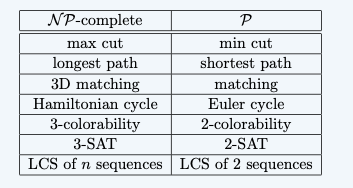
- Circuit SAT
- TSP
- Integer programming
Lecture18&19 Linear programming
Definition
- feasible solutions
- Feasible region
- Optimal solution
Duality
We can alternatively solve the dual to find the optimal objective value.
An optimal dual solution can be used to derive an optimal primal solution (complementary slackness).
The dual may have structure making it easier to solve at scale (e.g., via parallel optimization).

7-step dualization
formulating LPs
- Turn other forms of problems into LP or IP
边栏推荐
- 爬虫基础—WEB网页基础
- 用for循环怎么输出数字菱形啊
- m基于MATLAB-GUI的GPS数据经纬度高度解析与kalman分析软件设计
- How to record enterprise or personal domain names
- 9. Account and authority
- Pytorch learning diary (4)
- 听说今天发博客能领徽章!
- Speed feedback single closed loop DC speed regulation system based on Simulink
- Recursive access to directories, print Fibonacci sequences, high-order functions
- Crawler Basics - session and cookies
猜你喜欢

Component emit Foundation

Data protection / disk array raid protection IP segment 103.103.188 xxx

Pytorch learning diary (4)

用for循环怎么输出数字菱形啊

Review of Linear Algebra

网络知识-02 物理层

网络知识-03 数据链路层-以太网

regular expression

My world 1.18.1 forge version open service tutorial, can install mod, with panel

Steam game high frequency i9-12900k build cs:go server
随机推荐
Network knowledge-05 transport layer TCP
M analysis of anti-interference performance of high-speed frequency hopping communication system based on Simulink
9. Account and authority
Network knowledge-04 network layer ICMP Protocol
剑指Offer刷题记录——Offer 07.重建二叉树
字典、元組和列錶的使用及區別,
Sword finger offer question brushing record - offer 07 Rebuild binary tree
网络知识-04 网络层-IPv6
Quickly master the sort command and tr command
Nanny level one-stop service - self correlation to construct parent-child relationship (@jsonbackreference and @jsonmanagedreference solve circular dependency)
MySQL decompression installation steps (Windows)
Solution to the conflict between security automatic login and anti CSRF attack
论文阅读:Deep Residual Shrinkage Networksfor Fault Diagnosis
What role does 5g era server play in this?
Connaissance du réseau - 03 couche de liaison de données - PPPoE
Quickly learn to use cut command and uniq command
linux下执行shell脚本调用sql文件,传输到远程服务器
wcdma软切换性能matlab仿真m,对比平均激活集数(MASN)、激活集更新率(ASUR)及呼叫中断概率(OP)三个性能指标
剑指Offer刷题记录——Offer 04. 二维数组中的查找
TypeScript(一)