当前位置:网站首页>M simulation of cooperative MIMO distributed space-time coding technology based on MATLAB
M simulation of cooperative MIMO distributed space-time coding technology based on MATLAB
2022-07-19 07:07:00 【I love c programming】
Catalog
3. Preview of some simulation drawings
4. Source code acquisition method
1. Algorithm description
be based on matlab Cooperation mimo Simulation of distributed space-time coding technology , Including rules LDPC cascade D-STBC,ML,ZF,DFE equilibrium ,Fincke-Pohst-MAP Algorithm detection . take The rules LDPC Join this collaboration MIMO Of D-STBC in , That is, will LDPC Code and D-STBC cascade , The sender uses LDPC Send the code to the collaboration node , Then the collaboration node uses D-STBC Forward to the sender in the form of code . To make a ML、ZF-OSIC and ,RLS-MIMO-DFE Performance comparison of bit error rate of three detection algorithms ( Be careful : During the process from the sender to the relay cooperation node , There are three protocols for the processing of source signals by relay cooperative nodes : Amplify and forward , Decoding, forwarding and coding cooperation , Therefore, the three detection algorithms under these three protocols should be done separately ), as well as LDPC And D-STBC Combined collaboration MIMO The system has nothing to do with LDPC Code collaboration MIMO Of D-STBC The system is in ML Performance comparison under detection algorithm ( Only do “ Coding collaboration agreement ” Next ). Compare LDPC cascade D-STBC Cooperation MIMO Under the system , The detection at the receiving end adopts ML Algorithm and Fincke-Pohst MAP.
2. Partial procedure
clc;
clear;
close all;
warning off;
addpath(genpath(pwd));
% QQ   : 1480526168
%  WeChat  : lovemike121
% matlab/FPGA Project cooperation

Nt            = 2;
Nr            = 2;
Frame_Length  = 512;
Error_Num     = 1000000;% Count the number of errors
EbNo          = 0.5:0.5:4.5;
P             = 2;
QMod          = modem.pskmod('M',P,'PhaseOffset',0);
QDemod        = modem.pskdemod(QMod);
q             = modulate(QMod,0:1);
Q             = q;

for i = 2:Nt
    Q = [q(reshape(repmat(1:2, length(Q),1),1,2*length(Q)));repmat(Q,1,2)];
end

%LDPC Parameters
N        = Frame_Length;% Set parity matrix size
M        = N/2;
max_iter = 99;                 % Maximum number of iterations

load H2;
load G2;

BERs = zeros(1, length(EbNo));

for kk = 1:length(EbNo)
    kk
    totalNumErr = 0;
    count       = 0;
    SNR         = 10^(EbNo(kk)/10);
    N0          = 2*10^(-EbNo(kk)/10);
    sigma       = 1/(sqrt(SNR)/2);

    ii          = 0;
    Dsd         = 36;          %db Count
    Dsr         = 36;
    Drd         = 36;
    Qsd         = sqrt(10^(Dsd/10));
    Qsr         = sqrt(10^(Dsr/10));
    Qrd         = sqrt(10^(Drd/10));

    LL          = 2;

    while (totalNumErr < Error_Num)
        kk
        totalNumErr

        % Generate data
        data       = round(rand(1,N-M));
        %LDPC code
        u          = mod(data*G,2);
        %BPSK
        tx         = 2*u - 1;

        % Coding collaboration agreement
        Trans_N1    = tx(1:N-M);        %N1 Sequence
        Trans_N2    = tx(N-M+1:2*(N-M));%N2 Sequence
        %ii=1 When , Send your own codeword , and ii=2 Send the cooperative codeword when , So as to achieve the effect of time slot
        ii          = ii + 1;

        % take N1 Send to destination
        % take N1 Send to destination
        % As the sending source
        % Conduct AF relay
        % Channel gain
        Hsd=Qsd*(randn);
        Hsr=Qsr*(randn);
        Hrd=Qrd*(randn);
        % Amplification gain of cooperative nodes
        B=sqrt(1/(abs(Qsr)^2*1));
        %===============================
        % The weighting factor of the maximum merger ratio is calculated ( The first i The variable gain weighting coefficient of each branch is the ratio of the signal amplitude of the diversity path to the noise power )
        % Calculate the gain
        A0=conj(Hsd)/(1/(sqrt(LL)*EbNo(kk)));
        A1=B*conj(Hsr)*conj(Hrd)/((B^2*(abs(Hsr))^2+1)*(1/(sqrt(LL)*EbNo(kk))));
        % receive
        MIMO_Rx =  Trans_N1/max(abs(Trans_N1))+ 1/(sqrt(SNR))*randn(size(Trans_N1));
        Ysr      = Hsr*MIMO_Rx;
        Yrd      = Hrd*Ysr*B;
        Ysd      = Hsd*MIMO_Rx;
        Y        = A0*Ysd+A1*Yrd;
        % Received binary signal
        MIMO_Rx1 = Y;
        Rec_data1= sign(MIMO_Rx1);

        % take N1 Send to user 2
        % take N1 Send to user 2
        % receive
        MIMO_Rx2   = Trans_N1/max(max(Trans_N1))+ 1/(sqrt(SNR))*randn(size(Trans_N1));
        Ysr        = Hsr*MIMO_Rx2;
        Yrd        = Hrd*Ysr*B;
        Ysd        = Hsd*MIMO_Rx2;
        Y          = A0*Ysd+A1*Yrd;
        % Received binary signal
        MIMO_Rx12  = Y;
        Rec_data12 = sign(MIMO_Rx2);

        % Second time slot , user 2 Send the user to the destination 1 The second frame signal of , The user 2 Recoded about U1 In groups N2 Bit check the modulation signal corresponding to the codeword
        % stay USER2 in , Will receive N1 The sequence is recoded , Then put the sequence N2 Send to destination
        rec_datas              = -1*(Rec_data12-1)/2;
        Ldpc_trans_data_user2  = mod(data*G,2);
        Trans_N2_user2         = Ldpc_trans_data_user2(N-M+1:2*(N-M));%N2 Sequence
        Trans_N2_user3         = 2*Trans_N2_user2-1;

        %--------------------- Collaboration MIMO----------------------------------
        Hsd=Qsd*(randn);
        Hsr=Qsr*(randn);
        Hrd=Qrd*(randn);
        % Amplification gain of cooperative nodes
        B=sqrt(1/(abs(Qsr)^2*1));
        %===============================
        % The weighting factor of the maximum merger ratio is calculated ( The first i The variable gain weighting coefficient of each branch is the ratio of the signal amplitude of the diversity path to the noise power )
        % Calculate the gain
        A0=conj(Hsd)/(1/(sqrt(LL)*EbNo(kk)));
        A1=B*conj(Hsr)*conj(Hrd)/((B^2*(abs(Hsr))^2+1)*(1/(sqrt(LL)*EbNo(kk))));
        % receive
        MIMO_Rx =  Trans_N2/max(abs(Trans_N2))+ 1/(sqrt(SNR))*randn(size(Trans_N2));
        Ysr      = Hsr*MIMO_Rx;
        Yrd      = Hrd*Ysr*B;
        Ysd      = Hsd*MIMO_Rx;
        Y        = A0*Ysd+A1*Yrd;
        % Received binary signal
        MIMO_Rx2 = Y;
        Rec_data2= sign(MIMO_Rx2);


        YY1 = [MIMO_Rx12,MIMO_Rx2]';
        YY2 = [Rec_data12,Rec_data2]';

        Tx          = reshape(YY2,Nt, Frame_Length/Nt);
        RayleighMat = (rand(Nr, Nt) + j*rand(Nr, Nt));
        rr          = size(RayleighMat*Tx,1);
        cc          = size(RayleighMat*Tx,2);
        r           = awgn(RayleighMat*Tx, inf);
        Hs          = RayleighMat;
        HQ          = Hs*Q;

        ahat        = zeros(Nt,Frame_Length/Nt);

        yy2 = func_FP_MAP(r',(2*Nt)*(2/(SNR)),RayleighMat,[-1 1]);

        tmps        = demodulate(QDemod,yy2);
        Rec_data    = reshape(tmps,1,Frame_Length);

        %LDPC decoding
        Rec_data(find(Rec_data==0)) =-1;
        Rec_data                    =-1*Rec_data;
        z_hat = func_Dec(Rec_data,N0,H,max_iter);
        x_hat = z_hat(size(G,2)+1-size(G,1):size(G,2));

        %===========================================================================
        count       = count + 1;
        totalNumErr = totalNumErr + biterr(x_hat', data);
    end

    BERs(kk) = totalNumErr/(count*Frame_Length);

end

figure;
semilogy(EbNo,BERs,'r-o');
grid on;
% save Fincke_Pohst_MAP.mat EbNo BERs
3. Preview of some simulation drawings
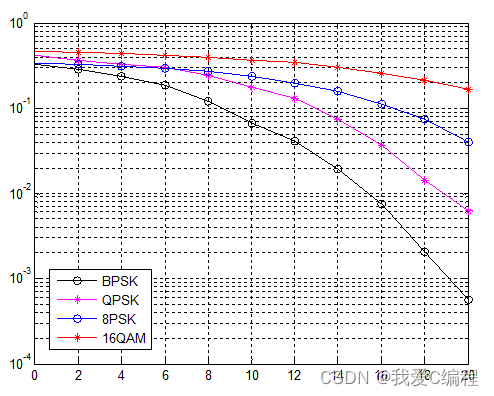


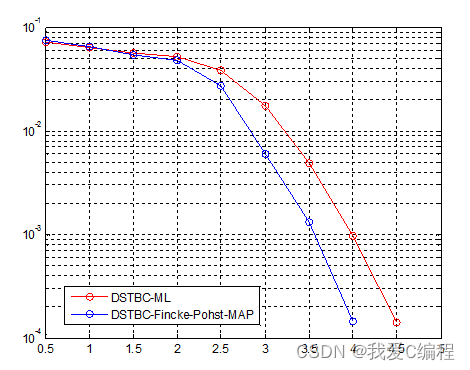
4. Source code acquisition method
Get the way 1:
Click the download link :
Access method 2:
Blog resource item , Search for resources with the same name as blog .
Access method 3:
If the download link fails , Blogger wechat contact .
01_050_m
边栏推荐
- The use and differences of dictionaries, tuples and lists,
- 1. What is a server?
- Xiaodi network security - Notes (2)
- Minecraft bedrock BDS service tutorial
- 103.53.124. What is the difference between X IP BGP line and ordinary dedicated line
- Personal information management system
- Class and super, inheritance
- Minecraft Paper 1.18.1 版开服教程,我的世界开服教程,MCSManager9面板使用教程
- Zuul路由的映射规则配置
- m基于Simulink的高速跳频通信系统抗干扰性能分析
猜你喜欢

基于simulink的转速反馈单闭环直流调速系统
My world 1.12.2 Magic Baby (Fairy treasure dream) service opening tutorial

爬虫基础—WEB网页基础

Xiaodi network security - Notes (4)

UCloud(优刻得) 上海 ARM 云服务器评测

Performance evaluation and comparison of lightweight application servers of major cloud service manufacturers, Alibaba cloud, Tencent cloud, Huawei cloud, and ucloud

m在VBLAST协作MIMO系统分部使用LDPC,Turbo,卷积三种信道编译码进行误码率matlab仿真

103.53.124.X IP段BGP线路和普通的专线有什么区别

正则表达式

m3GPP-LTE通信网络中认知家庭网络Cognitive-femtocell性能matlab仿真
随机推荐
Minecraft基岩版BDS开服教程
阿里云 杭州 ARM 云服务器性能评测
[untitled]
Text three swordsman's awk command -- interception
Decipher password (comprehensive)
Weight matching (greedy)
阿里云、腾讯云、华为云、Ucloud(优刻得)、天翼云 的云服务器性能测试和价格对比
5G时代服务器在这里面起着什么作用?
m基于matlab的MIMO信道容量分析,对比了不同天线数量;非码本预编码SVD,GMD;码本预编码DFT,TxAA以及空间分集
传奇怎么开服?开传奇私服需要准备什么呢?
Xiaodi network security - note encryption coding algorithm (6)
Performance test and price comparison of cloud servers of Alibaba cloud, Tencent cloud, Huawei cloud, ucloud and Tianyi cloud
字典,集合的使用,数据类型的转换
剑指Offer刷题记录——Offer 05. 替换空格
What role does 5g era server play in this?
Servlet 笔记
爬虫基础—代理的基本原理
STEAM游戏高主频i9-12900k 搭建CS:GO服务器
正则表达式,生成器,迭代器
Mapping rule configuration of zuul route