当前位置:网站首页>Review of 4246 Algorithms for Data Science
Review of 4246 Algorithms for Data Science
2022-07-17 05:23:00 【Alex Tech Bolg】
Contents
- Important algorithms
- Note
- Lecture1: Insertion sort, efficient algorithm
- Lecture2: Merge sort
- Lecture3: Binary search, quicksort
- Lecture5: Graphs, Breadth-First Search (BFS)
- Lecture6: Depth-first search, topological sorting
- Lecture7&8: Strongly connected components, single-origin shortest paths in weighted graphs
- Lecture12: Data compression and Huffman coding
- Lecture9: The dynamic programming principle; segmented least squares
- After midterm
- Lecture 11 Shortest paths in weighted graphs (Bellman-Ford)
- Lecture 15&16 Network flows
- Lecture 20&21 Reductions; independent set and vertex cover; decision problems
- Lecture 22 Satisfiability problems: SAT, 3SAT, Circuit-SAT
- Lecture 23&25 Representative NP-complete problems: TSP, Set Cover
- Lecture18&19 Linear programming
Important algorithms
- Sort: Insertion sort, merge sort, quick sort
- Binary search
- Graph: BFS、DFS and their application
- Greedy: Dijkstra’s algorithm and improved implementation
- Dynamic programming: Bellman-Ford
- Network flow: Ford-Fulkerson algorithm
- NPC: Vertex Cover(D), Independent Set(D), SAT, 3SAT, integer programming
- Linear programming (integer programming)
Note
重点是理解各种算法的应用以及时间复杂度。
Lecture1: Insertion sort, efficient algorithm
Insertion sort
Analysis of algorithms
- Correctness: Proof by induction.
- Running time: Best case: 5n − 4; worst case. 3n^2 + 7n − 4
- Space: in-place algorithm
Efficient algorithms (polynomial running time)
Lecture2: Merge sort
Asymptotic notation
- Asymptotic upper bounds: Big-O notation
- Asymptotic lower bounds: Big-Ω notation
- Asymptotic tight bounds: Θ notation
- Asymptotic upper bounds that are not tight: little-o
- Asymptotic lower bounds that are not tight: little-ω
Divide & conquer principle, application: merge sort
- Correctness
- Running time: O(nlogn)
- Space: Θ(n)
Solving recurrences and running time of merge sort
- recursion trees
- Master theorem
Lecture3: Binary search, quicksort
Binary search
- Running time: O(log n)
Quicksort
- divide and conquer
- Space: in-place
- Running time:
- Its worst-case running time is Θ(n^2) but its average-case running time is Θ(nlogn)
- Correctness:
- strong induction (the induction step at n requires that the inductive hypothesis holds at all steps 1, 2, …, n−1 and not just at step n−1, as with simple induction.)
Lecture5: Graphs, Breadth-First Search (BFS)
Definition
- Undirected / directed
- Simple: all vertices are distinct.
- An undirected graph is connected when there is a path between every pair of vertices.
- The connected component of a node u is the set of all node in the graph reachable by a path from u.
- A directed graph is strongly connected if for every pair of vertices u, v, there is a path from u to v and from v to u.
- The strongly connected component of a node u in a directed graph is the set of nodes v in the graph such that there is a path from u to v and from v to u.
- Tree: connected acyclic graph
- Bipartite graphs
- Degree theorem
- Linear graph algorithms run in O(n+m) time
Representing graphs
- adjacency matrix
- adjacency list
Breadth-first search (BFS)
- queue: FIFO data structure
- s-t connectivity
- shortest s-v paths in unweighted graphs.
- Connected components in undirected graphs
- Testing bipartiteness & graph 2-colorability
- SCC(u): SCC of node u
- All SCC: but not linear
Lecture6: Depth-first search, topological sorting
Depth-first search (DFS)
- stack: LIFO (Last-In First-Out)
- s-t connectivity
- Cycle detection
- Topological sorting in DAGs (directed acyclic graph)
- Run DFS(G); compute finish times.
- Process the tasks in decreasing order of finish times.
- Running time: O(m+n)
- different edges: forward, back, cross --> time intervals for vertices
- Undirected graphs: find all connected components
- SCC(u): SCC of node u
- All SCC: linear
- Compute Gr.
- Run DFS(Gr); compute finish(u) for all u.
- Run DFS(G) in decreasing order of finish(u).
- Output the vertices of each tree in the DFS forest of line 3 as an SCC.
Lecture7&8: Strongly connected components, single-origin shortest paths in weighted graphs
Applications of DFS: Strongly connected components
(combine it with the above)
Shortest paths in graphs with non-negative edge weights (Dijkstra’s algorithm)
- Greedy principle
- implementation and improved implementation
- running time
Lecture12: Data compression and Huffman coding
- Prefix codes and trees
- The Huffman algorithm
Lecture9: The dynamic programming principle; segmented least squares
- Overlapping subproblems
- An easy-to-compute recurrence
- Iterative, bottom-up computations
- Segmented least squares
- Sequence alignment
After midterm
Lecture 11 Shortest paths in weighted graphs (Bellman-Ford)
- Bellman-Ford algorithm (DP solution)
- OPT (i, v) = cost of shortest s-v path using at most I edges
- 二维数组: time: O(nm), space: O(n^2)
- Pseudocode: M [i, v]
- 一维数组: time: O(nm), space: O(n)
- Early termination condition: if at some iteration I no value in M changed, then stop.
- Pseudocode: M[v] similar to Dijkstra algorithm
- Detecting negative cycle
- Update all edges n times (1 more time)
Lecture 15&16 Network flows
Definition:
- Capacity constrains
- Flow conservation
- |f| = f_out
- Max flow and min cut
Residual graph and augmenting paths
- Residual graph (forward, backward)
- P is simple path. Augment f by pushing extra flow on P
- Bottleneck
Ford-Fulkerson algorithm
- Running time: O(nmU) —— pseudo-polynomial
- Correctness
- Application: max bipartite matching
- Reduction (Forward direction, Reverse direction)
Lecture 20&21 Reductions; independent set and vertex cover; decision problems
Reduction:
- x of X
- y=R(x) of Y
Reduction as a means to design efficient algorithm
- Y has polynomial computational steps
- Call polynomial number of Y
- X <= pY
Reduction as a means to argue about hard problems
- X <= p Y
- Y is at least as hard as X
- If X cannot be solved in polynomial time, then Y cannot.
- Relative level of difficulty: X <= pY, Y <= pX
Two hard problems
- Independent set
- Vertex cover
Optimization versions for IS and VC
- Max independent size
- Min vertex cover
Decision version of optimization problems
- Yes/no answer
- Max – lower, min – upper
Rough equivalence of decision & optimization problems
- Suppose we have an algorithm to solve MIS we can use it to solve IS(D)
- Suppose we have an algorithm to solve IS(D) we can use it to solve MIS
Reduction from Independent Set to Vertex Cover
- Forward direction
- Reverse direction
Class P
- Set of decision problems that can be solved by polynomial-time algorithm.
(引出NP)
- If we were given a solution S for such a problem X(D), we could check if it is correct quickly.
- Such an S is a succinct certificate that x 属于X(D)
Class NP
An efficient certifier (or verification algorithm) B for a problem X(D) is a polynomial algorithm that
- Takes two input arguments: instance x (which is a specific input of the problem) and the short certificate t
- B(x, t) = yes and |t| <= Poly(|x|), then we have x 属于 X(D)
Set of decision problems that have an efficient certifier.
P vs NP
- P 属于 NP
- P = NP ?
- Why would NP contain more problems than P? Intuitively, the hardest problems in NP are the least likely to belong to P
NPC
- The hardest problems
- NPC X(D) 定义:
- If X(D) 属于 NP
- For all Y 属于 NP, Y <= p X(D)
Show a problem is NP-complete
- Suppose we had an NP-complete problem X, to show Y is NPC, we only need to show:
- Y 属于 NP
- X <= p Y
- (相比根据定义证明NPC,这种方法只需要做一次reduction,简化了很多)
Lecture 22 Satisfiability problems: SAT, 3SAT, Circuit-SAT
Definition
- truth assignment
- A truth assignment satisfies a clause if it causes the clause to evaluate to 1.
- A formula φ is satisfiable if it has a satisfying truth assignment.
Satisfiability (SAT) and 3SAT
- SAT: Given a formula φ in CNF with n variables and m clauses, is φ
satisfiable? - 3SAT: Given a formula φ in CNF with n variables and m clauses such that each clause has exactly 3 literals, is φ satisfiable?
The art of proving NP-completeness
- Circuit-SAT ≤p SAT
- SAT ≤P 3SAT
- 3SAT ≤p IS(D)
Lecture 23&25 Representative NP-complete problems: TSP, Set Cover
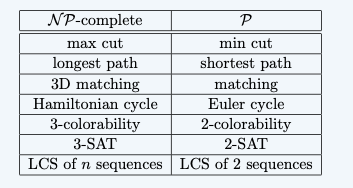
- Circuit SAT
- TSP
- Integer programming
Lecture18&19 Linear programming
Definition
- feasible solutions
- Feasible region
- Optimal solution
Duality
We can alternatively solve the dual to find the optimal objective value.
An optimal dual solution can be used to derive an optimal primal solution (complementary slackness).
The dual may have structure making it easier to solve at scale (e.g., via parallel optimization).

7-step dualization
formulating LPs
- 将其他形式的问题转化为LP或IP
边栏推荐
- 1.服务器是什么?
- M FPGA implementation of chaotic digital secure communication system based on Lorenz chaotic self synchronization, Verilog programming implementation, with MATLAB chaotic program
- 递归访问目录,打印斐波那契数列,高阶函数
- SYN洪水攻击的原理,syn洪水攻击的解决办法
- 闭包与装饰器
- 字典、元組和列錶的使用及區別,
- 类与对象
- M analysis of anti-interference performance of high-speed frequency hopping communication system based on Simulink
- 【无标题】
- Crawler Basics - session and cookies
猜你喜欢

网络知识-04 网络层-ICMP协议

cookie、session的配置和使用

Quickly learn to use cut command and uniq command
![[ restartedMain] o.s.b.d.LoggingFailureAnalysisReporter :](/img/dd/054af819c8bdca31bd135495386fb4.png)
[ restartedMain] o.s.b.d.LoggingFailureAnalysisReporter :

Review summary of MySQL

The principle of SYN Flood attack and the solution of SYN Flood Attack

Mapping rule configuration of zuul route

传奇游戏架设教程

数据分析及可视化——京东上销量最高的鞋子

m基于MATLAB-GUI的GPS数据经纬度高度解析与kalman分析软件设计
随机推荐
字典、元组和列表的使用及区别,
组件emit基础
传奇游戏架设教程
web安全(xss及csrf)
IP103.53.125. XXX IP address segment details
9.账户和权限
TypeScript(ts-loader,tsconfig.json及lodash)
How do you know whether the network needs to use advanced anti DDoS server? How to choose the computer room is also very important, as well as the stability of the later business
9. Account and authority
TypeScript(一)
M BTS antenna design based on MATLAB, with GUI interface
Quickly learn to use cut command and uniq command
How to open the service of legendary mobile games? How much investment is needed? What do you need?
103.53.124. What is the difference between X IP BGP line and ordinary dedicated line
Matlab simulation of cognitive femtocell performance in m3gpp LTE communication network
保姆级一条龙服务——自关联构造父子级关系(@JsonBackReference和@JsonManagedReference解决循环依赖)
传奇手游怎么开服?需要投资多少?需要那些东西?
m在VBLAST协作MIMO系统分部使用LDPC,Turbo,卷积三种信道编译码进行误码率matlab仿真
Fundamentals of reptiles - basic principles of reptiles
pytorch张量