当前位置:网站首页>"Baidu side" angrily sprayed the interviewer! Isn't it that the tree time increases by a line number?
"Baidu side" angrily sprayed the interviewer! Isn't it that the tree time increases by a line number?
2022-07-19 10:41:00 【Mona Lisa's Java】
A few days ago , A round of Baidu interview questions from a former colleague , It's not too hard , And then came up with , I joked with the interviewer because the topic was simple . If you have time, you may as well have a look at it as a dessert (o)/~
Personally, I feel that this belongs to the kind of topic that I will definitely meet when I see it , If you haven't been exposed to this kind of similar leetcode In terms of the title , Think about it is relatively simple .
But it's still out today , Share with you
The story begins →_→
1
subject
It is required to print out the tree information in the following format , Looking at the very intuitive print results

Required output format
A -> first line B C -> The second line D E F -> The third line G H -> In the fourth row
It is to print nodes according to the given format
2
Solution
It is obvious that , While achieving this result , The general solution must be based on the way we have seen in the past
While traversing the hierarchy , Record the actions of each line feed operation
Before all this , Let's give the node information first , So that the binary tree in the figure can be operated clearly later
【 utilize Python see , Simple and intuitive 】
class TreeNode:
def __init__(self, value):
self.val = value
#  Node values
self.left = None
#  To be a child
self.right = None
#  Point to the right child
Need to review the level of traversal code can turn to the end of the article , The display of hierarchical traversal is carried out , Here's the past C Language implementation code
Because the topic requires printing node information at the same time , Information about the row and column of the node is required
Using the characteristics of hierarchical traversal ( a key ! a key ! a key ! After all node elements of the current layer are queued , The last node element of the upper layer will pop up ), Initialize two pointers last and cur
- last Point to the rightmost node of the upper layer
- cur Is the current node location 【 The node entered into the queue 】
Only when the element pops up And last Points to the same node , explain cur Also traversed to the right side of the current layer . here , Can make last = cur
The detailed process , Look below [ Long, long, long …] chart 【 Click to enlarge 】
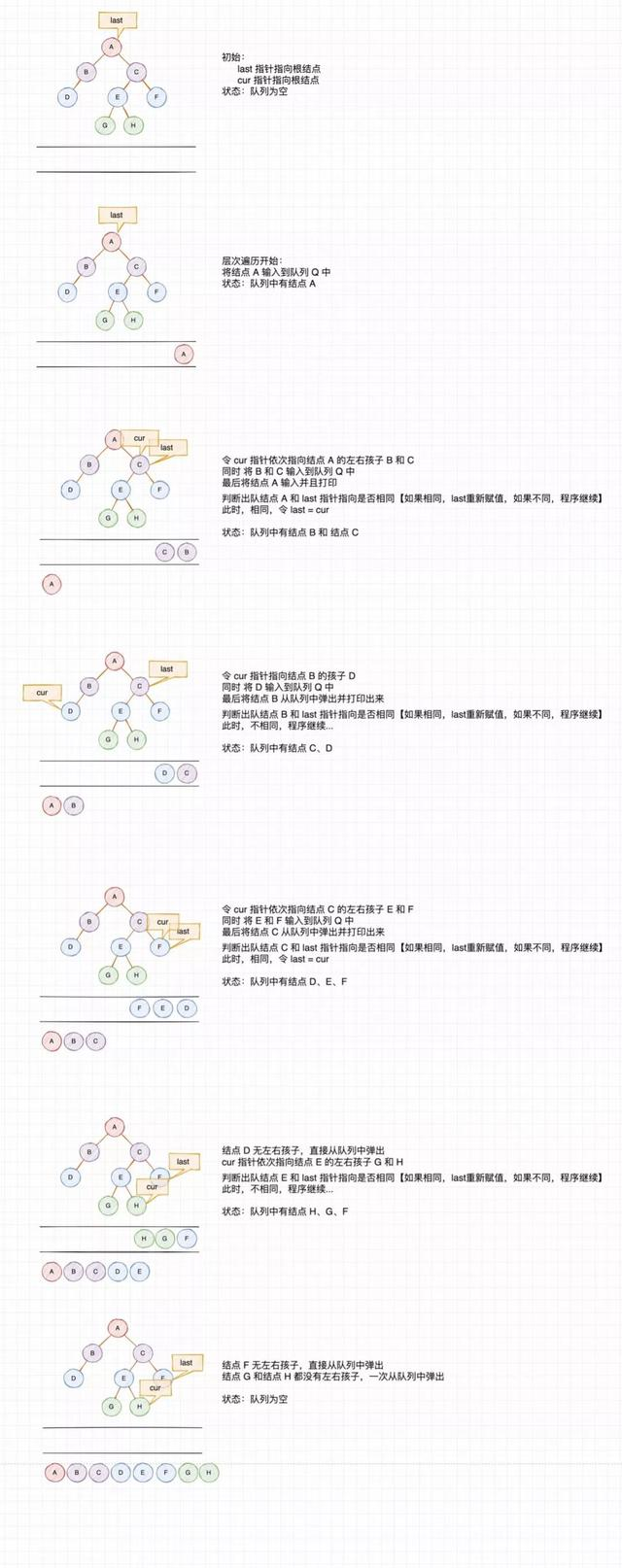
above , Based on the given tree structure, detailed description is given , For your reference . Another person doesn't like moving pictures very much , The reason is that when you want to see every step clearly , It's not easy to control
For queue operations , utilize Python Of list The data structure is implemented in the following way
#  The team list.append('A')
#  Out of the team list.append(0)
Here's the full code , And give the code of the construction tree that has been traversed hierarchically
3
Complete code
It can be directly posted to your own environment for implementation ~
# -*- coding:utf-8 -*-
# !/usr/bin/env python
#  Tree node class class TreeNode:
def __init__(self, value):
self.val = value
self.left = None
self.right = Nonedef level_order_traverse(root):
if not root:
return
#  queue queue
queue = [root]
while len(queue) > 0:
node = queue.pop(0)
print(node.val, end=" ")
if node.left:
queue.append(node.left)
if node.right:
queue.append(node.right)def level_order_traverse_datail(root):
last, n_last = root, root
i = 1
if not root:
return
#  queue queue
queue = [root]
while len(queue) > 0:
node = queue.pop(0)
print(node.val, end=" ")
if node.left:
n_last = node.left
queue.append(node.left)
if node.right:
n_last = node.right
queue.append(node.right)
#  When the pop-up node is last Point to the node of , Make  last = n_last
if last is node:
last = n_last
print(" ->  The first  %d  That's ok " % i)
i = i + 1if __name__ == "__main__":
#  The new node
node_A = TreeNode("A")
node_B = TreeNode("B")
node_C = TreeNode("C")
node_D = TreeNode("D")
node_E = TreeNode("E")
node_F = TreeNode("F")
node_G = TreeNode("G")
node_H = TreeNode("H")
#  Building a binary tree
#      A
#    /   \
#   B     C
#  /     / \
# D     E   F
#      / \
#     G   H
node_A.left, node_A.right = node_B, node_C
node_B.left = node_D
node_C.left, node_C.right = node_E, node_F
node_E.left, node_E.right = node_G, node_H
#  Print node elements
print(" Hierarchy traversal results :")
level_order_traverse(node_A)
print("\n Hierarchy traversal results ( Print line number ):")
level_order_traverse_datail(node_A)
Due to the length limitation of the article , Please click the business card below to receive the interview information displayed above
↓↓↓
边栏推荐
猜你喜欢






随机推荐
Avi 部署使用指南(2):Avi 架构概述
因果学习将开启下一代AI浪潮?九章云极DataCanvas正式发布YLearn因果学习开源项目
LeetCode 2315. 统计星号(字符串)
华为防火墙认证技术
Brush questions with binary tree (2)
37. flex布局
LeetCode 2335. 装满杯子需要的最短总时长
华为机试:连续出牌数量
高数__方程与函数的关系
Studio 3T unlimited trial
openfoam热流边界条件
How to use SVG to make text effects arranged along any path
移植吴恩达深度学习01机器学习和神经网络第二周神经网络基础编程作业选修作业到pycharm
爱可可AI前沿推介(7.17)
追根问底:Objective-C关联属性原理分析
微信小程序云开发 1 - 数据库
HCIA rip experiment 7.11
LeetCode 2325. 解密消息(map)
新能源赛道已经高位风险,提醒大家注意安全
Crud code practice of user management based on koa2 + MySQL