当前位置:网站首页>Depth first search (DFS for short)
Depth first search (DFS for short)
2022-07-19 06:35:00 【Watermelon that loves programming】
Text begins :
Depth-first traversal (Depth First Search, abbreviation DFS) With breadth first traversal (Breath First Search) Two very important algorithms in graph theory , It is widely used in topological sorting in production , Pathfinding ( Labyrinth ), Search engine , Reptiles, etc , It also appears frequently in leetcode, High frequency interview questions .
Preface
Depth-first traversal (Depth First Search, abbreviation DFS) With breadth first traversal (Breath First Search) Two very important algorithms in graph theory , It is widely used in topological sorting in production , Pathfinding ( Labyrinth ), Search engine , Reptiles, etc , It also appears frequently in leetcode, High frequency interview questions .
This article will talk about depth first traversal from the following aspects , Breadth first traversal , I'm sure you'll get something .
Depth-first traversal
- Introduction to depth first traversal
- Exercise exercise
- DFS,BFS Applications in search engines
Depth first traversal resume
The main idea is to extract an unreachable vertex from the graph V Start , Go all the way to the end , Then back from the node at the end of the road to the previous node , Start from another road to the end …, Repeat this process recursively , Until all the vertices are traversed , It is characterized by not hitting the south wall and not looking back , Go one way first , Another way to go .
Tree is a special case of graph ( A connected acyclic graph is a tree ), Next let's see how to traverse a tree with depth first .

1、 We're from the root node 1 To traverse the , Its adjacent nodes have 2,3,4, First traverse the nodes 2, Re traversal 2 Child nodes of 5, And I'm going to go through it again 5 Child nodes of 9.

2、 One of the roads in the picture above has come to the end (9 It's a leaf node , No more traversable nodes ), From now on 9 Fallback to previous node 5, Take a look at the nodes 5 Is there anything else besides 9 Other nodes , Didn't go back to 2,2 It's not except 5 Other nodes , Back to 1,1 Division 2 Other nodes 3, So from the node 3 Start depth first traversal , as follows :
3、 Similarly, from 10 Start going back up to 6, 6 There is no division 10 Other child nodes , Go back up , Find out 3 Division 6 The other way around 7, So it's going to traverse 7.

4、 from 7 Go back to 3, 1, Find out 1 And nodes 4 Not traversing , So this time along 4, 8 Traversal , This completes the traversal .
The complete node traversal order is as follows ( The blue numbers on the nodes represent ):

I believe you can see that this is the pre order traversal of the tree , In fact, whether it's preamble traversal , Or middle order traversal , Or post order traversal , All belong to depth first traversal .
How to implement depth first traversal , There are two expressions of recursion and non recursion , Next, let's take binary tree as an example to see how to implement depth first traversal by recursion and non recursion respectively .
1、 Recursive implementation
Recursive implementation is relatively simple , Because it's preamble traversal , So we traverse the current node in turn , The left node , Right node , For left and right nodes , Just traverse their left and right nodes one by one , Recursion goes on and on , Until the leaf node ( Recursive termination condition ), The code is as follows :
public class Solution {
    private static class Node {
        /**
         *  Node values
         */
        public int value;
        /**
         *  The left node
         */
        public Node left;
        /**
         *  Right node
         */
        public Node right;

        public Node(int value, Node left, Node right) {
            this.value = value;
            this.left = left;
            this.right = right;
        }
    }

    public static void dfs(Node treeNode) {
        if (treeNode == null) {
            return;
        }
        //  Traversal node
        process(treeNode)
        //  Traverse the left node
        dfs(treeNode.left);
        //  Traverse the right node
        dfs(treeNode.right);
    }
}
Recursion is very expressive , And it's easy to understand , But if the hierarchy is too deep , It's easy to cause stack overflow . So let's focus on non recursive implementation .
2、 Non recursive implementation
Carefully observe the characteristics of depth first traversal , For a binary tree , Because it's traversal first ( First traverse the current node , Traverse left node again , Then traverse the right node ), So we have the following ideas :
For each node , First traverse the current node , Then stack the right node , Press the left node again ( In this way, when you play the stack, you will get the left node to traverse first , Meet the depth first traversal requirements ).
Bomb stack , Get the node at the top of the stack , If the node is not empty , Repeat step 1, If it is empty , End traversal .
Let's take the following binary tree as an example to see how to use stack to achieve DFS.
The overall dynamic diagram is as follows :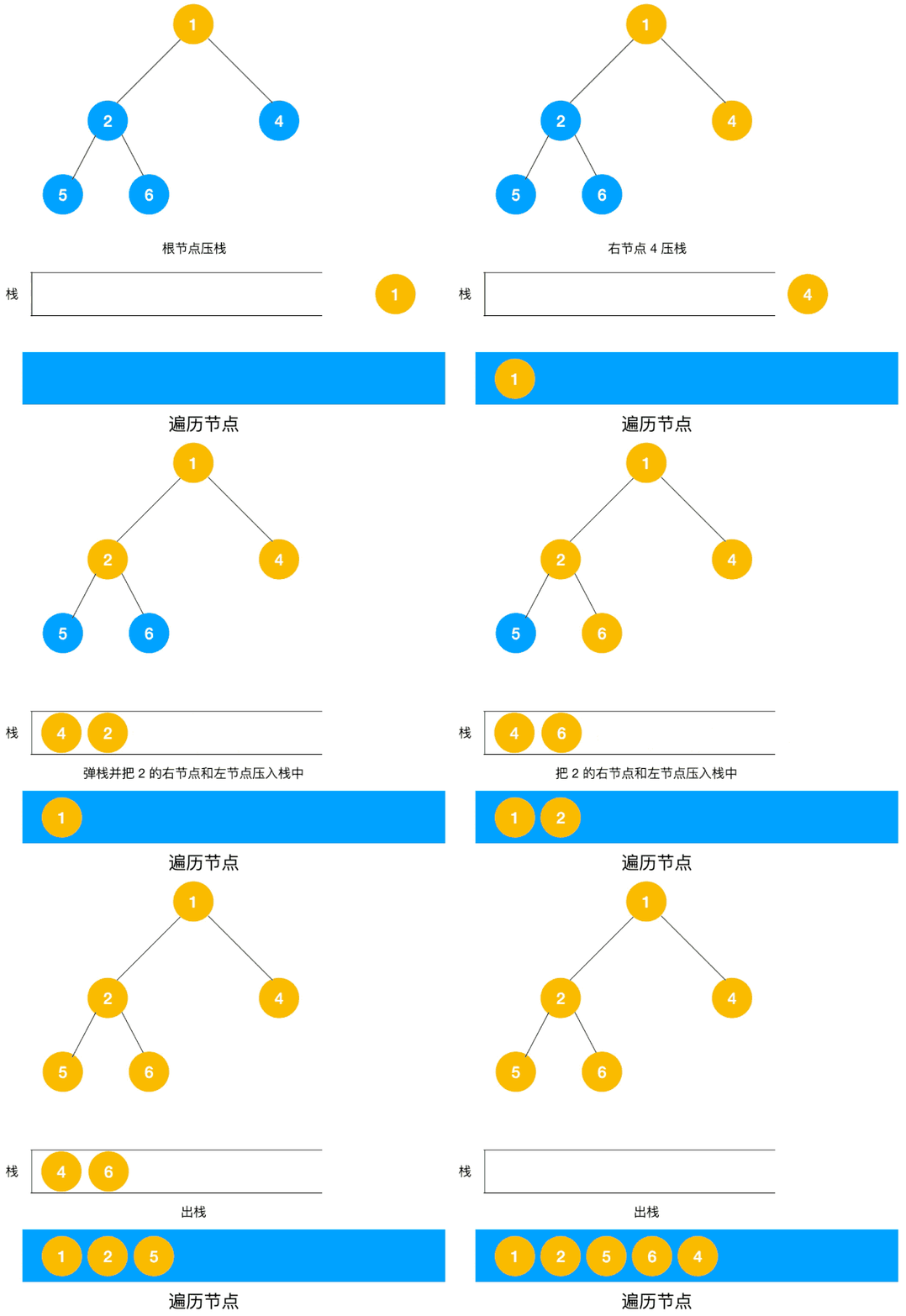
The overall thinking is relatively clear , Use the stack to stack the nodes to be traversed , Then check whether there is any node that has not been traversed after the stack , Some words press the stack , If you don't, keep going back ( Out of the stack ), A train of thought , It is not difficult to write the following binary tree depth first traversal code implemented by stack :
/**
 *  Using stacks to implement  dfs
 * @param root
 */
public static void dfsWithStack(Node root) {
    if (root == null) {
        return;
    }

    Stack<Node> stack = new Stack<>();
    //  First stack the root node
    stack.push(root);
    while (!stack.isEmpty()) {
        Node treeNode = stack.pop();
        //  Traversal node
        process(treeNode)

        //  Press the right node first
        if (treeNode.right != null) {
            stack.push(treeNode.right);
        }

        //  Press the left node again
        if (treeNode.left != null) {
            stack.push(treeNode.left);
        }
    }
}
You can see that it is not complicated to use stack to implement depth first traversal , And don't worry about stack overflow caused by too deep recursion .
ending
This is the depth first traversal algorithm I understand , If there's something wrong , Welcome to point out , thank you .
边栏推荐
- Salgaze: personalized gaze estimation using visual saliency
- DSL implements metrics aggregation
- 山西省第二届网络安全技能大赛(企业组)部分赛题WP(三)
- 数据库的查询(二)
- Quantum three body problem: an overview of numerical computation
- Acwing game 59 (AK)
- Unity2d learning Fox game production process 1: basic game character control, animation effects, lens control, item collection, bug optimization
- MEX and Increments
- 2022/07/14 learning notes (day07) array
- Mapping index attribute & operation of creating index
猜你喜欢

视图、索引文件的应用

Antd is not defined

【力扣】另一棵树的子树

Creation and implementation of WebService interface

Manjaro 系统日常使用入门导引

Talking about several solutions of cross domain

2022/07/12 learning notes (day05) cycle

无80和443端口下申请域名SSL证书(适用于 acme.sh 和 certbot)

实验二 类与对象定义初始化

EOG-based eye movement detection and gaze estimation for an asynchronous virtual keyboard基于EOG的异步虚
随机推荐
DSL implements bucket aggregation
Internship written examination answers
Local makefile compile other folder files specify obj directory
浅谈跨域的几种解决方案
2022/07/12 learning notes (day05) cycle
Vscode one dark and C extended variable color conflict settings JSON is as follows
Creation and implementation of WebService interface
2022/07/14 learning notes (day07) array
2022/07/09 group 5 Ding Shuai's study notes day02
Mapping index attribute & operation of creating index
Perceive the attention status of users on smart phones
Ehab the xorcist (XOR property, construction)
用头部运动学习无姿态注视偏差
【力扣】翻转二叉树
2022/07/12 learning notes (day05) JS built-in functions
手把手搭建家用 NAS 全能服务器(1)| 配置选择及准备
数据库的查询(二)
实验一 简单程序设计
EOG based eye movement detection and gaze estimation for an asynchronous virtual keyboard
Operation of documents in index library