当前位置:网站首页>Detailed explanation of extended physics informedneural networks paper
Detailed explanation of extended physics informedneural networks paper
2022-07-26 02:44:00 【Pinn Shanliwa】
author
- Ameya D. Jagtap1,∗ and George Em Karniadakis1,2
Periodical
- Communications in Computational Physics
date
- 2020
Code
1 Abstract
Propose a more flexible decomposition domain XPINN Method , Than cPINN Domain decomposition is more flexible , And use with all equations .
2 background
cPINN Through domain decomposition , Each area uses a small network for training , So that different regions can be calculated in parallel . Proposed by the paper XPINN have cPINN The advantages of domain decomposition , There are also the following advantages
- Generalized space-time domain decomposition,XPINN The formula provides highly irregular 、 Convex / Non convex space-time domain decomposition , Because of this decomposition XPINN The formula provides highly irregular 、 Convex / Non convex space-time domain decomposition
- XPINN The formula provides highly irregular 、 Convex / Non convex space-time domain decomposition
- Simple intermediate condition , stay XPINN in , For interfaces of any shape , The interface condition is very simple , Normal direction is not required , therefore , The proposed method can be easily extended to any complex geometry , Even higher dimensional geometry .
Accurately solve complex equations , In particular, high-dimensional equations have become one of the biggest challenges of Scientific Computing .XPINN Its advantages make it a candidate for such high-dimensional complex simulation , This high-dimensional simulation usually requires a lot of training costs .
3 XPINN Method
describe :
- Subdomains : Subdomain Ω q , q = 1 , 2 , ⋯ N s d \Omega_{q}, q=1,2, \cdots N_{s d} Ωq,q=1,2,⋯Nsd Is the entire computing domain Ω \Omega Ω Non overlapping subdomains of , Satisfy Ω = ⋃ q = 1 N s d Ω q \Omega=\bigcup_{q=1}^{N_{s d}} \Omega_{q} Ω=⋃q=1NsdΩq and Ω i ∩ Ω j = ∂ Ω i j , i ≠ j \Omega_{i} \cap \Omega_{j}=\partial \Omega_{i j}, i \neq j Ωi∩Ωj=∂Ωij,i=j Represents the number of decomposition fields , The intersection of subdomains is only at the boundary ∂ Ω i j \partial \Omega_{i j} ∂Ωij
- Interface : Represents the subnet corresponding to the common boundary of two or more subdomains (sub-Nets) To communicate with each other
- sub-Net: Son PINN It refers to the individuals with their own set of optimization super parameters used in each sub domain PINN
- Interface Conditions: These conditions are used to connect the decomposed subdomains , Thus, the solution of the governing partial differential equation on the complete field is obtained , According to the properties of the governing equation , One or more interface conditions can be applied to a common interface , Such as solution continuity 、 Flux continuity, etc
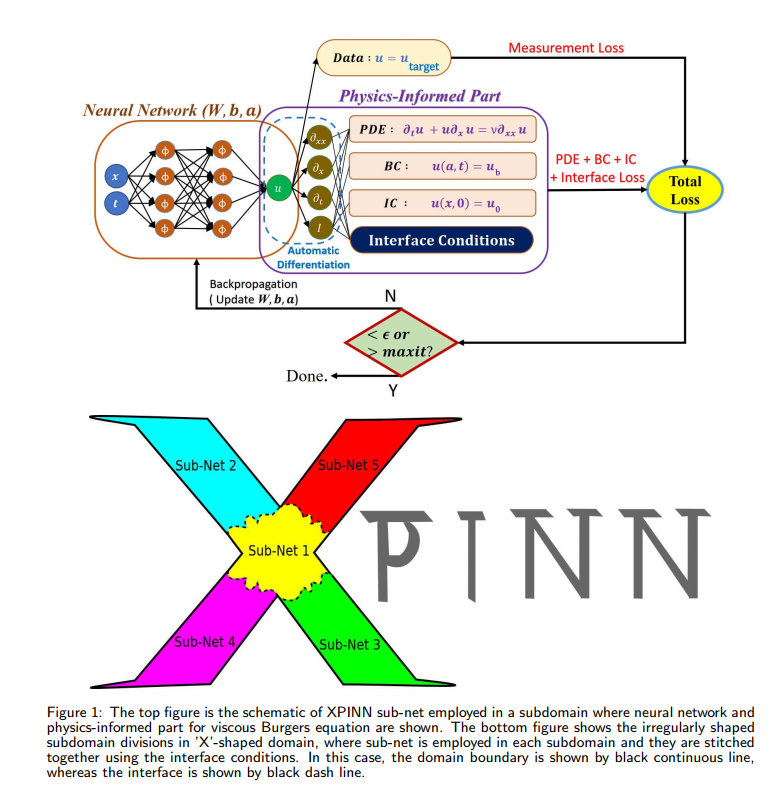
Above picture X Is the solution domain , The black solid line indicates the boundary of the area , The black dotted line indicates interface.XPINN Basic interface Conditions include strong form continuity conditions and in common interface Force the average solution given by different subnets .cPINN Mentioned in the text , For stability , There is no need to add the condition of average solution , But experiments also show that it will accelerate the convergence speed .XPINN have cPINN All the advantages of , Such as parallelization ability 、 Great presentation ability 、 An optimization method 、 Activation function 、 Efficient selection of super parameters such as network depth or width . And cPINN Different ,XPINN It can be used to solve any type of partial differential equation , Not necessarily the law of conservation . stay XPINN Under the circumstances , It is not necessary to find the normal direction to adopt the normal flux continuity condition . This greatly reduces the complexity of the algorithm , Especially in large-scale problems with complex fields and mobile interface problems .
The first q t h q^{t h} qth The neural network output of the subdomain is defined as
u Θ ~ q ( z ) = N L ( z ; Θ ~ q ) ∈ Ω q , q = 1 , 2 , ⋯ , N s d u_{\tilde{\mathbf{\Theta}}_{q}}(\mathbf{z})=\mathcal{N}^{L}\left(\mathbf{z} ; \tilde{\mathbf{\Theta}}_{q}\right) \in \Omega_{q}, \quad q=1,2, \cdots, N_{s d} uΘ~q(z)=NL(z;Θ~q)∈Ωq,q=1,2,⋯,Nsd
The final solution is defined as
u Θ ~ ( z ) = ∑ q = 1 N s d u Θ ~ q ( z ) ⋅ 1 Ω q ( z ) u_{\tilde{\mathbf{\Theta}}}(\mathbf{z})=\sum_{q=1}^{N_{s d}} u_{\tilde{\mathbf{\Theta}}_{q}}(\mathbf{z}) \cdot \mathbb{1}_{\Omega_{q}}(\mathbf{z}) uΘ~(z)=∑q=1NsduΘ~q(z)⋅1Ωq(z)
among
1 Ω q ( z ) : = { 0 if z ∉ Ω q 1 if z ∈ Ω q \ Common interface in the q t h subdomain 1 S if z ∈ Common interface in the q t h subdomain \mathbb{1}_{\Omega_{q}}(\mathbf{z}):=\left\{\begin{array}{ll} 0 & \text { if } \mathbf{z} \notin \Omega_{q} \\ 1 & \text { if } \mathbf{z} \in \Omega_{q} \backslash \text { Common interface in the } q^{t h} \text { subdomain } \\ \frac{1}{\mathcal{S}} & \text { if } \mathbf{z} \in \text { Common interface in the } q^{t h} \text { subdomain } \end{array}\right. 1Ωq(z):=⎩⎨⎧01S1 if z∈/Ωq if z∈Ωq\ Common interface in the qth subdomain if z∈ Common interface in the qth subdomain
S S S Express S Indicates the number of subdomains that intersect along the public interface
3.1 just 、 The loss function of the subdomain of the inverse problem
(1) Positive problem
stay q t h q^{t h} qth Subdomain { x u q ( i ) } i = 1 N u q , { x F q ( i ) } i = 1 N F q and { x I q ( i ) } i = 1 N I q \left\{\mathbf{x}_{u_{q}}^{(i)}\right\}_{i=1}^{N_{u q}},\left\{\mathbf{x}_{F_{q}}^{(i)}\right\}_{i=1}^{N_{F q}} \text { and }\left\{\mathbf{x}_{I_{q}}^{(i)}\right\}_{i=1}^{N_{I q}} { xuq(i)}i=1Nuq,{ xFq(i)}i=1NFq and { xIq(i)}i=1NIq Express training, residual, and the common interface points. N u q , N F q a n d N I q N_{u_{q}}, N_{F_{q}} and N_{I q} Nuq,NFqandNIq Respectively represent the number of corresponding points , Each subdomain uses one PINN, u q = u Θ ~ t u_{q}=u_{\tilde{\Theta}_{t}} uq=uΘ~t, The first q t h q^{t h} qth The sub domain loss function is defined as
J ( Θ ~ q ) = W u q MSE u q ( Θ ~ q ; { x u q ( i ) } i = 1 N u q ) + W F q MSE F q ( Θ ~ q ; { x F q ( i ) } i = 1 N F q ) + W I q MSE u a v g ( Θ ~ q ; { x I q ( i ) } i = 1 N I q ) ⏟ Interface condition + W I F q MSE R ( Θ ~ q ; { x I q ( i ) } i = 1 N I q ) ⏟ Interface condition + Additional Interface Condition’s ⏟ Optional \begin{aligned} \mathcal{J}\left(\tilde{\mathbf{\Theta}}_{q}\right)=& W_{u_{q}} \operatorname{MSE}_{u_{q}}\left(\tilde{\mathbf{\Theta}}_{q} ;\left\{\mathbf{x}_{u_{q}}^{(i)}\right\}_{i=1}^{N_{u q}}\right)+W_{\mathcal{F}_{q}} \operatorname{MSE}_{\mathcal{F}_{q}}\left(\tilde{\boldsymbol{\Theta}}_{q} ;\left\{\mathbf{x}_{F_{q}}^{(i)}\right\}_{i=1}^{N_{F q}}\right) \\ &+W_{I_{q}} \underbrace{\operatorname{MSE}_{u_{a v g}}\left(\tilde{\boldsymbol{\Theta}}_{q} ;\left\{\mathbf{x}_{I_{q}}^{(i)}\right\}_{i=1}^{N_{I q}}\right)}_{\text {Interface condition }}+W_{I_{\mathcal{F}_{q}}} \underbrace{\operatorname{MSE}_{\mathcal{R}}\left(\tilde{\boldsymbol{\Theta}}_{q} ;\left\{\mathbf{x}_{I_{q}}^{(i)}\right\}_{i=1}^{N_{I q}}\right)}_{\text {Interface condition }} \\ &+\underbrace{\text { Additional Interface Condition's }}_{\text {Optional }} \end{aligned} J(Θ~q)=WuqMSEuq(Θ~q;{ xuq(i)}i=1Nuq)+WFqMSEFq(Θ~q;{ xFq(i)}i=1NFq)+WIqInterface condition MSEuavg(Θ~q;{ xIq(i)}i=1NIq)+WIFqInterface condition MSER(Θ~q;{ xIq(i)}i=1NIq)+Optional Additional Interface Condition’s
W u q , W F q , W I F q and W I q W_{u_{q}}, W_{\mathcal{F}_{q}}, W_{I_{\mathcal{F}_{q}}} \text { and } W_{I_{q}} Wuq,WFq,WIFq and WIq Parameters representing different losses ,
MSE u q ( Θ ~ q ; { x u q ( i ) } i = 1 N u q ) = 1 N u q ∑ i = 1 N u q ∣ u ( i ) − u Θ ~ q ( x u q ( i ) ) ∣ 2 MSE F q ( Θ ~ q ; { x F q ( i ) } i = 1 N F q ) = 1 N F a ∑ i = 1 N F q ∣ F Θ ~ q ( x F q ( i ) ) ∣ 2 \begin{array}{l} \operatorname{MSE}_{u_{q}}\left(\tilde{\mathbf{\Theta}}_{q} ;\left\{\mathbf{x}_{u_{q}}^{(i)}\right\}_{i=1}^{N_{u q}}\right)=\frac{1}{N_{u_{q}}} \sum_{i=1}^{N_{u q}}\left|u^{(i)}-u_{\tilde{\mathbf{\Theta}}_{q}}\left(\mathbf{x}_{u_{q}}^{(i)}\right)\right|^{2} \\ \operatorname{MSE}_{\mathcal{F}_{q}}\left(\tilde{\mathbf{\Theta}}_{q} ;\left\{\mathbf{x}_{F_{q}}^{(i)}\right\}_{i=1}^{N_{F q}}\right)=\frac{1}{N_{F_{a}}} \sum_{i=1}^{N_{F q}}\left|\mathcal{F}_{\tilde{\mathbf{\Theta}}_{q}}\left(\mathbf{x}_{F_{q}}^{(i)}\right)\right|^{2} \end{array} MSEuq(Θ~q;{ xuq(i)}i=1Nuq)=Nuq1∑i=1Nuq∣∣u(i)−uΘ~q(xuq(i))∣∣2MSEFq(Θ~q;{ xFq(i)}i=1NFq)=NFa1∑i=1NFq∣∣FΘ~q(xFq(i))∣∣2
MSE u a v g ( Θ ~ q ; { x I q ( i ) } i = 1 N I q ) = ∑ ∀ q + ( 1 N I q ∑ i = 1 N I q ∣ u Θ ~ q ( x I q ( i ) ) − { { u Θ ~ q ( x I q ( i ) ) } } ∣ 2 ) MSE R ( Θ ~ q ; { x I q ( i ) } i = 1 N I q ) = ∑ ∀ q + ( 1 N I q ∑ i = 1 N I q ∣ F Θ ~ q ( x I q ( i ) ) − F Θ ~ q + ( x I q ( i ) ) ∣ 2 ) \begin{array}{l} \operatorname{MSE}_{u_{a v g}}\left(\tilde{\mathbf{\Theta}}_{q} ;\left\{\mathbf{x}_{I_{q}}^{(i)}\right\}_{i=1}^{N_{I q}}\right)=\sum_{\forall q^{+}}\left(\frac{1}{N_{I_{q}}} \sum_{i=1}^{N_{I_{q}}}\left|u_{\tilde{\mathbf{\Theta}}_{q}}\left(\mathbf{x}_{I_{q}}^{(i)}\right)-\left\{\left\{u_{\tilde{\mathbf{\Theta}}_{q}}\left(\mathbf{x}_{I_{q}}^{(i)}\right)\right\}\right\}\right|^{2}\right) \\ \operatorname{MSE}_{\mathcal{R}}\left(\tilde{\mathbf{\Theta}}_{q} ;\left\{\mathbf{x}_{I_{q}}^{(i)}\right\}_{i=1}^{N_{I q}}\right)=\sum_{\forall q^{+}}\left(\frac{1}{N_{I_{q}}} \sum_{i=1}^{N_{I_{q}}}\left|\mathcal{F}_{\tilde{\mathbf{\Theta}}_{q}}\left(\mathbf{x}_{I_{q}}^{(i)}\right)-\mathcal{F}_{\tilde{\Theta}_{q^{+}}}\left(\mathbf{x}_{I_{q}}^{(i)}\right)\right|^{2}\right) \end{array} MSEuavg(Θ~q;{ xIq(i)}i=1NIq)=∑∀q+(NIq1∑i=1NIq∣∣uΘ~q(xIq(i))−{ { uΘ~q(xIq(i))}}∣∣2)MSER(Θ~q;{ xIq(i)}i=1NIq)=∑∀q+(NIq1∑i=1NIq∣∣FΘ~q(xIq(i))−FΘ~q+(xIq(i))∣∣2)
The last two represent interface Condition loss , The fourth item is in the subdomain q q q and q + q^{+} q+ The residual continuity condition of two different networks , q + q^{+} q+ representative q q q The field of MSER and M S E u a v g MSE_{uavg} MSEuavg, Are defined in all adjacent sub domains , In the above formula { { u Θ ~ q } } = u avg : = u Θ ~ q + u Θ ~ q + 2 \left\{\left\{u_{\tilde{\mathbf{\Theta}}_{q}}\right\}\right\}=u_{\text {avg }}:=\frac{u_{\tilde{\mathbf{\Theta}}_{q}}+u_{\tilde{\mathbf{\Theta}}_{q^{+}}}}{2} { { uΘ~q}}=uavg :=2uΘ~q+uΘ~q+( Suppose only two subdomains intersect on the public interface ),additional interface conditions, for example flux continuity , c k c^{k} ck It can also be based on PDE And the type of interface The direction is added to the loss .
remark:
- interface conditions The type of determines the regularity of the solution of the whole interface , Thus affecting the convergence speed . stay interface The solution on is sufficiently continuous , So as to meet its control PDE
- Enough interface point To connect subdomains , This is very important for the convergence of the algorithm , Especially for internal
For the inverse problem :
J ( Θ ~ q , λ ) = W u q MSE u q ( Θ ~ q , λ ; { x u q ( i ) } i = 1 N u q ) + W F q MSE F q ( Θ ~ q , λ ; { x u q ( i ) } i = 1 N u q ) + W I q { MSE u a v g ( Θ ~ q , λ ; { x I q ( i ) } i = 1 N I q ) + MSE λ ( θ ~ q , λ ; { x I q ( i ) } i = 1 N I q ) } ⏟ Interface condition’s + W I F q MSE R ( Θ ~ q , λ ; { x I q ( i ) } i = 1 N I q ) ⏟ Intarf + Additional Interface Condition’s ⏟ Optional \begin{aligned} \mathcal{J}\left(\tilde{\mathbf{\Theta}}_{q}, \lambda\right)=& W_{u_{q}} \operatorname{MSE}_{u_{q}}\left(\tilde{\boldsymbol{\Theta}}_{q}, \lambda ;\left\{\mathbf{x}_{u_{q}}^{(i)}\right\}_{i=1}^{N_{u_{q}}}\right)+W_{\mathcal{F}_{q}} \operatorname{MSE}_{\mathcal{F}_{q}}\left(\tilde{\boldsymbol{\Theta}}_{q}, \lambda ;\left\{\mathbf{x}_{u_{q}}^{(i)}\right\}_{i=1}^{N_{u_{q}}}\right) \\ &+W_{I_{q}} \underbrace{\left\{\operatorname{MSE}_{u_{a v g}}\left(\tilde{\boldsymbol{\Theta}}_{q}, \lambda ;\left\{\mathbf{x}_{I_{q}}^{(i)}\right\}_{i=1}^{N_{I q}}\right)+\operatorname{MSE}_{\lambda}\left(\tilde{\boldsymbol{\theta}}_{q}, \lambda ;\left\{\mathbf{x}_{I_{q}}^{(i)}\right\}_{i=1}^{N_{I q}}\right)\right\}}_{\text {Interface condition's }} \\ &+W_{I_{\mathcal{F}_{q}}} \underbrace{\operatorname{MSE}_{\mathcal{R}}\left(\tilde{\boldsymbol{\Theta}}_{q}, \lambda ;\left\{\mathbf{x}_{I_{q}}^{(i)}\right\}_{i=1}^{N_{I q}}\right)}_{\text {Intarf }}+\underbrace{\text { Additional Interface Condition's }}_{\text {Optional }} \end{aligned} J(Θ~q,λ)=WuqMSEuq(Θ~q,λ;{ xuq(i)}i=1Nuq)+WFqMSEFq(Θ~q,λ;{ xuq(i)}i=1Nuq)+WIqInterface condition’s { MSEuavg(Θ~q,λ;{ xIq(i)}i=1NIq)+MSEλ(θ~q,λ;{ xIq(i)}i=1NIq)}+WIFqIntarf MSER(Θ~q,λ;{ xIq(i)}i=1NIq)+Optional Additional Interface Condition’s
among
MSE F q ( Θ ~ q , λ ; { x u q ( i ) } i = 1 N u q ) = 1 N u q ∑ i = 1 N u q ∣ F Θ ~ q ( x u q ( i ) ) ∣ 2 MSE λ ( Θ ~ q , λ ; { x I q ( i ) } i = 1 N I q ) = ∑ ∀ q + ( 1 N I q ∑ i = 1 N l q ∣ λ q ( x I q ( i ) ) − λ q + ( x I q ( i ) ) ∣ 2 ) \begin{array}{l} \operatorname{MSE}_{\mathcal{F}_{q}}\left(\tilde{\boldsymbol{\Theta}}_{q}, \lambda ;\left\{\mathbf{x}_{u_{q}}^{(i)}\right\}_{i=1}^{N_{u_{q}}}\right)=\frac{1}{N_{u_{q}}} \sum_{i=1}^{N_{u_{q}}}\left|\mathcal{F}_{\tilde{\mathbf{\Theta}}_{q}}\left(\mathbf{x}_{u_{q}}^{(i)}\right)\right|^{2} \\ \operatorname{MSE}_{\lambda}\left(\tilde{\mathbf{\Theta}}_{q}, \lambda ;\left\{\mathbf{x}_{I_{q}}^{(i)}\right\}_{i=1}^{N_{I q}}\right)=\sum_{\forall q^{+}}\left(\frac{1}{N_{I_{q}}} \sum_{i=1}^{N_{l q}}\left|\lambda_{q}\left(\mathbf{x}_{I_{q}}^{(i)}\right)-\lambda_{q^{+}}\left(\mathbf{x}_{I_{q}}^{(i)}\right)\right|^{2}\right) \end{array} MSEFq(Θ~q,λ;{ xuq(i)}i=1Nuq)=Nuq1∑i=1Nuq∣∣FΘ~q(xuq(i))∣∣2MSEλ(Θ~q,λ;{ xIq(i)}i=1NIq)=∑∀q+(NIq1∑i=1Nlq∣∣λq(xIq(i))−λq+(xIq(i))∣∣2)
Other residual losses are the same as positive losses .
**Remark:** It should be noted that , because XPINN Highly nonconvex loss function , It is very difficult to locate its global minimum . however , For several local minima , The value of the loss function is similar , The accuracy of the corresponding prediction solution is similar .
3.2 An optimization method
Automatic derivation
3.3 error
E app q = ∥ u a q − u q e x ∥ E gen q = ∥ u g q − u a q ∥ E opt q = ∥ u τ q − u g q ∥ \begin{aligned} \mathcal{E}_{\text {app }} q &=\left\|u_{a_{q}}-u_{q}^{e x}\right\| \\ \mathcal{E}_{\text {gen }} q &=\left\|u_{g_{q}}-u_{a_{q}}\right\| \\ \mathcal{E}_{\text {opt }} q &=\left\|u_{\tau_{q}}-u_{g_{q}}\right\| \end{aligned} Eapp qEgen qEopt q=∥∥uaq−uqex∥∥=∥∥ugq−uaq∥∥=∥∥uτq−ugq∥∥
Represent the approximation error、 generalization error as well as optimization error.
- u a q = arg min f ∈ F q ∥ f − u q e x ∥ u_{a_{q}}=\arg \min _{f \in F_{q}}\left\|f-u_{q}^{e x}\right\| uaq=argminf∈Fq∥∥f−uqex∥∥ True solution u q e x u_{q}^{e x} uqex Approximation of
- u g q = arg min Θ ~ q J ( Θ ~ q ) u_{g_{q}}=\arg \min _{\tilde{\mathbf{\Theta}}_{q}} \mathcal{J}\left(\tilde{\mathbf{\Theta}}_{q}\right) ugq=argminΘ~qJ(Θ~q) Is the global optimal solution
- u τ q = arg min Θ ~ q J ( Θ ~ q ) u_{\tau_{q}}=\arg \min _{\tilde{\mathbf{\Theta}}_{q}} \mathcal{J}\left(\tilde{\mathbf{\Theta}}_{q}\right) uτq=argminΘ~qJ(Θ~q) It is the solution obtained after the subnetwork training ,
Last XPINN The error of can be summarized as
E X P I N N : = ∥ u τ − u e x ∥ ≤ ∥ u τ − u g ∥ + ∥ u g − u a ∥ + ∥ u a − u e x ∥ \mathcal{E}_{X P I N N}:=\left\|u_{\tau}-u^{e x}\right\| \leq\left\|u_{\tau}-u_{g}\right\|+\left\|u_{g}-u_{a}\right\|+\left\|u_{a}-u^{e x}\right\| EXPINN:=∥uτ−uex∥≤∥uτ−ug∥+∥ug−ua∥+∥ua−uex∥
among , ( u e x , u τ , u g , u a ) ( z ) = ∑ q = 1 N s d ( u q e x , u τ q , u g q , u a q ) ( z ) ⋅ 1 Ω q ( z ) \left(u^{e x}, u_{\tau}, u_{g}, u_{a}\right)(\mathbf{z})=\sum_{q=1}^{N_{s d}}\left(u_{q}^{e x}, u_{\tau_{q}}, u_{g_{q}}, u_{a_{q}}\right)(\mathbf{z}) \cdot \mathbb{1}_{\Omega_{q}}(\mathbf{z}) (uex,uτ,ug,ua)(z)=∑q=1Nsd(uqex,uτq,ugq,uaq)(z)⋅1Ωq(z)

Remark:
- When the estimation error decreases ( Data fitting is better ), Generalization error will increase , This is a kind of bias variance trade-off, The two main factors affecting generalization error are the number and distribution of residual points
- The optimization error is affected by the complexity of the loss function , The network structure deeply affects the optimization error
3.4 XPINN、cPINN,PINN contrast

And PINN and cPINN Compared to the framework ,XPINN Framework has many advantages , But it also has the same limitations as the previous framework . Absolute error
PDE Solution , Not lower than the level , This is due to the inaccuracy involved in solving high-dimensional nonconvex optimization problems , May lead to a bad minimum
边栏推荐
- 对于稳定性测试必需关注的26点
- AMD64 (x86_64) architecture ABI document: medium
- 如何加速矩阵乘法
- Prometheus + process exporter + grafana monitor the resource usage of the process
- [C] Explain language file operation in detail
- What can EAM system help enterprises do?
- Study notes of pytorch deep learning practice: convolutional neural network (Advanced)
- Is the securities account presented by qiniu true? How to open it safely and reliably?
- scipy.sparse.vstack
- Handling process of the problem that the virtual machine's intranet communication Ping fails
猜你喜欢

JS get the time composition array of two time periods

MySQL build websites data table
![[reading notes] user portrait methodology and engineering solutions](/img/5e/916853accf3a5af237f7f114855437.jpg)
[reading notes] user portrait methodology and engineering solutions

How to effectively prevent others from wearing the homepage snapshot of the website

Games101 review: rasterization
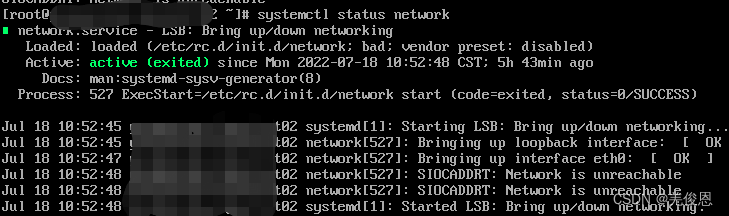
Handling process of the problem that the virtual machine's intranet communication Ping fails

VOFA+ 串口调试助手

Bo Yun container cloud and Devops platform won the trusted cloud "technology best practice Award"

What if the test / development programmer gets old? Lingering cruel facts
![[steering wheel] how to transfer the start command and idea: VM parameters, command line parameters, system parameters, environment variable parameters, main method parameters](/img/97/159d7df5e2d11b129c400d61e3fde6.png)
[steering wheel] how to transfer the start command and idea: VM parameters, command line parameters, system parameters, environment variable parameters, main method parameters
随机推荐
Recorded target detection NMS (non maximum suppression)
npm link的简单介绍及使用
17. Reverse the linked list
(pc+wap) dream weaving template vegetable and fruit websites
assert _Aligns
Is it safe to open galaxy securities account by mobile phone?
Uni app cross domain configuration
SQL how to return all data when the input query condition is empty
(Dynamic Programming Series) sword finger offer 48. the longest substring without repeated characters
scipy.sparse.vstack
High score technical document sharing of ink Sky Wheel - Database Security (48 in total)
MySQL build websites data table
Pinia的数据持久化插件 pinia-plugin-persist
循环与分支(一)
From the annual reports of major apps, we can see that user portraits - labels know you better than you do
Convert rich text to normal text
Effectively solve the problem of garbled code when idea runs the web project (with detailed steps)
Overview of pytoch's API
1.软件测试-----软件测试的基本概念
Mandatory interview questions: 1. shallow copy and deep copy_ Deep copy