当前位置:网站首页>[C data storage]
[C data storage]
2022-07-18 01:41:00 【Domeecky】
Catalog
One 、 Basic classification of data types
The original code, the reverse code, the complement code
Byte order at the large and small end
3、 ... and 、 Floating point storage
One 、 Basic classification of data types
signed: A signed
unsigned: Unsigned
Data in memory defaults to signed, except char,char Whether there are symbols depends on different compilers .
integer :
char(char The essence of type is ASCII Code value )、short、int、long
floating-point :
float、double
Construction type :
An array type :int [n]、char [n] ......
n Number of elements , The number of elements is different , The type is different , Such as int [1] and int [2] Just different types
Type of structure :struct
Enumeration type :menu
Joint type :union
Pointer types :
int* p、char* p、float* p、void* p ......
Empty type :void
Usually used for function return types , Function parameter , Pointer types .
*C There is no string type in the language , Can only be stored by character array
Two 、 The storage of integers
The original code, the reverse code, the complement code
Integers are stored in memory as complements .
Original code : Convert integer to binary to get , The highest bit is the sign bit (1 It's a negative number ,0 Is a positive number )
Inverse code : The sign bit of the original code remains unchanged , Other bits are inversed to get
Complement code : Inverse code +1 obtain
The original code of a positive number is the same as the complement of an inverse code .
Negative numbers need to be converted .

Why should integers be stored as complements in memory ?
This is because :
1. Use complement , Symbol bits and value fields can be treated in a unified way , meanwhile , Addition and subtraction can also be handled in a unified way ( Convert subtraction to addition ).
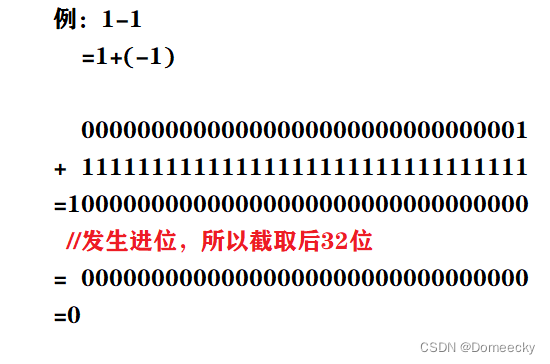
2. Complement and original code are converted to each other , The operation process is the same , No additional hardware circuits are required .
In a nutshell :
Original code ( The sign bit remains the same and reverses by bit )→ Inverse code (+1)→ Complement code
Complement code ( The sign bit remains the same and reverses by bit )→ Inverse code (+1)→ Original code

We can check the data stored in the variable to know whether the integer is stored as a complement in memory .

It can be seen that integers store complements in memory , But the order is reversed , This is because of the problem of byte order at the size end .
Byte order at the large and small end
Why is there big and small byte order ?
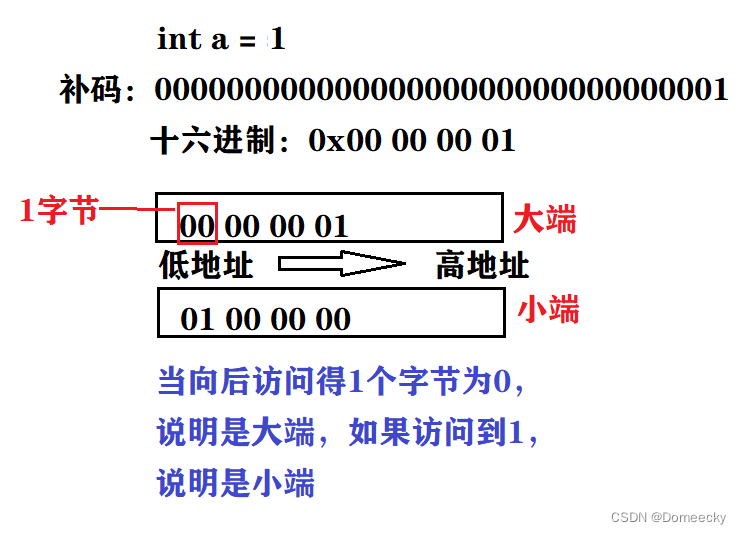
Low bytes are preferentially processed inside the computer , More efficient , So in most computers, small end storage mode is used , In other scenes , The big end storage mode is more efficient .
Big end : Put the low order value in the high address , Put the high address into the low address .
The small end : Put the low order value in the low address , Put the high address in the high address .

Under my compiler , The storage mode is small end .
Exercise one
Write a piece of code to judge the byte order of the size end of the current machine .
#include<stdio.h>
int main()
{
	int a = 1;
	if (*(char*)&a)// take a Cast address to char* type , You can only access backwards at a time 1 Bytes
		printf(" The small end ");
	else
		printf(" Big end ");
	return 0;
}
Exercise 2
Judge the output of the following code
1.
int main()
{
	char a = -1;
	signed char b = -1;
	unsigned char c = -1;
	printf("a=%d,=%d,c=%d", a, b, c);
	return 0;
}
answer :-1,-1,255
a and b They all print normally , Main analysis c

2.
int main()
{
	char a = -128;
	printf("%u\n", a);
	return 0;
}
answer :4294967168

3.
int main()
{
	char a = 128;
	printf("%u\n", a);
	return 0;
}
answer :4294967168

4.
int main()
{
	int i = -20;
	unsigned int j = 10;
	printf("%d\n", i + j);
	return 0;
}
answer :-10

5.
int main()
{
	unsigned int i;
	for (i = 9; i >= 0; i--)
	{
		printf("%u\n", i);
	}
	return 0;
}
answer : Dead cycle .


int main()
{
	char a[1000];
	int i;
	for (i = 0; i < 1000; i++)
	{
		a[i] = -1 - i;
	}
	printf("%d", strlen(a));
	return 0;
}
answer :255
First we need to know char The value range of the type is :-128~127
Think of them as a circle .

Why? 10000000 yes -128
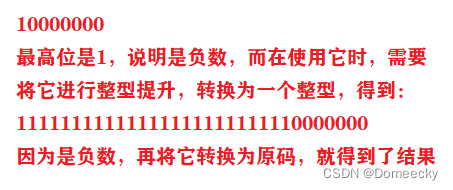
meanwhile , We can also observe , In this ‘ egg ’ in , Just keep adding 1, You can get the next number , conversely , constantly -1, You can also get the next number .
Only when -1+1 when , You'll get 0, and strlen encounter 0 Will stop , because i It's from 0 At the beginning , So we just need to find out from 0 To 1 Just how many numbers there are between , At this time, we can see from the picture 0~1 It happens to be a whole cycle , There is a total of 255 A digital .
6.
unsigned char i = 0;
int main()
{
	for (i = 0; i <= 255; i++)
	{
		printf("hello world\n");
	}
	return 0;
}
answer : Dead cycle
Unsigned char The value of type is 0~255, The duty of 255 Time again +1, It's back 1, Cycle again .
7.
int main()
{
	unsigned int a = -1;
	printf("%d", a);
	return 0;
}
answer :-1
The printing result is subject to the printing type , Regardless of the original type of data .
-1 In memory for :11111111111111111111111111111111
Although the type is unsigned int , But printing is based on int Type print , So we will judge this number as negative according to the sign bit , So it needs to be converted to the original code , Finally get -1.
8.
int main()
{
	if (strlen("abc") - strlen("abcdef") >= 0)
		printf(">");
	else
		printf("<");

	return 0;
}
answer :>
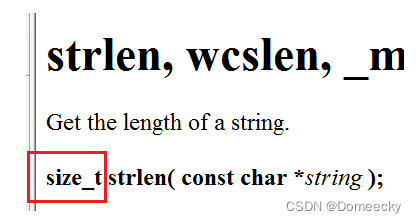
because strlen The return type is size_t = unsigned int ( Unsigned integer ), And an unsigned integer minus an unsigned integer , The final result is unsigned integer , It can't be negative .
3、 ... and 、 Floating point storage
Let's start with a piece of code , Look at its output .
int main()
{
	int n = 9;
	float* p = (float*)&n;

	printf("n The value of is :%d\n", n);
	printf("*p The value of is :%d\n", *p);

	*p = 9.0;
	printf("n The value of is :%d\n", n);
	printf("p The value of is :%d\n", *p);

	return 0;
}
Output results :

Although I don't know why this is the result , But we can draw a preliminary conclusion : Integer and floating-point numbers are stored in different ways in memory .
Floating point storage rules
Any binary floating-point number can be expressed in the following form :
V=(-1)^S*M*2^E
V Represents any floating-point number
S Represents the sign bit , When S=0 when ,V Is a positive number , When S=1 when ,V It's a negative number
M Represents a significant number , Greater than 1, Less than 2
E Indicates the index bit
And the last thing stored in memory is S、M、E These three values
Simply speaking , That is to write floating-point numbers in the form of scientific counting , Finally, add a plus or minus to the front .


Inaccurate situation :

Different types of floating-point number storage :
about 32 Floating point number of bits (float), The highest bit is the sign bit S, next 8 Bits are exponents E, be left over 23 Bits are valid letters M
about 64 Floating point number of bits (double), The highest bit is the sign bit S, next 11 Bits are exponents E, be left over 52 Bits are valid letters M
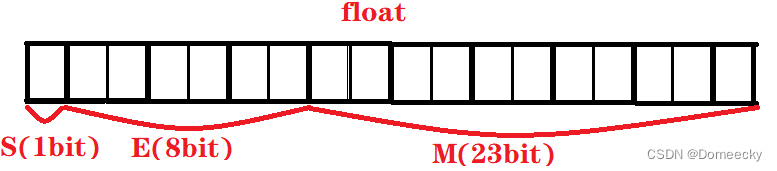
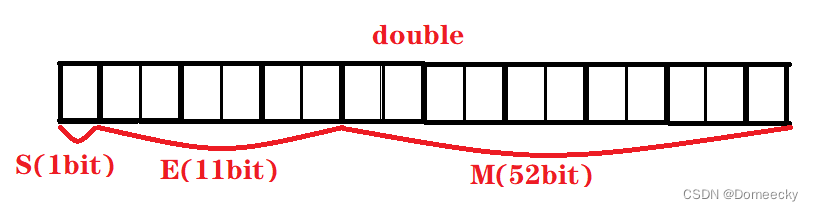
When storing floating point numbers , There are also the following rules :
1. because M Always with 1 start , So will M When it's in memory , Omit the beginning 1, When taking out the data, add . In this way, you can save one more digit , Improve data accuracy .
2. take E The value of is set to unsigned , This can store more data .
On the second point, there is a problem , Because of our E It is possible to have negative numbers .

At this time , In order not to have negative numbers , It is stipulated in E In memory , You need to add a middle number ,float The median number under type is 127,double The median number under type is 1023
for example , stay float Next E by 2 when , The value stored in memory is 2+127=129, It's written as binary 10000001
Verify storage rules :

When taking out floating-point numbers , There are three situations :
1. E Incomplete 0 Or not all 1
Subtract the value of the index 127( or 1023), Get the real value , And then the significant number M Add the omitted 1, Get the original value , Perform normal operation .
2. E For all 0
Direct will E The value is equal to the 1-127= - 126,M It doesn't add 1, But to become 0, In order to express 0 Or close to 0 The number of .
3. E For all 1
Expressed as positive and negative infinity
Explain the topic :
int main()
{
	int n = 9;
	float* p = (float*)&n;

	printf("n The value of is :%d\n", n);
	printf("*p The value of is :%d\n", *p);

	*p = 9.0;
	printf("n The value of is :%d\n", n);
	printf("p The value of is :%d\n", *p);

	return 0;
}
边栏推荐
猜你喜欢
结构体相关类型解析

STM32 application development practice tutorial: application development of environmental light intensity monitoring

【C】 Const decorated pointer

Restore of data encryption returned by a website

【C 练习】打印菱形

Say goodbye to Leica, Huawei opens a new era! Netizen: Xiaomi

Matlab bottom source code realizes image corrosion and expansion operation (consistent with Halcon effect)

Realizing Halcon scale with MATLAB low-level source code_ image_ Max operator effect

Smiling face detection based on machine learning

Matlab bottom source code to realize image dynamic binarization
随机推荐
百家号排名会丢吗,不稳定怎么办?
C# 飞行棋小游戏
Axure如何做到屏幕自适应
2020-10-11
结构体相关类型解析
Redis入门介绍
VDD,VCC,VSS,GND,地之间有何区别?
机器学习预备知识:分类与回归
【C 练习】倒序字符串
51单片机串口波特率(保留一下以后就不用到处找了)
Codeforces Round #806 (Div. 4)
云原生:Docker实践经验(三)Docker 上部署 MySQL8 主从复制
高权重没备案网站,批量降权,正常吗?
C语言实现简单扫雷游戏(二维数组)
After writing a paper in 2 hours, why gpt-3 doesn't deserve a name?
Chrome realizes automated testing: recording and playback web page actions
2020CCPC秦皇岛 Exam Results(尺取)
Data Lake (19): SQL API reads Kafka data and writes it to iceberg table in real time
Understanding at different stages
反射面试