Riskfolio-Lib
Quantitative Strategic Asset Allocation, Easy for Everyone.





Description
Riskfolio-Lib is a library for making quantitative strategic asset allocation or portfolio optimization in Python made in Peru
Some of key functionalities that Riskfolio-Lib offers:
-
Mean Risk and Logarithmic Mean Risk (Kelly Criterion) Portfolio Optimization with 4 objective functions:
- Minimum Risk.
- Maximum Return.
- Maximum Utility Function.
- Maximum Risk Adjusted Return Ratio.
-
Mean Risk and Logarithmic Mean Risk (Kelly Criterion) Portfolio Optimization with 13 convex risk measures:
- Standard Deviation.
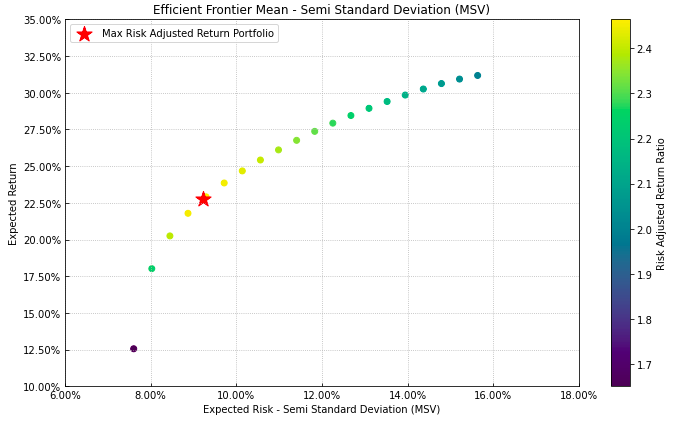
- Semi Standard Deviation.
- Mean Absolute Deviation (MAD).
- First Lower Partial Moment (Omega Ratio).
- Second Lower Partial Moment (Sortino Ratio).
- Conditional Value at Risk (CVaR).
- Entropic Value at Risk (EVaR).
- Worst Case Realization (Minimax Model).
- Maximum Drawdown (Calmar Ratio) for uncompounded cumulative returns.
- Average Drawdown for uncompounded cumulative returns.
- Conditional Drawdown at Risk (CDaR) for uncompounded cumulative returns.
- Entropic Drawdown at Risk (EDaR) for uncompounded cumulative returns.
- Ulcer Index for uncompounded cumulative returns.
-
Risk Parity Portfolio Optimization with 10 convex risk measures:
- Standard Deviation.
- Semi Standard Deviation.
- Mean Absolute Deviation (MAD).
- First Lower Partial Moment (Omega Ratio).
- Second Lower Partial Moment (Sortino Ratio).
- Conditional Value at Risk (CVaR).
- Entropic Value at Risk (EVaR).
- Conditional Drawdown at Risk (CDaR) for uncompounded cumulative returns.
- Entropic Drawdown at Risk (EDaR) for uncompounded cumulative returns.
- Ulcer Index for uncompounded cumulative returns.
-
Hierarchical Clustering Portfolio Optimization: Hierarchical Risk Parity (HRP) and Hierarchical Equal Risk Contribution (HERC) with 22 risk measures:
- Standard Deviation.
- Variance.
- Semi Standard Deviation.
- Mean Absolute Deviation (MAD).
- First Lower Partial Moment (Omega Ratio).
- Second Lower Partial Moment (Sortino Ratio).
- Value at Risk (VaR).
- Conditional Value at Risk (CVaR).
- Entropic Value at Risk (EVaR).
- Worst Case Realization (Minimax Model).
- Maximum Drawdown (Calmar Ratio) for compounded and uncompounded cumulative returns.
- Average Drawdown for compounded and uncompounded cumulative returns.
- Drawdown at Risk (DaR) for compounded and uncompounded cumulative returns.
- Conditional Drawdown at Risk (CDaR) for compounded and uncompounded cumulative returns.
- Entropic Drawdown at Risk (EDaR) for compounded and uncompounded cumulative returns.
- Ulcer Index for compounded and uncompounded cumulative returns.
-
Nested Clustered Optimization (NCO) with four objective functions and the available risk measures to each objective:
- Minimum Risk.
- Maximum Return.
- Maximum Utility Function.
- Equal Risk Contribution.
-
Worst Case Mean Variance Portfolio Optimization.
-
Relaxed Risk Parity Portfolio Optimization.
-
Portfolio optimization with Black Litterman model.
-
Portfolio optimization with Risk Factors model.
-
Portfolio optimization with Black Litterman Bayesian model.
-
Portfolio optimization with Augmented Black Litterman model.
-
Portfolio optimization with constraints on tracking error and turnover.
-
Portfolio optimization with short positions and leveraged portfolios.
-
Portfolio optimization with constraints on number of assets and number of effective assets.
-
Tools to build efficient frontier for 13 risk measures.
-
Tools to build linear constraints on assets, asset classes and risk factors.
-
Tools to build views on assets and asset classes.
-
Tools to build views on risk factors.
-
Tools to calculate risk measures.
-
Tools to calculate risk contributions per asset.
-
Tools to calculate uncertainty sets for mean vector and covariance matrix.
-
Tools to calculate assets clusters based on codependence metrics.
-
Tools to estimate loadings matrix (Stepwise Regression and Principal Components Regression).
-
Tools to visualizing portfolio properties and risk measures.
-
Tools to build reports on Jupyter Notebook and Excel.
-
Option to use commercial optimization solver like MOSEK or GUROBI for large scale problems.
Documentation
Online documentation is available at Documentation.
The docs include a tutorial with examples that shows the capacities of Riskfolio-Lib.
Dependencies
Riskfolio-Lib supports Python 3.7+.
Installation requires:
- numpy >= 1.17.0
- scipy >= 1.1.0
- pandas >= 1.0.0
- matplotlib >= 3.3.0
- cvxpy >= 1.0.15
- scikit-learn >= 0.22.0
- statsmodels >= 0.10.1
- arch >= 4.15
- xlsxwriter >= 1.3.7
- networkx >= 2.5.1
- astropy >= 4.3.1
Installation
The latest stable release (and older versions) can be installed from PyPI:
pip install riskfolio-lib
Citing
If you use Riskfolio-Lib for published work, please use the following BibTeX entrie:
@misc{riskfolio,
      author = {Dany Cajas},
      title = {Riskfolio-Lib (2.0.0)},
      year  = {2021},
      url   = {https://github.com/dcajasn/Riskfolio-Lib},
      }
Development
Riskfolio-Lib development takes place on Github: https://github.com/dcajasn/Riskfolio-Lib
RoadMap
The plan for this module is to add more functions that will be very useful to asset managers.
- Add more functions based on suggestion of users.

 50 Dec 29, 2022
 64 Dec 31, 2022
 1 Nov 21, 2021
 42 Dec 09, 2022
 37 Nov 13, 2022
 7 Oct 30, 2022
 27 Nov 05, 2022
 3 Dec 07, 2022
 5.2k Jan 02, 2023
 13 Dec 07, 2022
 540 Dec 30, 2022
 141 Dec 26, 2022
 50 Jan 01, 2023
 116 Jan 04, 2023
 8 Sep 09, 2022
 59 Dec 08, 2022
 37 Oct 26, 2022
 65 Dec 01, 2022
 101 Dec 01, 2022
 1.1k Dec 18, 2022